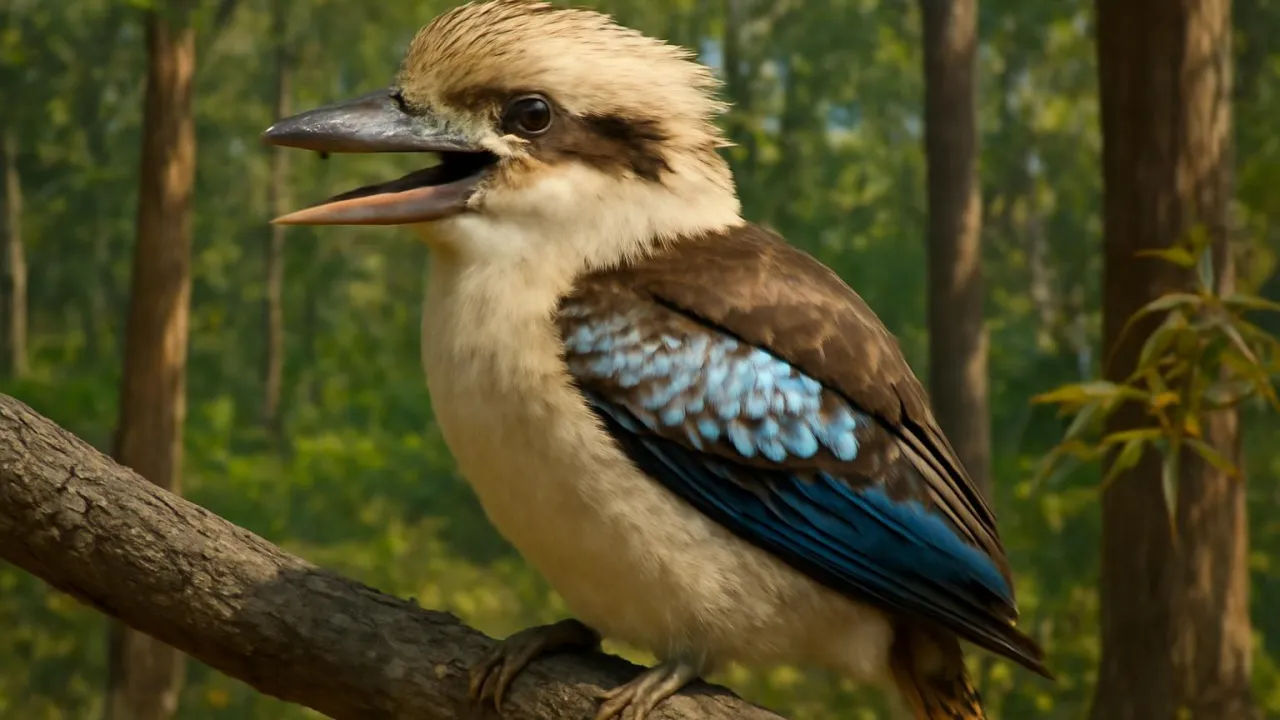
Kookaburras laugh together in groups to protect their territory from others.
✨ Word Sparks (Grade 2 Glossary)
Tap 🔊 to hear
territory
An animal’s special area it protects
prey
Animals that are hunted for food
nest
A home birds build to lay eggs
🪝
Have you ever heard a bird that sounds like it is laughing loudly?
1
The Laughing Call
The kookaburra makes a loud laughing sound early in the morning. It uses this call to talk to other kookaburras. This sound helps keep other birds away from its home.
2
Where It Lives
Kookaburras live in forests and woodlands in Australia and New Guinea. They like to sit high in trees to watch for food. They build in tree holes or old termite mounds.
3
What It Eats
This bird eats insects, small reptiles, and worms. It catches by watching carefully and then swooping down quickly. Its strong beak helps it grab and kill food.
1. Why do kookaburras laugh loudly in the morning?
2. Where do kookaburras build their nests?
🤯 Mind-Blowing Fact • Grade 3
Kookaburras are the largest kingfisher species and are famous for their unique laugh.
✨ Word Sparks (Grade 3 Glossary)
Tap 🔊 to hear
camouflage
Colors that help animals hide from others
adaptation
A trait that helps animals survive better
predator
An animal that hunts other animals for food
🪝
Did you know the kookaburra’s laugh helps it survive in the wild?
1
Laughing to Protect Territory
The kookaburra’s loud laugh warns other birds to stay away from its territory. This call is a form of communication that helps prevent fights. Groups of kookaburras often laugh together to strengthen their message. This behavior is an important for survival.
2
Camouflage and Hunting
Its brown and white feathers help the kookaburra blend into tree bark and leaves. This makes it harder for prey and to see it. The kookaburra waits quietly before swooping down to catch insects and small reptiles. Its sharp beak is designed to grab and kill prey quickly.
3
Life Cycle and Nesting
Kookaburras build nests in tree hollows or termite mounds to protect their eggs. Both parents take turns feeding the chicks after they hatch. The young birds learn to hunt by watching their parents. This care helps the chicks survive until they can live alone.
4
Ecosystem Role
Kookaburras help control insect and small reptile populations by eating them. They are important in their forest ecosystem. Their presence helps keep a balance between different animal species. This balance supports a healthy environment for many creatures.
1. How does the kookaburra’s laugh help it survive?
2. What helps the kookaburra catch prey quickly?
🤯 Mind-Blowing Fact • Grade 4
Kookaburras can laugh so loudly they can be heard up to a mile away in the forest.
✨ Word Sparks (Grade 4 Glossary)
Tap 🔊 to hear
ecosystem
All living things and their homes working together
territory
An area an animal protects from others
conservation
Helping animals and plants stay safe and healthy
🪝
Why does the kookaburra’s laughter echo through Australian forests every dawn?
1
Cause and Effect of Laughing
The kookaburra’s loud laughing call causes other birds to recognize its quickly. This effect reduces conflicts with rival birds and predators. Laughing together strengthens group bonds and signals safety to family members. Because of this, kookaburras maintain clear boundaries in their habitat.
2
Role in the Ecosystem
As a predator, the kookaburra controls insect and small reptile populations effectively. This control helps prevent overpopulation that could harm plants and other animals. Kookaburras also serve as prey for larger predators, linking them in the food web. Their balanced role supports the health of Australian forest .
3
Geographic Distribution
Kookaburras are native to eastern Australia and parts of New Guinea’s forests. They prefer open woodlands and forest edges where food is abundant. Human activity, like deforestation, can reduce their habitat but they adapt well to some urban areas. efforts help protect their natural homes.
4
Human Impact and Conservation
Humans sometimes feed kookaburras, which can change their natural hunting behavior. Loss of habitat from farming and development threatens their populations in some regions. However, kookaburras are not currently endangered and remain common in many areas. Protecting forests ensures kookaburras continue their important role.
1. How does kookaburra laughter help reduce fights?
2. What can hurt kookaburras’ homes?
🤯 Mind-Blowing Fact • Grade 5
A kookaburra’s laugh can be heard up to one mile away, louder than many other bird calls.
✨ Word Sparks (Grade 5 Glossary)
Tap 🔊 to hear
syrinx
The special organ birds use to make sounds
apex predator
The top hunter in an ecosystem with no enemies
vocalization
Sounds animals make to communicate with others
🪝
How does the laughing kookaburra’s unique call and biology help it thrive in diverse Australian habitats?
1
Taxonomy and Scientific Context
The laughing kookaburra, scientifically named Dacelo novaeguineae, belongs to the kingfisher family Alcedinidae. It is the largest species within this family, measuring about 43 centimeters long. Its closest relatives are other kookaburras found in Australia and New Guinea. This bird’s unique distinguish it from other kingfishers globally.
2
Physiological Mechanics of Its Call
The kookaburra produces its iconic laugh through rapid modulation of its muscles, the bird’s vocal organ. This complex muscle control allows it to create a series of loud, staccato calls resembling human laughter. The call can carry over long distances, up to one mile, facilitating communication across dense forest habitats. This vocal ability plays a crucial role in territory defense and social bonding.
3
Ecological Role and Conservation History
Ecologically, kookaburras are of insects, small reptiles, and amphibians, helping maintain balanced populations. They occupy a niche in Australian forest and woodland ecosystems, contributing to food web stability. Historically, habitat loss from agriculture has impacted some populations, but the species remains widespread and resilient. Conservation efforts focus on habitat preservation and limiting human interference.
4
Quantitative Comparisons and Adaptations
Adult kookaburras weigh between 300 and 400 grams, with a wingspan of approximately 65 centimeters. They can fly at speeds up to 25 miles per hour when hunting or defending territory. Their strong beaks measure about 6 centimeters, adapted for gripping and dispatching prey swiftly. Compared to other kingfishers, kookaburras favor terrestrial hunting over fishing, showcasing unique behavioral adaptations.
5
Cultural Significance and Human Interaction
The laughing kookaburra holds a special place in Australian culture, often featured in stories and folklore. Its distinctive call is used in media to evoke the Australian bush atmosphere. While humans sometimes feed kookaburras, this can alter their natural hunting instincts. Responsible interaction and habitat conservation are vital to preserving this iconic species for future generations.