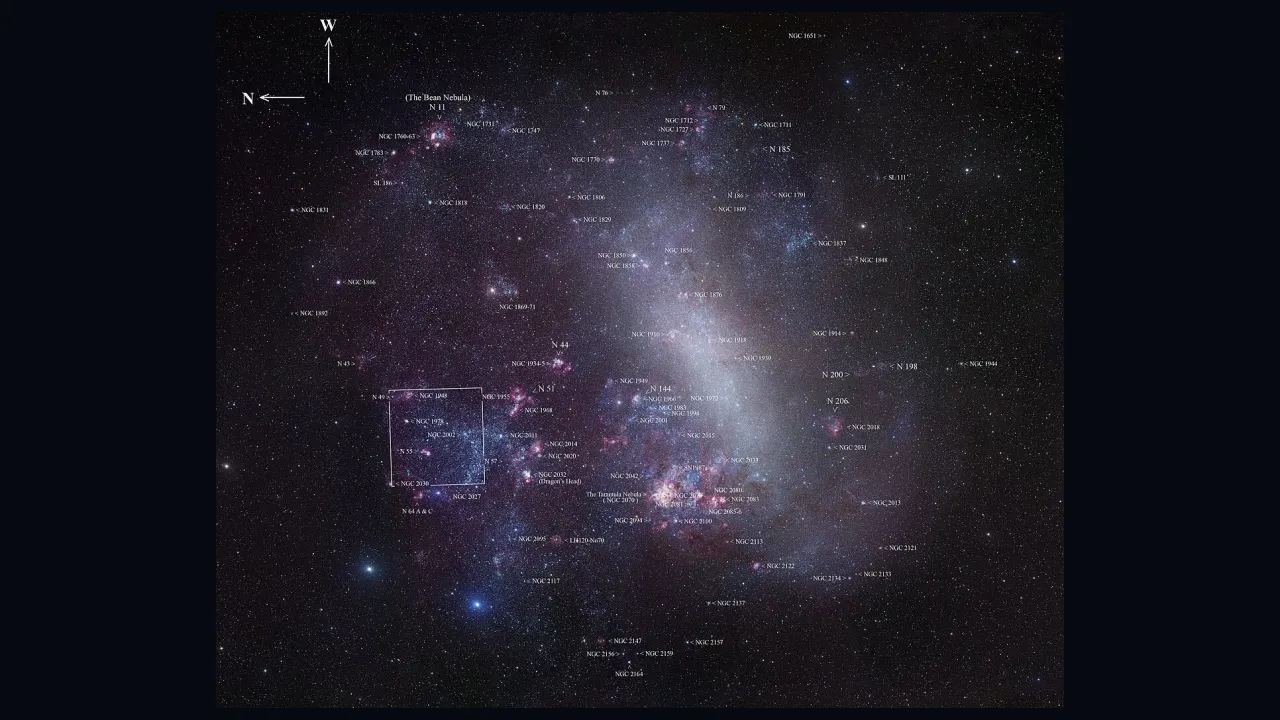
🪐 Scale / Diameter32,200 light-years (189 quadrillion mi / 305 quadrillion km) wide • 138 billion solar masses
☄️ Composition & Orbit30 billion stars, central stellar bar & giant Tarantula Nebula star factory
⚡ Cosmic SparkBrightest satellite galaxy visible to the unaided eye and home to the monster Tarantula Nebula
🤯 Mind-Blowing Fact • Grade 1
People living in Australia, Africa, and South America can see the Large Magellanic Cloud with just their eyes—no telescope needed!
✨ Word Sparks (Grade 1 Glossary)
Tap 🔊 to hear
Milky Way
The big home galaxy where Earth lives
dwarf galaxy
A smaller galaxy with fewer stars than giants
nebula
A giant glowing cloud of gas and dust
🪝
What if a silvery cloud in the night sky never blew away with the wind?
1
A Cloud Made of Stars
Step outside at night in the far south of Earth! High above, a misty silver patch glows in the dark sky. Wind cannot blow it away because it is not weather at all. It is the Large Magellanic Cloud!
2
Our Space Neighbor
Billions of stars pack into this bright island in space. It floats right next door to our own galaxy.
3
Giant Star Factories
Inside this starry cloud, pink gas bubbles shine bright. Huge baby stars pop to life inside them every day!
1. Why doesn't wind blow the Large Magellanic Cloud across the sky like a rain cloud?
2. From which half of Earth is it easiest to spot the Large Magellanic Cloud?
🤯 Mind-Blowing Fact • Grade 2
If the Tarantula Nebula inside the Large Magellanic Cloud were as close to Earth as the Orion Nebula, it would cast shadows on the ground at night!
✨ Word Sparks (Grade 2 Glossary)
Tap 🔊 to hear
satellite galaxy
Smaller galaxy pulled by a bigger galaxy's gravity
Southern Hemisphere
Half of Earth south of the equator
filament
A long, thin ribbon of glowing gas
🪝
How did ancient sailors navigate dark southern oceans using a glowing patch of distant stars?
1
A Lantern in Southern Skies
Long ago, peoples across South America, Africa, and Polynesia told stories about two misty patches glowing in the southern sky. Later, European sailors with Ferdinand Magellan wrote about them during their voyage around Earth, giving the bigger one its modern name: the Large Magellanic Cloud.
2
Close Neighbor to the Milky Way
Floating about 163,000 light-years away, this neighbor is a pulled by our Milky Way's gravity. A bright bar of older stars stretches across its middle, while a single lopsided arm curves off one side.
3
Home of the Tarantula Nebula
Inside the galaxy blazes a gigantic star nursery called the Tarantula Nebula. Its glowing gas look like spider legs and build some of the hottest, biggest stars known!
1. What famous star-forming nursery lives inside the Large Magellanic Cloud?
2. About how far away from Earth is the Large Magellanic Cloud?
🤯 Mind-Blowing Fact • Grade 3
Persian astronomer Abd al-Rahman al-Sufi wrote the earliest surviving scientific record of the Large Magellanic Cloud in 964 CE, calling it 'Al-Bakr' (the White Ox)!
✨ Word Sparks (Grade 3 Glossary)
Tap 🔊 to hear
Local Group
Our home cluster of nearby neighbor galaxies
irregular
Having an uneven, stretched, or lopsided shape
supergiant
An extra-huge, super-bright star near life's end
🪝
Why does one of our closest neighbor galaxies look bent and lopsided instead of round and neat?
1
Fourth Largest in Our Local Group
Our Milky Way belongs to a neighborhood of more than eighty galaxies called the . Spanning 32,200 light-years across the constellations Dorado and Mensa, the Large Magellanic Cloud ranks fourth in size right behind Andromeda, the Milky Way, and the Triangulum Galaxy.
2
Warped by Cosmic Tug-of-War
Long ago, this neighbor may have been a tidy barred spiral galaxy. Today, fierce gravitational pulls from both the giant Milky Way and the nearby Small Magellanic Cloud have stretched its outer disk into an off-center, shape with just one stubby spiral arm.
3
Superpower Star Factory
All that gravitational squeezing sloshes gas clouds together and ignites furious star birth! Inside its famous Tarantula Nebula, astronomers discovered monster stars weighing more than 200 times the mass of our Sun.
4
A Front-Row Seat to a Supernova
In February 1987, astronomers saw a blue star explode inside the Large Magellanic Cloud. Named Supernova 1987A, it became the brightest exploding star seen from Earth in nearly four hundred years!
1. What twisted the Large Magellanic Cloud into its lopsided shape?
2. Why was Supernova 1987A in the Large Magellanic Cloud so exciting for scientists?
🤯 Mind-Blowing Fact • Grade 4
Computer models predict that gravitational drag will slow the Large Magellanic Cloud down until it merges into our Milky Way in roughly 2.4 billion years!
✨ Word Sparks (Grade 4 Glossary)
Tap 🔊 to hear
ram pressure
Headwind force stripping gas from speeding galaxies
neutrino
Tiny ghostlike particle racing from exploding stars
Magellanic Stream
Giant ribbon of gas trailing both Magellanic Clouds
🪝
What happens when a gas-rich galaxy plunges headfirst through our Milky Way's invisible halo?
1
Not an Eternal Orbiter After All
For generations, textbooks described the Large Magellanic Cloud as a quiet little moon-galaxy endlessly circling our Milky Way. Then precision star-motion measurements from Hubble and the European Space Agency's Gaia spacecraft delivered a surprise: moving at more than 200 miles (320 km) per second, the LMC may actually be making its very first high-speed plunge past our galaxy!
2
Cosmic Wind Tunnel and the Magellanic Stream
As the 32,200-light-year-wide galaxy plows through the hot, thin gas halo surrounding the Milky Way, acts like a cosmic wind tunnel, blowing a long wake of hydrogen behind it. Together with gravitational tugs from its smaller sibling, the Small Magellanic Cloud, this encounter tore loose a 600,000-light-year ribbon of gas called the .
3
Inside 30 Doradus: Extreme Star Birth
Despite losing outer gas, the LMC remains rich in star-making fuel. Its jewel is 30 Doradus—the Tarantula Nebula—spanning nearly 1,000 light-years across. At its core blazes star cluster R136, where stars like R136a1 reach roughly 200 solar masses and shine millions of times brighter than our Sun.
4
Ghost Particles From Supernova 1987A
When Supernova 1987A detonated inside the LMC, underground detectors on Earth caught a burst of tiny subatomic particles called three hours before the flash of visible light arrived, launching modern neutrino astronomy.
1. What surprising fact did Hubble and Gaia star-motion measurements reveal about the Large Magellanic Cloud?
2. What reached underground detectors on Earth three hours before visible light from Supernova 1987A?
🤯 Mind-Blowing Fact • Grade 5
In 2024, after a 37-year cosmic treasure hunt, the James Webb Space Telescope finally found chemical glow from the newborn neutron star hiding inside the wreckage of Supernova 1987A!
✨ Word Sparks (Grade 5 Glossary)
Tap 🔊 to hear
cosmic distance ladder
Step-by-step methods astronomers use to measure deep-space distances
metallicity
Share of elements heavier than hydrogen and helium
neutron star
Ultra-dense city-sized core left after a supernova
🪝
How has our Milky Way's brightest satellite galaxy reshaped cosmic distance scales, neutrino physics, and our own galaxy's dark matter halo?
1
Cultural Heritage and Scientific Discovery
Long before Ferdinand Magellan's 1519 expedition popularized its European name, Indigenous Australians, Khoisan skywatchers in southern Africa, Inca astronomers in the Andes, and Polynesian navigators wove the glowing patch spanning Dorado and Mensa into seasonal calendars and ocean wayfinding. In 964 CE, Persian astronomer Abd al-Rahman al-Sufi cataloged it from southern Arabia in his Book of Fixed Stars. Today, classified as the prototype Magellanic spiral galaxy (SB(s)m), the Large Magellanic Cloud sits 163,000 light-years away, spanning roughly 32,200 light-years in diameter with a total dark-and-baryonic mass near 138 billion solar masses—over ten percent of the Milky Way's own mass.
2
Anchor of the Extragalactic Distance Ladder
Because all stars inside the LMC lie at nearly the same relative distance from Earth, astronomers use thousands of its pulsating Cepheid variables and eclipsing binary stars to calibrate the —the step-by-step ruler used to measure the Hubble constant and the expansion rate of the entire universe.
3
30 Doradus and Early-Universe Conditions
With roughly half the heavy-element abundance ('') of our Solar System, the LMC mimics star-forming environments from the young universe. Within its 1,000-light-year-wide H II region 30 Doradus (the Tarantula Nebula), James Webb Space Telescope infrared spectrographs peer through dusty cocoons around the super-star cluster R136, where Wolf-Rayet stars exceeding 200 solar masses blast out fierce ultraviolet winds.
4
Supernova 1987A and Multi-Messenger Astronomy
On February 23, 1987, light and two dozen electron antineutrinos from the core collapse of blue supergiant Sanduleak -69 202 reached Earth, marking the birth of multi-messenger astrophysics beyond our Solar System. In 2024, JWST finally detected ionized argon and sulfur at the blast center—direct evidence of the long-sought newborn .
5
Waking Up the Milky Way's Halo
Precision astrometry from Gaia demonstrates that the massive LMC is not a featherweight bystander; its gravitational pull actively tugs the Milky Way's stellar disk off-center, leaving a measurable density wake across our dark matter halo before an eventual merger ~2.4 billion years from now.