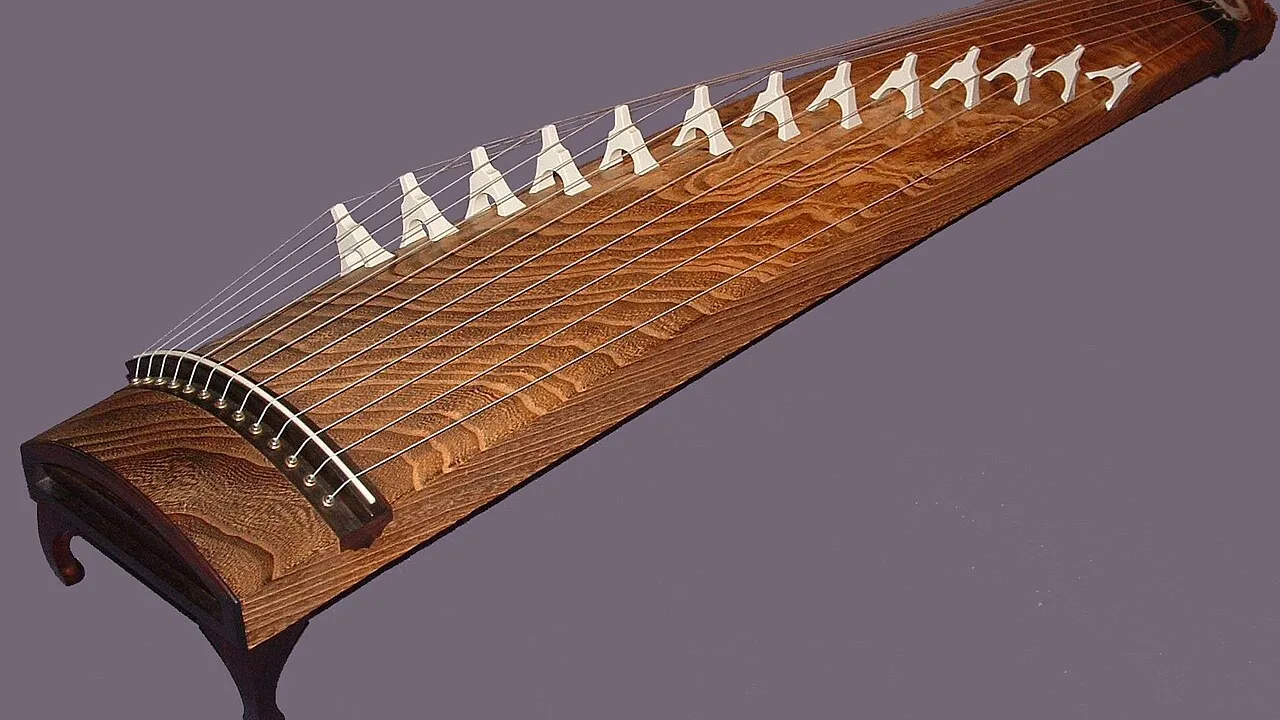
🔊 How Sound Is MadeThree finger picks pluck strings tuned by sliding 13 movable bridges
⚡ Signature Sound SparkSlides arched bridges to retune scales fast and bends notes like falling blossoms
🤯 Mind-Blowing Fact • Grade 1
Parts of the koto have dragon names like Dragon's Back, Dragon's Horn, and Dragon's Tongue!
✨ Word Sparks (Grade 1 Glossary)
Tap 🔊 to hear
koto
A long thirteen-stringed wooden zither from Japan.
arch
A curved bridge shape standing under a string.
bend
To push a string so its note rises.
🪝
Why is this six-foot wooden instrument named after parts of a dragon?
1
A Wooden Sleeping Dragon
Twang, glide, shimmer! Listen to gentle notes float like cherry blossoms in spring. Japan's stretches six feet long across the floor, shaped like a resting wooden dragon.
2
Thirteen Sliding Bridges
Thirteen long strings run from the dragon's head to its tail. White stand under every string, and sliding them changes the notes.
3
Picks and String Presses
Three picks slip onto the right hand to pluck clear tunes. Pressing a string with the left hand makes the note up!
1. How many strings stretch across a traditional Japanese koto?
2. What happens when a koto player presses down on a string with their left hand?
🤯 Mind-Blowing Fact • Grade 2
Japanese craftsmen toast the paulownia wood with a hot iron to bring out dramatic swirling grain patterns!
✨ Word Sparks (Grade 2 Glossary)
Tap 🔊 to hear
ji
A movable arched bridge under each koto string.
tsume
Finger picks worn on three right-hand fingers.
scale
A ladder of musical notes arranged in order.
🪝
How do you change a song's whole scale just by sliding little white arches?
1
Music of Falling Blossoms
Close your eyes and hear calm, bell-like notes drift across a peaceful Japanese garden! Kneeling beside a six-foot wooden board, a musician brings the koto to life. Craftsmen carve its long, curved body from light paulownia wood and name every part after a mythical dragon.
2
Bridges That Walk Across Wood
Thirteen taut strings stretch from end to end, and each string rests on its own movable white bridge called a . By sliding those arched bridges left or right before a song, the player tunes all thirteen strings into a brand-new musical !
3
Two Hands Working Together
The right thumb, index, and middle fingers wear smooth picks called to pluck crisp melodies. Meanwhile, the left hand presses and wiggles strings behind the bridges so notes sigh, shimmer, and glide.
1. How does a koto player retune the strings for a new song?
2. Which fingers wear tsume picks when plucking the koto?
🤯 Mind-Blowing Fact • Grade 3
Different Japanese koto schools wear different pick shapes—Ikuta players use square-tipped picks at an angle, while Yamada players use rounded, oval-tipped picks!
✨ Word Sparks (Grade 3 Glossary)
Tap 🔊 to hear
paulownia
Light, resonant wood used to carve koto bodies.
pentatonic
A musical scale built from five notes per octave.
vibrato
A gentle, expressive quiver in a note's pitch.
🪝
Why can thirteen strings sound like wind in bamboo, ocean waves, and singing voices all at once?
1
From Imperial Courts to Concert Halls
Ping—shimmer—glide! One single plucked string blooms into a warm wave of sound that seems to hang in the air. More than twelve hundred years ago, ancestors of the koto arrived in Japan from Tang Dynasty China to play stately palace music called gagaku. Over centuries, Japanese masters shaped it into their beloved national zither.
2
Carving the Paulownia Dragon
Luthiers hollow out light, resonant wood—known in Japan as kiri—to form a curved six-foot soundboard, then seal the bottom with a flat backboard containing two soundholes. Poetic legend views the whole body as a crouching dragon, from its brocade-wrapped head to its tail.
3
Sliding Ji Bridges and Tension
All thirteen silk or polyester strings are stretched to nearly the exact same tension! Instead of turning tuning pegs for every song, players position thirteen two-legged bridges called ji in a graceful diagonal line, adjusting each string's vibrating length to build haunting scales.
4
Expressive Left-Hand Pitch Bends
While three right-hand tsume picks pluck melodies and sweeping glissandos, the left hand presses strings on the unplucked side of the bridges. Pushing downward increases string tension, raising pitch by a half step or whole step or adding trembling .
1. Uniquely, how are the thirteen strings on a koto tightened before the ji bridges are placed?
2. How do the Ikuta and Yamada koto traditions differ in their playing gear?
🤯 Mind-Blowing Fact • Grade 4
In 1921, blind Japanese composer Michio Miyagi invented the seventeen-string bass koto—jushichigen—to give modern koto ensembles deep cello-like basslines!
✨ Word Sparks (Grade 4 Glossary)
Tap 🔊 to hear
gagaku
Ancient classical court music of Japan's imperial palace.
hirajoshi
A famous five-note Japanese tuning for the koto.
oshide
Pressing a koto string left of its bridge.
🪝
What happens acoustically when thirteen identically tensioned strings meet thirteen movable bridges?
1
Echoes of Cherry Blossoms in Spring
What would happen if an instrument could imitate rustling bamboo leaves, distant temple bells, and a human sigh with just thirteen taut cords? Across Japan, the unmistakable voice of 'Sakura, Sakura' floating from a hollowed paulownia zither signals the timeless artistry of the koto. Introduced from Tang China during the eighth-century Nara period for imperial ensembles, the koto evolved into a solo chamber marvel.
2
Anatomy of a Six-Foot Wooden Resonator
Measuring roughly one hundred eighty centimetres long, a concert koto begins as a seasoned block of kiri—Japanese paulownia wood prized for low density and rapid acoustic response. Artisans carve interior sound-wave ridges inside the upper shell before joining a flat bottom board pierced by two sound apertures. Scorching the exterior grain with hot irons and buffing it with dried reeds reveals dramatic whirlpool patterns across the 'Dragon's Back.'
3
Equal Tension and Movable-Bridge Physics
Unlike harps whose strings vary wildly in thickness and length, all thirteen koto strings share uniform gauge and baseline tension between fixed end-bridges. Pitch depends entirely on where the player sets thirteen inverted-V bridges called ji. Sliding a bridge rightward shortens the active right-hand segment, raising its frequency according to five-note pentatonic modes such as the meditative tuning.
4
Oshide: Sculpting Pitch Left of the Bridge
Because only five notes per octave sit open under right-hand tsume picks, the left hand unlocks missing chromatic tones through techniques called . Pressing downward left of a ji bridge stretches the string across its saddle, raising pitch cleanly by a semitone or whole step, while scraping picks lengthwise along twisted strings mimics autumn wind.
1. Why do koto makers carve tiny ridges inside the hidden ceiling of the hollow paulownia shell?
2. Why did composer Michio Miyagi design the seventeen-string jushichigen in 1921?
🤯 Mind-Blowing Fact • Grade 5
Inside a concert-grade koto's sealed wooden cavity—where audiences never see it—master artisans hand-carve intricate herringbone grooves called ayasugi solely to refine how sound waves bounce!
✨ Word Sparks (Grade 5 Glossary)
Tap 🔊 to hear
fulcrum
A support point where a bridge divides a string.
sokyoku
Traditional Japanese chamber music composed for the koto.
ma
Expressive musical pause or space between plucked notes.
🪝
How does uniform string tension paired with movable fulcrums turn a hollowed paulownia plank into an expressive micro-bending voice?
1
Resonance Sculpted from Kiri Wood and Silk
Before the second note even sounds, the first plucked tone on a Japanese koto swells, shimmers, and bends upward like mist rising off a temple pond. Revered as Japan's national instrument, this long board zither spans roughly one hundred eighty-two centimetres of hollowed Paulownia tomentosa timber. Though descended from the eighth-century Chinese guzheng used in imperial gagaku court orchestras, the Japanese koto developed an intimate chamber aesthetic where silence——carries as much weight as sound.
2
Organology and Interior Acoustic Architecture
Classified under Hornbostel-Sachs 312.22 as a half-tube or board zither with movable bridges, the koto unites two seasoned kiri planks: a thick, arched upper shell hollowed from beneath and a thinner flat backboard pierced with dual sound ports near the extremities. Inside the concealed cavity, master makers carve ayasugi—fine herringbone or zigzag grooves—that scatter standing waves and enrich upper overtones before scorching the outer grain through yakimokume finishing.
3
Uniform Gauge Mechanics and Pentatonic Modes
Remarkably, all thirteen strings—historically twisted raw silk and today high-density Tetron polyester—share identical diameter and near-identical baseline tension stretched between fixed bridges at the 'Dragon's Horn' and 'Cloud Horn.' Pitch differentiation across roughly two and a half octaves arises strictly from sliding thirteen two-footed ji bridges along the soundboard. Positioning these establishes hemitonic pentatonic tunings like hirajoshi or kumoi, and skilled performers even shift individual bridges mid-piece to modulate instantaneously.
4
Kinesthetics of Tsume Picks and Left-Hand Inflection
Kneeling at an oblique angle near the right end, performers fit ivory or polymer tsume onto the right thumb, index, and middle digits—square-tipped in the Ikuta school, rounded in the Yamada school. Meanwhile, the left hand operates left of the ji : oshide downward pressure raises tension up to a whole tone, ato-oshi bends a note after it is plucked, and tsuki-iro creates a subtle momentary pitch dip.
5
Sokyoku Heritage to Twenty-First-Century Innovation
In the seventeenth century, blind musician Yatsuhashi Kengyo revolutionized solo koto repertoire——by adapting popular folk scales into virtuosic variations such as 'Rokudan no Shirabe.' Three centuries later, Michio Miyagi introduced twenty- and seventeen-string bass variants, empowering contemporary composers to blend ancient Japanese timbres with global chamber music.