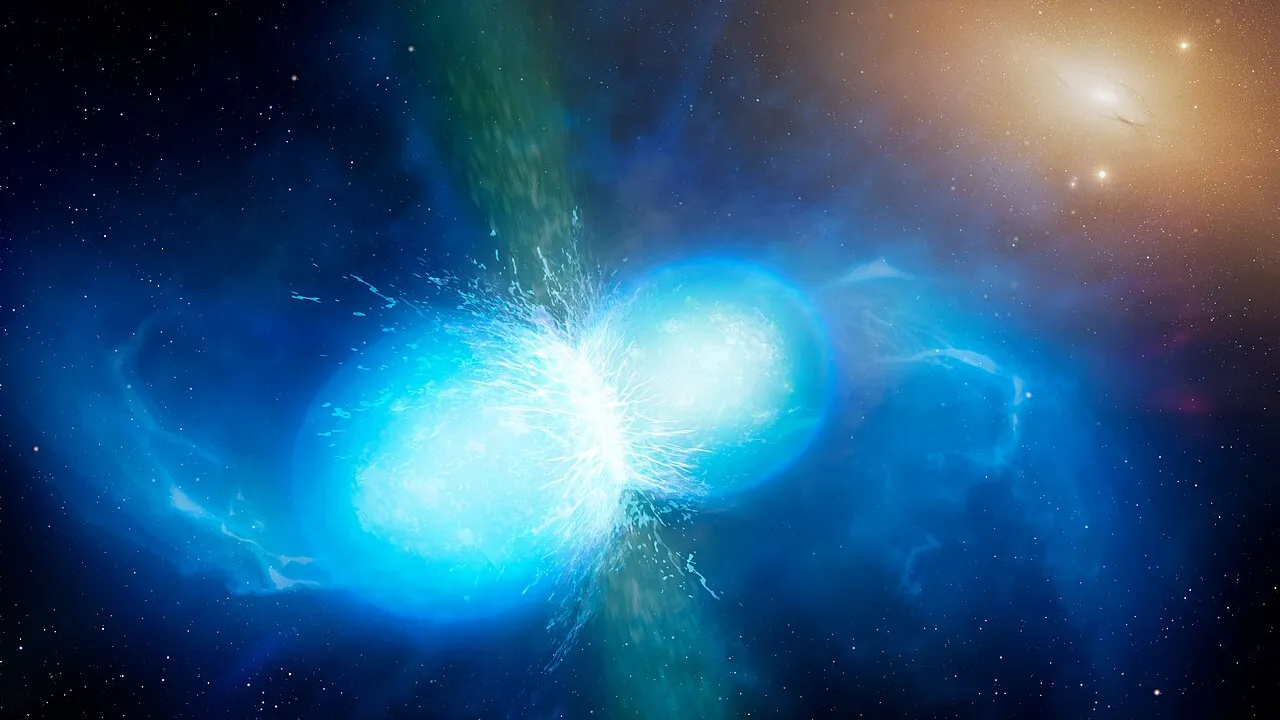
1. What crashes together in space to trigger a kilonova?
2. Which shiny metals get forged during a kilonova explosion?
🤯 Mind-Blowing Fact • Grade 2
Even one percent of Earth's total gold came from ancient kilonova crashes that happened billions of years before our Sun was born!
✨ Word Sparks (Grade 2 Glossary)
Tap 🔊 to hear
kilo
Metric prefix meaning exactly one thousand
nova
Sudden bright flash on a white dwarf
spiral
Curved path winding closer toward the middle
🪝
Why is an explosion called a 'kilonova'—and what does 'kilo' mean?
1
One Thousand Times Brighter
In science, the prefix '' means one thousand—just like a kilometer is one thousand meters! Astronomers named a kilonova because it shines roughly one thousand times brighter than a regular small star flash called a , though slightly dimmer than a giant supernova.
2
A Spiral Dance of Gravity
Sometimes two massive stars in a pair both explode and leave behind two neutron stars orbiting each other. Over millions of years, they closer until they whirl hundreds of times per second and slam together!
3
Blue First, Then Red
A kilonova glows bright blue on the first day, then turns deep red as clouds of fresh gold and platinum block blue light!
1. Why did astronomers put 'kilo' at the front of the word kilonova?
2. How does a kilonova's color change over just a few days?
🤯 Mind-Blowing Fact • Grade 3
More than 3,500 scientists—nearly one-third of all astronomers in the world—teamed up to study that single August 2017 kilonova!
✨ Word Sparks (Grade 3 Glossary)
Tap 🔊 to hear
LIGO
Twin laser observatories catching ripples in spacetime
uranium
Heavy radioactive metal forged in neutron crashes
debris
Scattered pieces flung outward from a crash
🪝
How did scientists both 'HEAR' space ripple AND see light from the same kilonova in August 2017?
1
A Cosmic Mystery of Heavy Metals
For decades, scientists knew supernovas cook elements like oxygen, calcium, and iron. Yet even supernovas struggled to explain where the universe got its heaviest treasures—like gold, platinum, and ! Making those heavyweights takes an extreme blizzard of free neutrons.
2
August 17, 2017: The Historic Chirp!
On August 17, 2017, giant laser detectors on Earth— in America and Virgo in Italy—caught space itself rippling for 100 seconds! Less than two seconds later, NASA's Fermi satellite spotted a flash of gamma rays from galaxy NGC 4993, 130 million light-years away.
3
Seventy Observatories Turn Together
Seventy telescopes across every continent and in orbit raced to point at that galaxy. Together they watched a brand-new kilonova bloom blue and fade crimson over a week—catching fresh gold and platinum forming live!
4
A Newborn Black Hole
After spraying neutron-rich outward at a fifth the speed of light, the merged cores collapsed into a tiny black hole.
1. Why was the August 17, 2017 kilonova one of the biggest breakthroughs in astronomy history?
2. Why are colliding neutron stars better than regular stars at forging gold and uranium?
🤯 Mind-Blowing Fact • Grade 4
Comparing the gravitational-wave arrival and gamma-ray flash of GW170817 across 130 million light-years proved gravity and light travel at the exact same speed to 1 part in a quadrillion!
✨ Word Sparks (Grade 4 Glossary)
Tap 🔊 to hear
r-process
Rapid neutron capture building universe's heaviest elements
nucleosynthesis
Creation of new atomic nuclei in cosmos
lanthanides
Rare-earth metals that absorb blue kilonova light
🪝
How can atoms gobble up dozens of neutrons in less than a single second during a kilonova?
1
Rapid Neutron Capture (The r-Process)
Building an atom of gold (79 protons, 118 neutrons) requires stuffing dozens of extra neutrons into lighter nuclei before unstable isotopes have time to radioactively decay—a race against the clock called rapid neutron capture, or the '$r$-process.' When two neutron stars violently shred each other's crusts at up to 30 percent light speed, a tsunami of pure neutron matter decompresses into space, triggering furious $r$-process !
2
Radioactive Heating and Lanthanide Curtains
In 2010, astrophysicist Brian Metzger and colleagues calculated how thousands of freshly forged radioactive isotopes decaying simultaneously would heat the expanding cloud—coining the modern term 'kilonova' because it peaks ~1,000 times brighter than a classical white-dwarf nova. Heavy 'lanthanide' elements (like neodymium used in earbud magnets) pack complex electron shells that trap blue photons, shifting the kilonova's glow deep into red and infrared wavelengths.
3
Solving Short Gamma-Ray Bursts
For decades, mysteries surrounded 'short gamma-ray bursts' lasting under two seconds. Catching GRB 170817A just 1.7 seconds after GW170817's gravitational-wave chirp proved neutron-star mergers launch narrow relativistic jets AND prove gravity travels at the exact speed of light!
4
James Webb Spots Tellurium
In 2023, JWST observed a distant kilonova (GRB 230307A) and directly identified spectral lines of heavy element tellurium 29 days post-merger!
1. What heats a kilonova cloud so it glows 1,000 times brighter than a regular nova?
2. What did the 1.7-second gap between GW170817's gravitational waves and gamma rays prove after a 130-million-year race?
🤯 Mind-Blowing Fact • Grade 5
Astronomers call colliding neutron stars 'standard sirens' because the loudness of their gravitational-wave chirp directly reveals their exact cosmic distance without any intermediate steps!
Combining light, neutrinos, and spacetime ripples together
opacity
How strongly material blocks or absorbs light
🪝
How can a single neutron-star collision independently measure the expansion rate of the entire universe?
1
From Theoretical Prediction to AT2017gfo
Proposed conceptually by Li-Xin Li and Bohdan Paczyński in 1998 and quantitatively modeled by Brian Metzger's team in 2010, kilonovae bridged nuclear physics and relativistic astrophysics on August 17, 2017. When LIGO-Virgo recorded gravitational-wave inspiral GW170817 from two 1.1-to-1.6-solar-mass neutron stars, optical telescopes swiftly pinpointed transient AT2017gfo in lenticular galaxy NGC 4993—inaugurating with gravitational waves and electromagnetic light.
2
Ejecta Geometry and Lanthanide Opacity
Spectroscopy from ultraviolet to near-infrared across the Very Large Telescope and Hubble revealed two distinct ejecta components: fast ($\sim 0.3c$), lanthanide-poor polar wind driven by shock heating and neutrinos that shone blue on day one, surrounded by slower ($\sim 0.1c$), neutron-rich equatorial tidal tails opaque with heavy lanthanides and actinides whose millions of bound-bound electronic transitions shifted radiation into infrared.
3
Direct Spectroscopy of Strontium and Tellurium
Researchers identified clear absorption features of freshly synthesized strontium ($Z=38$) in AT2017gfo, while in 2023 JWST's NIRSpec detected mid-infrared emission of tellurium ($Z=52$) following merger GRB 230307A—confirming third-peak $r$-process production of ~16,000 Earth masses of heavy metals per crash!
4
Standard Sirens and the Hubble Constant
Unlike Type Ia supernovae ('standard candles') that rely on multi-step distance calibration ladders, a binary merger's gravitational-wave chirp amplitude directly encodes absolute luminosity distance from Einstein's general relativity alone! Pairing GW170817's '' distance of 40 megaparsecs with host galaxy NGC 4993's recession velocity yielded an independent measurement of the Hubble constant ($H_0$) free of dust-extinction systematics.
5
Hypermassive Remnant Collapse
Within ~1 second of collision, differential rotation and thermal pressure briefly supported a bloated hypermassive neutron star weighing ~2.7 solar masses before gravity won out—collapsing into a spinning stellar-mass black hole that launched a structured relativistic gamma-ray jet.