1. How does the Juno spacecraft make electricity way out at giant Jupiter?
2. What colorful surprise did Juno photograph at Jupiter's north and south poles?
🤯 Mind-Blowing Fact • Grade 2
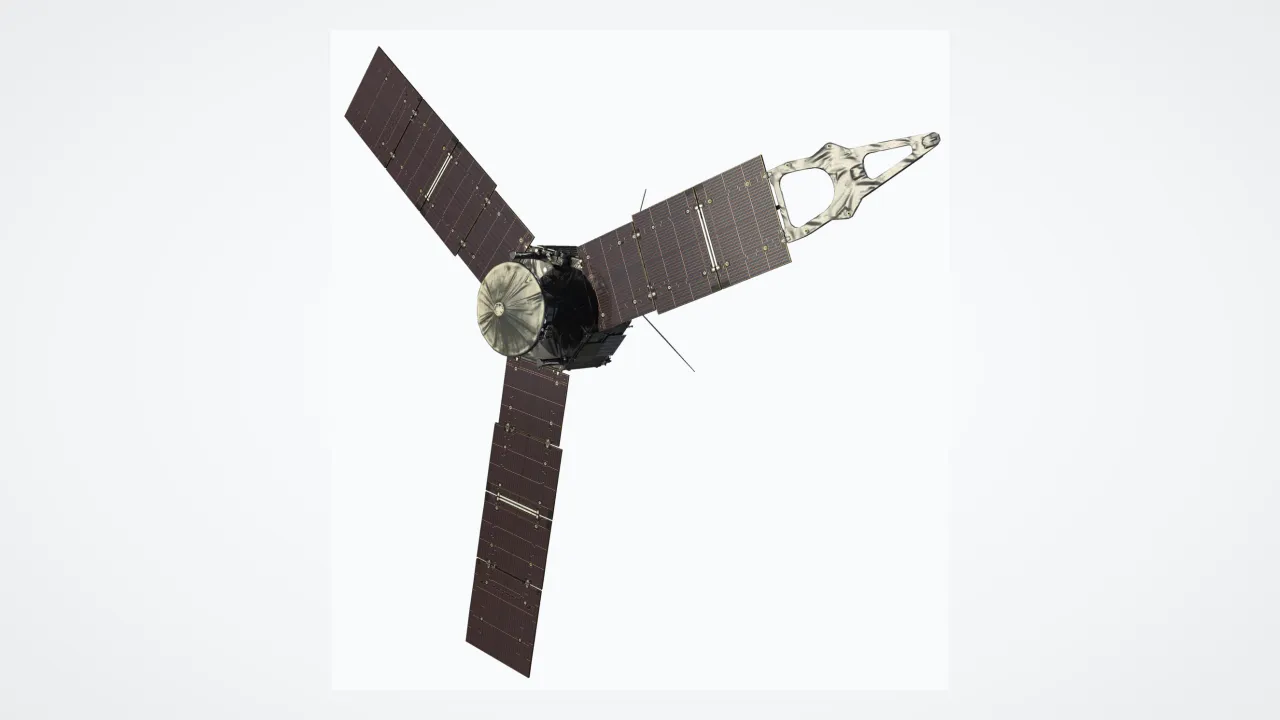
Even with three giant wings spanning the width of a basketball court, dim sunlight at Jupiter gives Juno only about 500 watts—roughly enough to run one kitchen blender!
✨ Word Sparks (Grade 2 Glossary)
Tap 🔊 to hear
polar orbit
path looping over north and south poles
titanium
super-strong lightweight silver-gray metal
solar cell
wafer converting light directly into electricity
🪝
How can solar panels power a spacecraft where sunlight is 25 times dimmer than at your house?
1
Breaking the Solar Distance Record
Before Juno launched in August 2011, every mission to Jupiter relied on nuclear heat generators because sunlight out there is twenty-five times weaker than at Earth! Engineers packed nearly 19,000 ultra-modern onto three 29-foot wings—making Juno the farthest solar-powered planet explorer ever!
2
A Titanium Armor Box
Arriving on July 4, 2016, Juno loops in wide ovals that dive within 2,600 miles of Jupiter's cloud tops at over 130,000 miles per hour! A 400-pound vault shields its computers from fierce radiation.
3
Peeking Under the Clouds
Special sensors let Juno look hundreds of miles beneath Jupiter's colorful stripes, measuring how deep the Great Red Spot really goes!
1. What protects Juno's sensitive computer brain from Jupiter's zapping radiation belts?
2. About how much electricity do Juno's three huge solar wings make out at Jupiter?
🤯 Mind-Blowing Fact • Grade 3
Riding aboard Juno are three custom aluminum LEGO minifigures—astronomer Galileo Galilei alongside Roman figures Jupiter and Juno—built to inspire kids about science!
✨ Word Sparks (Grade 3 Glossary)
Tap 🔊 to hear
microwave
invisible radio wave piercing thick clouds
ammonia
pungent gas forming Jupiter's top clouds
octagon
geometric ring with eight neat sides
🪝
Why did Juno find geometric shapes of hurricanes spinning like clockwork gears at Jupiter's poles?
1
Named for the Cloud-Peering Roman Myth
In ancient Roman myth, Jupiter wrapped himself in clouds to hide mischief, and only his clever wife Juno could peer straight through the mist! True to its name, NASA's Juno spacecraft uses sensors and gravity trackers to look deep beneath Jupiter's cloud tops.
2
Octagons and Pentagons of Cyclones
Nobody had ever clearly seen Jupiter's poles from Earth's sideways view. Swooping straight overhead, Juno's JunoCam revealed eight giant cyclones arranged in a neat around a central storm at the north pole, and five cyclones forming a pentagon at the south pole!
3
Roots of the Great Red Spot
Measuring subtle gravity tugs and glow showed that Jupiter's famous Great Red Spot isn't just a thin surface cloud—its swirling roots plunge 200 to 300 miles deep!
4
Visiting Galilean Moons
In its extended mission, Juno also skimmed close past icy Ganymede, ocean-moon Europa, and volcano-packed Io!
1. How deep beneath the cloud tops did Juno discover the Great Red Spot's storm roots reach?
2. How does Juno 'see' hundreds of miles beneath Jupiter's thick colorful clouds?
🤯 Mind-Blowing Fact • Grade 4
During its closest perijove plunges over Jupiter's poles, Juno hits speeds over 130,000 miles per hour—making it one of the fastest human-made objects ever relative to a planet, able to cross the continental United States in under eighty seconds!
Why did Jupiter's deep core turn out to be 'fuzzy' and spread out instead of a neat solid ball of rock?
1
Needle-Threading Perijove Dives
To survive Jupiter's deadly doughnut-shaped radiation belts, Juno flies highly stretched polar orbits! Spending weeks safely far from Jupiter, Juno plunges inward during brief two-hour '' passes at 130,000 miles per hour—threading the narrow gap right between Jupiter's upper atmosphere and the inner edge of the radiation belts while spinning twice a minute for stability.
2
Mystery of the 'Fuzzy' Diluted Core
For decades, planetary textbooks pictured Jupiter with either a compact rocky-icy seed core or no core at all. By measuring millimeter-per-second Doppler shifts in Juno's radio link to Earth, scientists discovered something shocking: Jupiter has a huge 'fuzzy' where heavy rock and ice dissolve smoothly into surrounding liquid metallic hydrogen across nearly half the planet's diameter—possibly stirred up by a colossal head-on planetary crash billions of years ago!
3
Mushballs of Ammonia and Hail
Juno's six-wavelength Microwave Radiometer also solved why ammonia seemed missing across wide belts: violent high-altitude thunderstorms mix water and ammonia into slushy '' hailstones that fall deep into the atmosphere before evaporating!
4
Citizen Science with JunoCam
Uniquely among flagship missions, NASA added visible-light JunoCam specifically for public engagement and left image processing open to everyone—allowing students, classroom teams, artists, and amateur astronomers worldwide to turn raw Jupiter camera strips into breathtaking scientific portraits and discover brand-new storms!
1. How does Juno's stretched polar orbit help it survive Jupiter's fierce radiation?
2. What surprising structure did Juno's precision gravity measurements reveal deep inside Jupiter?
🤯 Mind-Blowing Fact • Grade 5
By tracking tiny gravitational tugs during twin 1,500-kilometer flybys of volcanic moon Io in 2023 and 2024, Juno solved a 45-year mystery—proving Io's 400 erupting volcanoes draw magma from localized chambers inside a mostly solid mantle rather than a shallow global magma ocean!
✨ Word Sparks (Grade 5 Glossary)
Tap 🔊 to hear
gallium arsenide
high-efficiency crystal used in space solar cells
zonal jet stream
east-west wind band wrapping a planet
gravitational harmonics
subtle gravity variations revealing interior mass
🪝
How did a solar-powered polar orbiter map Jupiter's lopsided magnetic dynamo, water abundance, and global magma tides on Io?
1
High-Efficiency Photovoltaics and Titanium Shielding
Launched August 5, 2011 and boosted via a 2013 Earth flyby, the 3,625-kilogram Juno spacecraft entered a 53-day polar orbit around Jupiter on July 4, 2016—retaining that longer orbital period after engineers wisely skipped a main-engine burn over a sticky helium check valve. Operating at 5.2 astronomical units where solar irradiance drops to 50 watts per square meter, Juno's three 8.9-meter triple-junction gallium-arsenide solar arrays generate ~490 watts while a 1-centimeter-thick, 180-kilogram titanium vault attenuates relativistic MeV electrons around its command and data-handling avionics.
2
Six-Channel Microwave Sounding and Shallow Lightning
Spinning at 2 RPM so instruments sweep pole-to-pole every 30 seconds during 58-kilometer-per-second perijoves, Juno's Microwave Radiometer peers through clouds down to 500 bars of pressure—roughly 550 kilometers deep! Besides measuring equatorial water abundance at roughly three times solar proportions—key evidence for how Jupiter accreted volatile-rich pebbles in the protoplanetary disk—Juno discovered high-altitude 'shallow lightning' above water-freezing levels powered by liquid ammonia-water 'mushball' collisions.
3
The 'Great Blue Spot' and Asymmetric Dynamo
Vector magnetometers mapped Jupiter's internal dynamo in unprecedented three-dimensional detail, revealing a starkly non-dipolar field: magnetic flux emerges through multiple northern patches yet plunges back into an intense isolated equatorial anomaly nicknamed the 'Great Blue Spot,' sheared eastward by deep extending 3,000 kilometers down to where hydrogen turns electrically conducting!
4
Circumpolar Vortices and Diluted Core Gravity
Dual-frequency X- and Ka-band Doppler tracking resolved to parts per hundred million, proving Jupiter's jet streams carry one percent of the planet's mass while revealing a compositional gradient ('fuzzy core') spanning 50 percent of Jovian radius. Meanwhile, infrared JIRAM mosaics tracked polygonal circumpolar cyclone crystals stabilized by anti-cyclonic vorticity shields.
5
Extended Galilean Moon Flybys
Natural precession of Juno's perijove northward enabled daring 2021–2024 close flybys within 355 kilometers of Europa and 1,500 kilometers of Io—where gravity data ruled out a shallow global magma ocean beneath Io's hyper-volcanic crust!