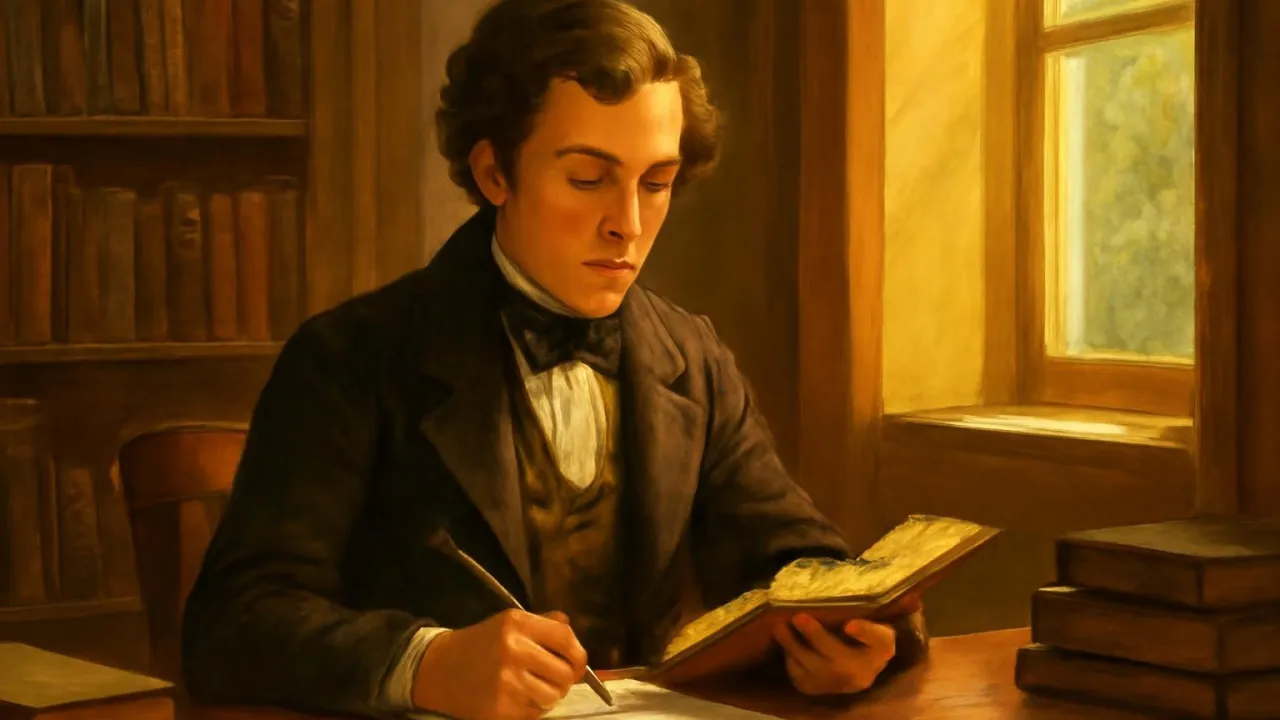
John wrote his first big book when he was just a teenager!
✨ Word Sparks (Grade 2 Glossary)
Tap 🔊 to hear
essay
A short piece of writing.
freedom
Being able to choose for yourself.
kindness
Being nice and caring to others.
🪝
Have you ever wondered how to make the world more fair?
1
Curious Young Thinker
John grew up asking questions about fairness and happiness. His father taught him many things at home. John read books in many languages, even as a boy.
2
Hard Work and Big Ideas
John worked hard to understand what makes people happy. He wrote his thoughts in and letters. He wanted to help others have and .
3
A Famous Achievement
John became famous for his ideas about liberty. He believed everyone should have the right to speak and choose. His words helped people think about fairness in new ways.
John debated grown-ups about philosophy when he was only a kid!
✨ Word Sparks (Grade 3 Glossary)
Tap 🔊 to hear
philosophy
The study of big ideas and questions.
justice
Making sure things are fair for all.
perseverance
Not giving up, even when it’s hard.
🪝
What if you could read ancient books and debate big ideas before you were ten?
1
A Spark of Curiosity
Picture a young boy sitting beside a stack of thick books, eyes wide with wonder. John Stuart Mill loved to ask questions about why things were fair or unfair. His father encouraged him to explore big ideas and learn new languages. John’s curiosity made every day feel like a new adventure in learning.
2
Learning Through Perseverance
John studied hard and learned about , history, and science. He wrote essays about happiness and how to treat others kindly. Sometimes, his ideas were different from other people’s, but he kept thinking and writing. helped him become a great philosopher.
3
Champion of Liberty
As an adult, John wrote a famous book called 'On Liberty.' He explained why people should have the freedom to speak and make their own choices. He believed everyone deserved respect and kindness. His ideas inspired many people to think about and human rights.
4
Changing the World
John’s work helped change how people thought about fairness and laws. He wanted women to have the same rights as men. He also believed in helping the poor and making schools better. John’s big ideas still matter in our world today.
John Stuart Mill was one of the first men in England to speak out for women’s right to vote.
✨ Word Sparks (Grade 4 Glossary)
Tap 🔊 to hear
utilitarianism
Helping the most people be happy.
democracy
A way people help make rules together.
legacy
What someone leaves behind for others.
🪝
What would you do if you wanted to make society more just for everyone?
1
A Childhood of Intense Learning
From a very young age, John Stuart Mill’s father challenged him with tough questions and advanced books. John learned Greek at three and Latin at eight, reading works by famous philosophers before most children could read at all. His home became his school, filled with debates about fairness and knowledge. This early education shaped John’s lifelong curiosity about what makes people happy and societies fair.
2
Developing Revolutionary Ideas
John worked tirelessly, reading and writing essays about philosophy, government, and human rights. He believed in , an idea that actions should help the most people be happy. Sometimes, people disagreed with him, but Mill stood firm and explained his thoughts clearly. His perseverance made him a respected thinker even when his ideas were new or unpopular.
3
On Liberty and Equality
Mill’s famous book 'On Liberty' argued that everyone deserves freedom of speech and the right to make personal choices. He also spoke up for women’s rights, believing women should vote and have equal opportunities. His writing influenced new laws and encouraged others to fight for justice and equality. Mill’s ideas helped shape modern in England and beyond.
4
A Lasting Legacy
John Stuart Mill’s thoughts about fairness and freedom are still studied in schools today. He inspired leaders and lawmakers to create fairer societies with equal rights for all. Mill’s work showed that one person’s ideas can help change the world for the better. His reminds us to keep asking big questions and to stand up for what is right.
John Stuart Mill’s books are still read in universities around the world, over 150 years later.
✨ Word Sparks (Grade 5 Glossary)
Tap 🔊 to hear
utilitarianism
Doing what brings the most happiness to many.
reform
Making changes to improve something.
parliament
A group that helps make a country’s laws.
🪝
What if your words could change how an entire country thinks about freedom and justice?
1
A Childhood Shaped by Intense Curiosity
Imagine being taught ancient Greek at age three and reading philosophy before most children learn to write. John Stuart Mill’s father, James Mill, was determined to raise a thinker who could change the world. Their home in 1800s London became a place of constant debate and study, where John’s days were filled with challenging books and discussions about fairness, logic, and happiness. This rigorous education made John question everything, sparking a lifelong passion for understanding how to make society better for everyone.
2
Philosophy, Perseverance, and the Power of Ideas
As a young man, John faced personal challenges, including exhaustion and doubt, but he never stopped searching for answers. He studied philosophy, economics, and history, eventually developing the theory of with philosopher Jeremy Bentham. Utilitarianism says that the best actions are those that bring the greatest happiness to the most people. Mill’s perseverance and willingness to challenge old ideas made him a leader in the world of philosophy and social .
3
On Liberty: Defending Freedom for All
In 1859, John published 'On Liberty,' a groundbreaking book that argued for individual rights and freedom of speech. He believed that people should be able to express their opinions, even if others disagreed, as long as they did not harm anyone. Mill’s careful reasoning and powerful writing influenced lawmakers and inspired debates about democracy, free speech, and personal responsibility. His ideas are still studied and discussed in classrooms and governments around the world.
4
Championing Equality and Social Reform
John Stuart Mill was also a strong supporter of women’s rights and social justice. He was one of the first men in to openly argue for women’s right to vote, writing 'The Subjection of Women' to support equality. Mill believed that education, fair laws, and equal opportunities could help everyone reach their potential. He also spoke out for the poor, supporting to improve working conditions and access to education.
5
Legacy: Inspiring Generations to Think and Act
John’s writings and actions helped shape modern ideas about liberty, justice, and democracy. His commitment to fairness and his belief in questioning old ways continue to inspire students, leaders, and thinkers today. Mill’s life shows that one person’s ideas, when shared with courage and clarity, can help make the world more just and free. His legacy encourages us to keep asking important questions and to stand up for the rights of all people.