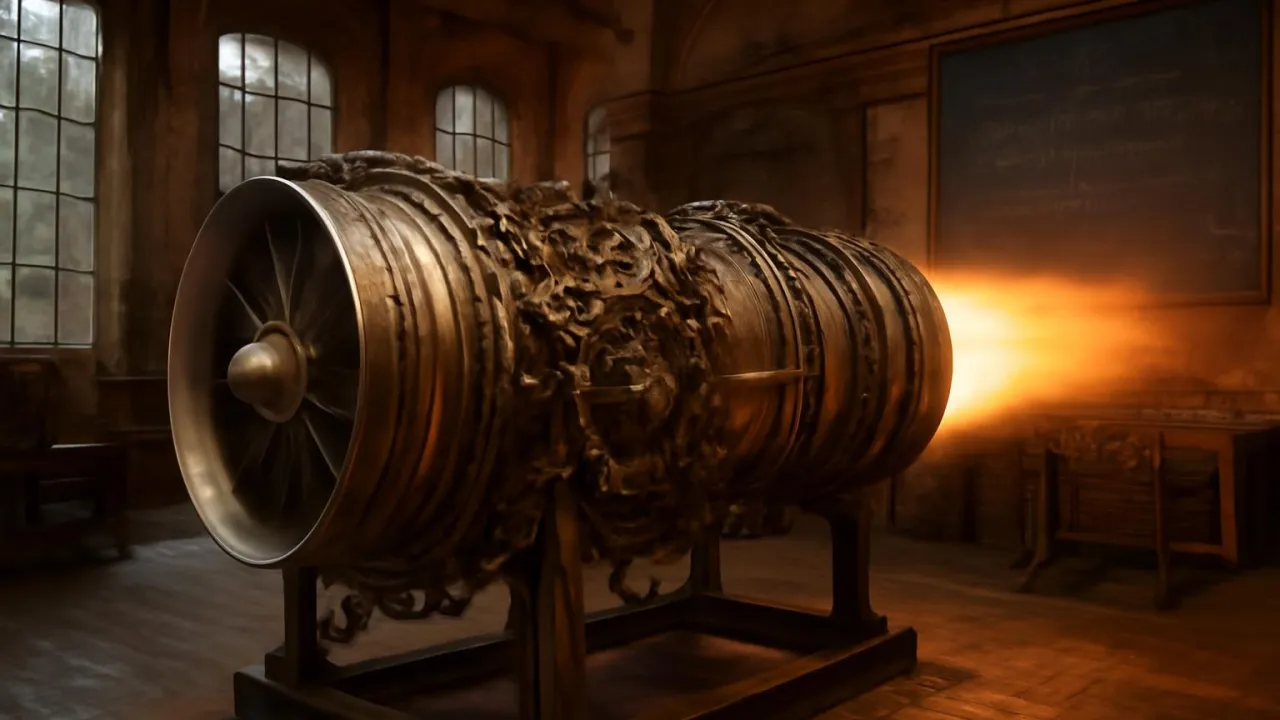
A jet engine can spin its turbines over 10,000 times every minute!
✨ Word Sparks (Grade 3 Glossary)
Tap 🔊 to hear
turbine
A spinning fan inside an engine
combustion
Burning to make heat and power
nozzle
The tube where hot air shoots out
🪝
Can you imagine riding in a plane powered by fire and spinning fans?
1
The Mighty Roar
Jet engines make a thunderous roar as they blast planes into the sky. They use a special kind of power called thrust, which is much stronger than car engines. The engine pulls in air, squeezes it, and mixes it with burning fuel. This creates a rush of hot gases that shoot out the back.
2
How Jet Engines Work
Inside the engine, spinning fans called compress the air. The compressed air enters a chamber, where it mixes with fuel and burns. The burning creates high-pressure, high-temperature gases that push out of the . This strong push forward is called thrust.
3
A New Age of Travel
Before jet engines, airplanes flew slowly and could not go very high. When the first jet planes flew in the 1930s and 1940s, people could travel across continents in just hours. Jet engines changed how people explored the world.
4
Inventors and Impact
Frank Whittle in England and Hans von Ohain in Germany built the first working jet engines. Their inventions used principles of compression, , and rapid exhaust. Today, jet engines power almost all big airplanes and make global travel possible for millions.
A modern jet engine can push a plane over 600 miles per hour—almost as fast as a race car on the ground!
✨ Word Sparks (Grade 4 Glossary)
Tap 🔊 to hear
compression
Squeezing air to make it smaller
Newton’s third law
For every push, there’s a push back
altitude
How high something is above the ground
🪝
What if you could ride across the world on a stream of hot, rushing air?
1
The Science of Jet Power
Jet engines work by taking in large amounts of air, compressing it, and mixing it with fuel for combustion. The burning mixture creates extremely hot, high-pressure gases that expand rapidly and are forced out through a nozzle. This rapid exhaust produces thrust, which propels the plane forward at high speeds. The entire process is based on : for every action, there is an equal and opposite reaction.
2
A Revolution in Flight
Before jet engines, propeller planes traveled slowly and had limited . The invention of the jet engine in the late 1930s changed aviation forever, allowing planes to fly faster, higher, and farther than ever before. Early jet-powered flights amazed crowds with their speed and power, signaling a new era in transportation. Today, almost all commercial airliners use jet engines for efficient long-distance travel.
3
Inventors and Innovations
Frank Whittle in Britain and Hans von Ohain in Germany independently developed the first working jet engines. Their designs used turbines to compress air and combustion chambers to ignite fuel, creating powerful thrust. The first jet-powered flight took place in 1939, and soon after, jet engines spread worldwide. Their invention led to rapid advances in both military and civilian aviation.
4
Impact on the World
Jet engines have made global travel faster, safer, and more accessible to people everywhere. They have connected distant countries and cultures, making it possible to visit family, do business, or explore new places in just hours. The jet engine’s influence can be seen in everything from international tourism to emergency aid and scientific exploration.
1. What law of physics helps jet engines create thrust?
2. Why did jet engines change travel?
🤯 Mind-Blowing Fact • Grade 5
The largest jet engines, like the GE9X, have fans over 11 feet wide—wider than a school bus is tall!
✨ Word Sparks (Grade 5 Glossary)
Tap 🔊 to hear
compressor
Part that squeezes air tightly in engines
turbofan
A jet engine with a large spinning fan
supersonic
Faster than the speed of sound
🪝
Imagine standing on a runway, feeling the ground tremble as a jet engine thunders to life—how does this incredible machine lift hundreds of people into the sky?
1
The Physics Behind Jet Propulsion
Jet engines operate on the principles of aerodynamics and thermodynamics, specifically Newton’s third law of motion: every action produces an equal and opposite reaction. Air is drawn into the front intake and rapidly compressed by a series of spinning axial and centrifugal . This highly compressed air is then mixed with fuel in combustion chambers, where it is ignited, producing extremely hot, expanding gases. As these gases rush out the exhaust nozzle at high velocity, they generate a powerful forward thrust that propels the aircraft. The efficiency of this process allows modern jets to travel at speeds exceeding 600 miles per hour and altitudes above 35,000 feet.
2
Engineering Marvels: Key Components
A jet engine is composed of several critical parts: the intake, , combustion chamber, turbines, and exhaust nozzle. The compressors increase the pressure of incoming air, making combustion more efficient. In the combustion chamber, fuel is sprayed and ignited, creating high-energy gases. The turbines, positioned behind the combustion chamber, extract energy from these gases to spin both the compressors and the engine’s fan blades. Finally, the exhaust nozzle accelerates the gases out of the engine, maximizing thrust. Each component must withstand extreme temperatures, pressures, and rotational speeds—sometimes over 10,000 revolutions per minute.
3
Aviation History: From Idea to Innovation
The concept of jet propulsion dates back to ancient times, but practical jet engines emerged only in the 20th century. Frank Whittle in the United Kingdom and Hans von Ohain in Germany independently built the first working prototypes in the late 1930s. Whittle’s design used centrifugal compression, while von Ohain’s employed axial flow, both relying on the same fundamental principles. The first jet-powered flight occurred in 1939, and by the 1950s, jet engines had revolutionized both military and commercial aviation, making and transcontinental travel possible.
4
Transforming the Modern World
Jet engines have dramatically changed how people, goods, and ideas move across the globe. They have made international travel accessible to millions, enabled rapid delivery of medical supplies and emergency aid, and fostered cultural exchange. The speed and efficiency of jet-powered flight have also impacted global business, scientific research, and even weather forecasting, as research aircraft can now reach remote parts of the atmosphere.
5
Future Innovations and Environmental Challenges
Today, engineers are developing new jet engine technologies to reduce fuel consumption, noise, and environmental impact. Advances include high-bypass engines, variable cycle engines, and experiments with alternative fuels such as biofuels or hydrogen. As the world seeks greener transportation, the jet engine continues to evolve, balancing the need for speed and efficiency with the responsibility to protect our planet. The story of the jet engine is far from over—it is a testament to human ingenuity and the ongoing quest for flight.