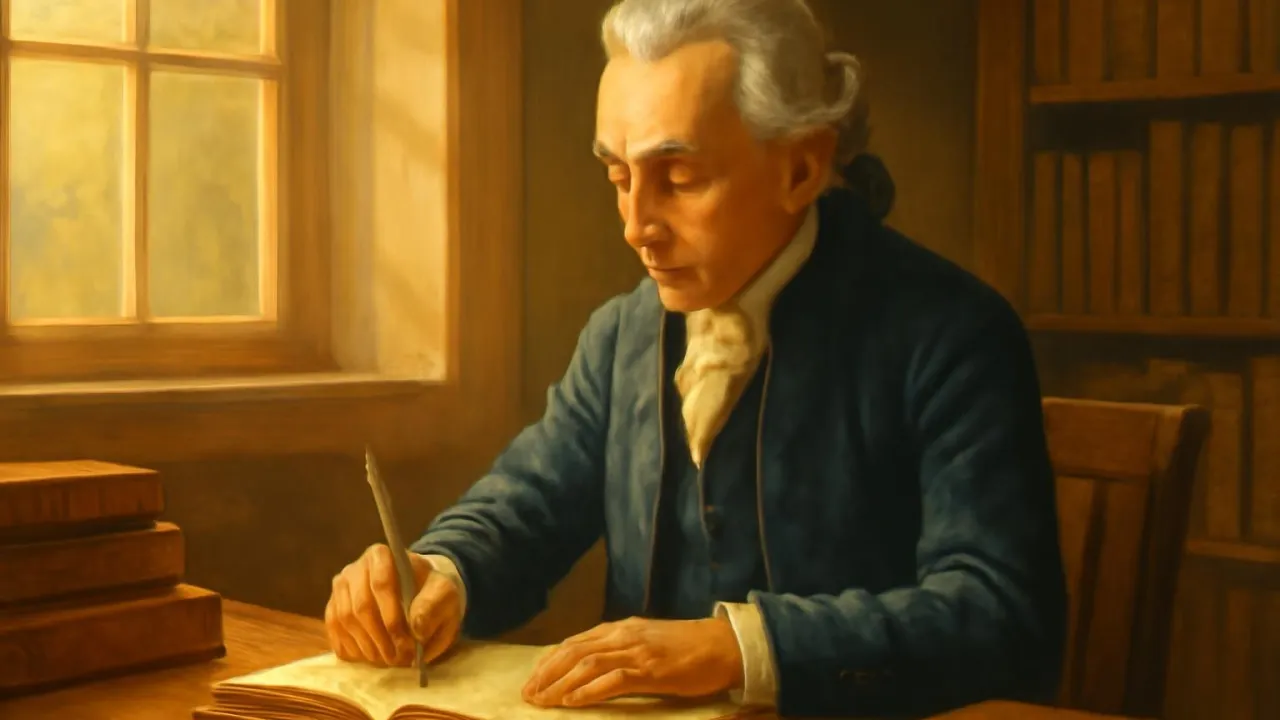
Kant’s neighbors set their clocks by his daily walk!
✨ Word Sparks (Grade 2 Glossary)
Tap 🔊 to hear
knowledge
What you know or learn
reason
Thinking carefully about something
famous
Known by many people
🪝
Have you ever wondered how you know what is true?
1
Curious About Everything
Imagine a boy who always wondered about the world around him. Immanuel Kant asked questions about how people know things and what makes something right or wrong. He loved reading books and talking with his teachers about big ideas.
2
Working and Wondering
Kant worked hard every day and wrote his thoughts in a notebook. He spent a lot of time thinking and studying in his quiet room. His curiosity helped him learn more and more each year.
3
A Big Idea
Kant created a new way to think about and how our minds work. He wrote a book called 'Critique of Pure .' His ideas helped people all over the world think in new ways.
Kant never left his hometown, but his ideas traveled worldwide.
✨ Word Sparks (Grade 3 Glossary)
Tap 🔊 to hear
philosopher
A person who studies big ideas
routine
Doing things the same way each day
perseverance
Not giving up, even when it’s hard
🪝
Imagine trying to solve the biggest puzzle: How do we know what’s real?
1
A Child Full of Wonder
When Immanuel Kant was a child, he always asked questions about the world. He wanted to understand why things happen and how people decide what is right or wrong. His curiosity led him to read many books and discuss ideas with friends. Kant believed thinking deeply could help solve life’s mysteries.
2
A Life of Discipline
Kant kept a strict daily to help his thinking. Every day, he woke up early, taught students, and took a walk at the same time. He wrote in his notebook and read philosophy books for hours. This discipline helped him develop his own important ideas.
3
Changing Philosophy
Kant’s most famous book, 'Critique of Pure Reason,' introduced the idea that our minds help shape our experiences. He explained that people use both their senses and their thinking to understand the world. This was a big change from old ways of thinking. His work started a new era in philosophy.
4
Overcoming Challenges
Kant faced many challenges, like living in a small city and not traveling far. He didn’t let this stop his learning. By reading, writing, and teaching, he shared his ideas with people everywhere. His made him one of history’s greatest .
Kant’s ideas helped shape modern science and government.
✨ Word Sparks (Grade 4 Glossary)
Tap 🔊 to hear
transcendental
Going beyond what we see or touch
idealism
Belief that ideas shape reality
ethics
Rules about right and wrong
🪝
What if your ideas could change how the whole world thinks about truth?
1
A World of Questions
Immanuel Kant grew up in 18th-century Prussia, where curiosity was his greatest companion. Even as a child, he wondered how people could be sure of what they know or decide what is right. His love for reading and deep thinking set him on a path to become a philosopher. Kant’s early questions would inspire some of the most important ideas in history.
2
A Life of Discipline and Study
Kant was famous for his strict daily schedule, which he followed for decades. He woke up at five, lectured at the university, and took a walk at the exact same time every afternoon. This discipline allowed him to focus on reading, writing, and developing complex philosophical ideas. His dedication helped him become a respected professor and thinker.
3
Revolutionizing Philosophy
Kant’s most influential work, 'Critique of Pure Reason,' introduced the idea that our minds actively organize what we experience. He argued that knowledge comes from both our senses and the way our minds structure information. This theory, called ' ,' changed how philosophers thought about reality and knowledge. Kant’s ideas challenged old beliefs and started a new era in philosophy.
4
Legacy and Global Impact
Although Kant never left his hometown, his books and teachings reached scholars across Europe and beyond. His ideas about , reason, and freedom influenced many fields, including science, law, and education. Kant’s work inspired generations of thinkers to question, reason, and seek truth. Today, he is remembered as one of the greatest philosophers in history.
1. What did Kant’s 'Critique of Pure Reason' suggest?
2. How did Kant’s ideas spread worldwide?
🤯 Mind-Blowing Fact • Grade 5
Kant’s 'categorical imperative' is still debated in philosophy classes worldwide today.
✨ Word Sparks (Grade 5 Glossary)
Tap 🔊 to hear
categorical imperative
A rule for judging if actions are truly right
transcendental idealism
The idea that our minds shape reality
morality
Knowing and choosing what is right or wrong
🪝
Can one person’s questions about knowledge and morality transform how the world thinks forever?
1
The Young Thinker’s Curiosity
In the bustling city of Königsberg, young Immanuel Kant spent his childhood surrounded by books, deep questions, and lively debates. He often pondered mysteries like, 'How do I know what’s real?' and 'What makes an action truly right?' These questions set him apart from his classmates and sparked a lifelong quest to understand the foundations of human knowledge and . Kant’s early fascination with science and logic shaped his future as a philosopher who would challenge the world’s greatest thinkers.
2
A Life of Rigorous Routine and Study
Kant became known for his unwavering discipline, following a strict daily schedule that rarely changed for decades. He rose at five o’clock, taught university lectures, read and wrote for hours, and took his famous afternoon walk so punctually that neighbors set their clocks by him. This structured lifestyle allowed Kant to concentrate on developing complex philosophical arguments and to write some of the most influential works in Western thought. His commitment to routine reflected his belief that reason and order were keys to understanding reality.
3
Philosophical Breakthroughs and the Critique of Pure Reason
Kant’s masterpiece, 'Critique of Pure Reason,' revolutionized philosophy by arguing that the mind actively shapes how we experience the world. He introduced the concept of ',' which suggests that while our senses provide raw data, it is our mind’s categories that organize and interpret this information. Kant’s work challenged both rationalists, who believed knowledge comes only from reason, and empiricists, who trusted only sensory experience. His ideas established a new framework for understanding knowledge, science, and reality itself.
4
Ethics, Freedom, and Lasting Influence
Beyond his theories of knowledge, Kant developed a powerful system of ethics based on the ',' a rule that actions must be guided by principles everyone could follow. He argued that true freedom comes from acting according to moral laws we give ourselves, not just following orders or desires. Kant’s ethical philosophy influenced debates about human rights, democracy, and justice around the world. His teachings inspired future philosophers, scientists, and leaders to think critically and act responsibly.
5
Legacy of a World-Changing Philosopher
Although Kant never traveled far from Königsberg, his writings reached every corner of the globe, shaping modern philosophy, science, law, and education. Today, his questions about knowledge, reality, and continue to challenge students and scholars. Kant’s dedication to careful thinking and ethical living reminds us that asking big questions can lead to world-changing ideas. His legacy proves that a single thinker’s curiosity and discipline can transform how humanity understands itself and its place in the universe.