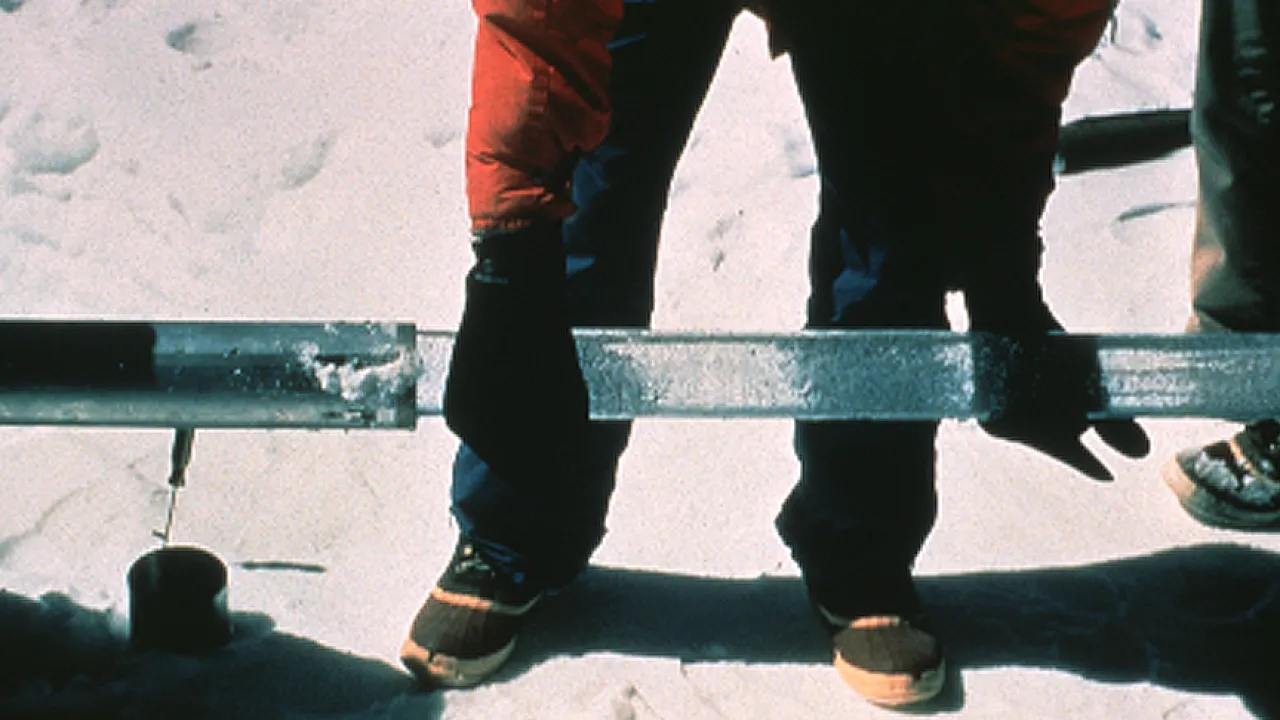
1. How do tiny bubbles of old air get inside glacier ice?
2. Where do scientists travel to drill the deepest ice cores?
🤯 Mind-Blowing Fact • Grade 2
Ice cores are stored in giant super-cold library freezers kept at minus thirty degrees Fahrenheit so their ancient air bubbles never melt!
✨ Word Sparks (Grade 2 Glossary)
Tap 🔊 to hear
Antarctica
Frozen continent around Earth's South Pole
Layer
One flat sheet stacked on another
Ash
Fine gray powder blown from volcanoes
🪝
How can a tube of frozen snow tell scientists what the sky was like when woolly mammoths walked Earth?
1
Fluffy Snow Turns to Ice
Picture freshly fallen snow—it is mostly fluffy crystals with air spaces in between! In freezing places like Greenland and , summer never melts all the snow. Year after year, new blizzards pile heavier on top.
2
Sealed Time Capsules
Deep down, that weight squeezes old snow into solid glacier ice. Tiny bubbles of real sky air get locked inside like sealed glass jars. Even specks of desert dust and volcano freeze right in place!
3
Reading the Layers
Glacier scientists use hollow drills to pull up long ice cylinders. Deeper ice is older, letting scientists count yearly like pages in a history book.
2. Besides air bubbles, what else can get trapped inside ice layers?
🤯 Mind-Blowing Fact • Grade 3
Scientists have drilled Antarctic ice cores over two miles deep that hold continuous climate records stretching back 800,000 years!
✨ Word Sparks (Grade 3 Glossary)
Tap 🔊 to hear
Glaciologist
A scientist who studies glaciers and ice
Firn
Packed grainy snow turning into solid ice
Vacuum
A sealed space with all air removed
🪝
What does an ice scientist see when holding a slice of 50,000-year-old Antarctic ice up to a bright lamp?
1
Sparkling Cylinders from the Deep
Inside a sub-zero research tent in Antarctica, a slides a clear cylinder of blue-white ice onto a glowing light table. Tiny silver bubbles sparkle inside like frozen fizzy water! Those bubbles hold genuine air from thousands of years before pyramids were built.
2
From Snowflakes to Firn to Ice
Snowflakes trap up to ninety percent air when they first land. Over decades, buried snow packs into grainy ice called . About sixty to one hundred meters down, the pores pinch shut completely, sealing microscopic bubbles of ancient atmosphere.
3
Summer and Winter Stripes
Summer snow and winter snow look slightly different in crystal size and dustiness. That difference creates neat annual bands scientists count to find exact years, much like counting rings inside a tree trunk.
4
Clues Inside Every Slice
In ultra-clean labs, researchers crush small ice samples inside chambers to measure ancient carbon dioxide and methane. Dark smudges of volcanic ash and sea-salt crystals even reveal ancient storms and eruptions!
2. Why do scientists crush ancient ice inside a sealed vacuum chamber?
🤯 Mind-Blowing Fact • Grade 4
Greenland ice cores preserve tiny traces of copper and lead smoke drifted northward from ancient Roman workshops more than two thousand years ago!
✨ Word Sparks (Grade 4 Glossary)
Tap 🔊 to hear
Paleoclimate
Earth's ancient climate from thousands of years ago
Isotope
Lighter or heavier version of the same atom
Interglacial
Warmer time period between major Ice Ages
🪝
How can frozen water molecules act as a prehistoric thermometer when nobody was around to read one?
1
Drilling Through Two Miles of History
High on the East Antarctic Plateau, summer temperatures rarely climb above minus twenty-five degrees Celsius, and howling winds sweep across a flat white horizon. Beneath the snowpack lies an unbroken frozen archive more than three kilometers thick. Using hollow rotary drills, polar engineering teams bring up one-meter-long ice cores segment by segment, reconstructing Earth's past atmosphere and climate across hundreds of millennia.
2
Direct Samples of Prehistoric Skies
Unlike fossils or rocks that give indirect clues about ancient air, ice cores trap actual molecules of past atmospheres. As snow compacts into dense firn and finally closes off into impermeable ice, microscopic bubbles preserve the exact mix of oxygen, nitrogen, carbon dioxide, and methane that circulated in the troposphere during Ice Ages and warm periods.
3
Water Isotopes as a Thermometer
Even the ice crystals themselves record ancient temperatures! Water molecules contain either lighter oxygen-16 or slightly heavier oxygen-18 atoms. Because heavier water molecules evaporate less easily and condense out of clouds sooner during cold eras, polar snow formed in frigid Ice Ages contains less oxygen-18 than snow formed during warmer eras.
4
Matching Volcanoes, Dust, and Wildfire Soot
Trace layers of sulfate acids pinpoint historic volcanic eruptions—such as Indonesia's 1815 Mount Tambora blast—helping cross-check exact dates. Windblown desert dust reveals when Ice Age continents were drier and windier, giving Earth scientists a remarkably detailed timeline of planetary change.
1. How do scientists figure out ancient polar temperatures from the ice crystals themselves?
2. How do historic volcanic eruptions help scientists date ice core layers?
🤯 Mind-Blowing Fact • Grade 5
Scientists recently identified blue ice in Antarctica's Allan Hills containing trapped atmospheric bubbles more than four million years old!
✨ Word Sparks (Grade 5 Glossary)
Tap 🔊 to hear
Porosity
Percentage of open pore space inside snow
Deuterium
Hydrogen isotope carrying one extra neutron
Spectroscopy
Measuring molecules using precise beams of light
🪝
Why is the air trapped inside an Antarctic bubble slightly younger than the crystal ice wall surrounding it?
1
Polar Archives of the Cryosphere
At Dome C in East Antarctica, European EPICA researchers extracted 3,270 meters of cylindrical glacial ice, unveiling eight complete glacial-interglacial cycles spanning 800,000 years—with newer international drills pushing past one million years. Meanwhile, high-accumulation ice sheets in Greenland and alpine glaciers in Peru's Andes resolve seasonal weather shifts down to individual decades and years.
2
Sintering and the Gas-Ice Age Offset
Freshly fallen snow begins with roughly 90 percent , allowing atmospheric air to diffuse slowly through interconnected channels in the upper firn column. Only at the 'lock-in depth'—typically 50 to 120 meters down, depending on temperature and snowfall rate—does pressure sinter ice grains until air bubbles seal completely. Consequently, trapped gas inside any layer is slightly younger than the surrounding ice crystals, an offset glaciologists calculate precisely as delta-age.
3
Stable Isotopic Thermometry
To reconstruct paleotemperatures, mass spectrometers measure stable isotope ratios of oxygen-18 to oxygen-16 and (heavy hydrogen) to ordinary hydrogen within melted ice water. During glacial maxima, cooler ocean surfaces and steeper poleward temperature gradients cause heavy isotopes to rain out over mid-latitudes before moisture reaches polar plateaus, leaving Ice Age ice distinctly depleted in heavy isotopes.
4
Greenhouse Coupling and Abrupt Shifts
Laser and gas chromatography of extracted bubbles reveal a tight historical coupling: across 800,000 years, atmospheric CO2 oscillated naturally between ~180 parts per million during cold glacial maxima and ~280 to 300 ppm during warm interglacials, while methane tracked wetland expansion. Beryllium-10 cosmogenic isotopes even record ancient solar activity and geomagnetic field strength.
5
Safeguarding Vanishing Mountain Records
Today, repositories like the U.S. National Science Foundation Ice Core Facility in Colorado preserve thousands of meters of cores at minus 36 degrees Celsius. International teams also race to archive cores from high-altitude tropical glaciers before warming melts those irreplaceable frozen libraries.