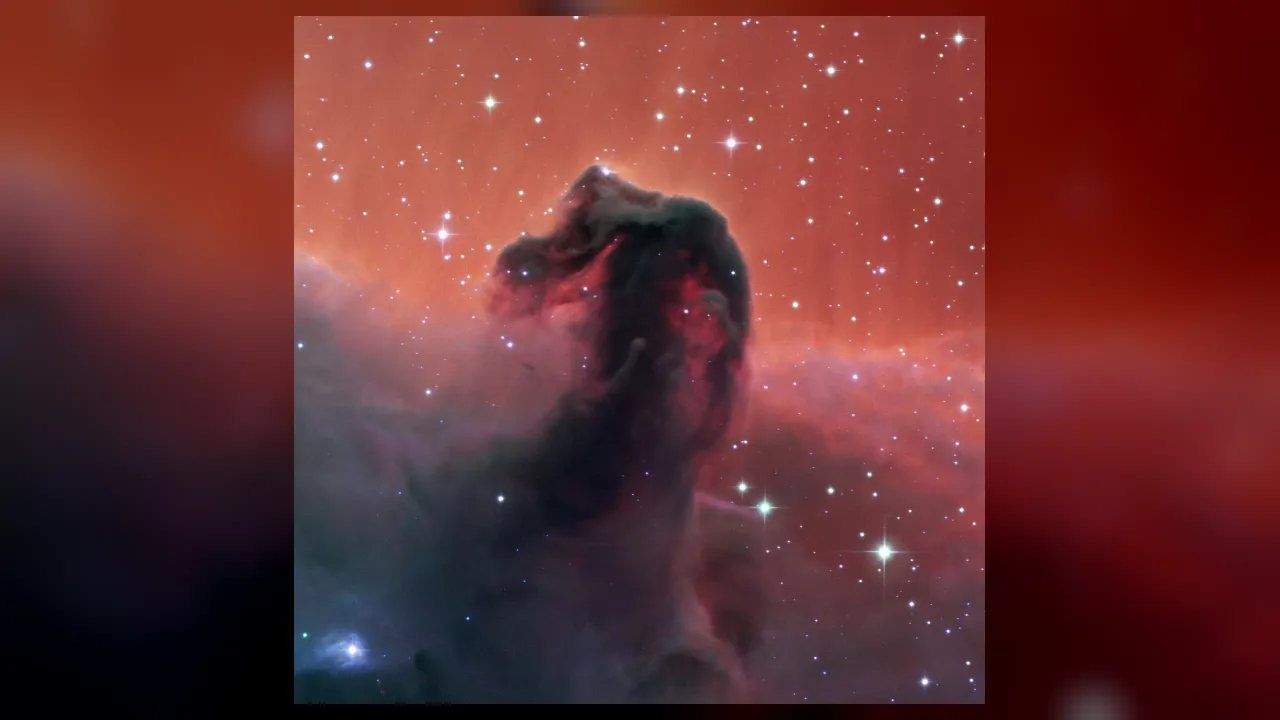
1. Why does the Horsehead Nebula look dark in visible-light pictures?
2. Near which famous star pattern can telescopes find the Horsehead Nebula?
🤯 Mind-Blowing Fact • Grade 2
Twenty-five thousand Solar Systems lined up edge to edge could fit from the bottom of the Horsehead Nebula to the tip of its ears!
✨ Word Sparks (Grade 2 Glossary)
Tap 🔊 to hear
dark nebula
Dense dust cloud blocking light behind
glass plate
Early sheet used for telescope photos
chess knight
Game piece shaped like horse's head
🪝
Who spotted the famous Horsehead Nebula hiding on a glass camera plate in 1888?
1
Williamina Fleming's Eagle Eyes
Back in 1888, astronomer Williamina Fleming carefully examined glass telescope photographs at Harvard College Observatory. Near Orion's Belt, she noticed a tiny semicircular notch of darkness against a glowing curtain of gas—discovering the world-famous Horsehead Nebula!
2
A Cosmic Chess Knight
Sitting 1,375 light-years from Earth, this towering pillar of cold gas and soot-like dust rises 3.5 light-years tall. Bright pink hydrogen gas behind it outlines its snout, ears, and flowing mane like a .
3
Glowing Mane in Infrared
When NASA's Hubble and James Webb telescopes used infrared cameras, the dark shadow turned into dreamy, glowing waves of golden mist!
1. Which astronomer discovered the Horsehead Nebula on a Harvard glass photograph in 1888?
2. How does the Horsehead Nebula change when space telescopes view it in infrared light instead of ordinary light?
🤯 Mind-Blowing Fact • Grade 3
Strong magnetic fields thread through the Horsehead's neck like invisible guitar strings, guiding evaporating gas into neat, glowing stripes!
✨ Word Sparks (Grade 3 Glossary)
Tap 🔊 to hear
absorption
Soaking up and blocking incoming light
mesa
Flat-topped rock hill with steep sides
backlit
Lit brightly from directly behind
🪝
What keeps the Horsehead's snout so sharp while fierce starlight boils gas all around it?
1
Cataloged as Barnard 33
Just south of Alnitak, the leftmost star of Orion's Belt for northern skywatchers, rises Barnard 33—the Horsehead Nebula. Located 1,375 light-years away, it belongs to the same giant Orion Molecular Cloud Complex that builds the Orion Nebula nearby.
2
Backlit by Sigma Orionis
We would barely notice this dark dust cloud if not for a lucky cosmic spotlight! Above the horse's head blazes Sigma Orionis, a dazzling five-star system. Its ultraviolet rays make a background sheet of hydrogen gas called IC 434 glow bright pink, outlining the dark stallion!
3
Heavy Elements Inside
Dense, icy dust grains mixed with cold hydrogen pack the top of the horse's head tightly. Like hard caprock atop a desert , that thick ridge protects the shadowy neck below from eroding right away.
4
Zooming Into the Mane
In 2024, the James Webb Space Telescope captured the sharpest close-up ever taken of the horse's mane, showing wispy plumes of dust steaming into space!
Radio telescopes studying the Horsehead's sunlit mane discovered more than thirty kinds of complex carbon molecules—including ingredients similar to natural gas on Earth!
✨ Word Sparks (Grade 4 Glossary)
Tap 🔊 to hear
equine
Shaped like or relating to horses
astrochemistry
Study of chemical molecules in space
crest
Topmost ridge of a wave or cloud
🪝
Why do astrochemists treat the glowing edge of the Horsehead's mane like a natural chemistry lab?
1
From Glass Plate to Cosmic Icon
When Scottish-born astronomer Williamina Fleming logged 'a semicircular indentation' on Harvard photographic plate B2312 in 1888, early astronomers debated whether dark patches in the Milky Way were empty holes between stars. Pioneer astrophotographer Edward Emerson Barnard later cataloged the Horsehead as Barnard 33, helping prove these silhouettes are frigid clouds of molecular gas and opaque carbon-silicate dust.
2
Edge-On Photodissociation Region
Positioned 1,375 light-years away, the Horsehead presents astronomers with a rare gift: we view its sunlit top edge almost perfectly sideways! Ultraviolet radiation from the hot O9.5 star Sigma Orionis strikes the dense cloud from straight overhead, heating and breaking apart molecules across a razor-thin boundary called a photodissociation region.
3
JWST's 2024 Micro-Scale Portrait
In April 2024, NASA's James Webb Space Telescope aimed both its NIRCam and MIRI infrared cameras directly at the illuminated of the horse's mane. At unprecedented sharpness, astronomers watched tiny soot-like hydrocarbon dust particles getting swept upward along heated hydrogen currents out into open space.
4
Five Million Years Left
Even though young low-mass stars are already shining softly from dusty pockets inside the Horsehead's base and snout, steady ultraviolet photoevaporation will gradually erode its iconic silhouette over roughly five million years—unveiling those newborn stars to the winter sky.
1. What old astronomical misconception did dark nebulae like Barnard 33 help overturn?
2. Why is the sunlit top edge of the Horsehead Nebula especially useful to astrochemists?
🤯 Mind-Blowing Fact • Grade 5
Williamina Fleming originally began working at Harvard Observatory as a housekeeper before director Edward Pickering recognized her brilliance—leading her to catalog over 10,000 stars, white dwarfs, and the Horsehead Nebula!
✨ Word Sparks (Grade 5 Glossary)
Tap 🔊 to hear
extinction
Dimming and reddening of starlight by dust
hydrocarbon
Molecule built purely of hydrogen and carbon
entrainment
Sweeping tiny dust specks into flowing gas
🪝
How did an edge-on pillar of soot and hydrogen in Orion solve a puzzle about hydrocarbon chemistry in space?
1
Discovery and Historical Credit
Situated 422 parsecs (1,375 light-years) away along the western edge of the Orion B molecular cloud, Barnard 33—the Horsehead Nebula—entered scientific history in 1888 when Scottish-American astronomer Williamina Fleming identified it on a 90-minute photographic glass exposure captured by William Henry Pickering at Harvard College Observatory. Decades later, pioneer astrophotographer Edward Emerson Barnard's dark-nebula catalog cemented B33 as the textbook showcase of interstellar dust silhouetted against H-alpha emission curtain IC 434.
2
Moderate UV Benchmark Laboratory
Unlike the blistering radiation blasting the Orion Bar inside Messier 42, the Horsehead's crown is bathed in gentle-to-moderate far-ultraviolet light—roughly 60 times the average interstellar field—beamed from the young O9.5V five-star system Sigma Orionis half a degree north. Viewed almost precisely edge-on from Earth, this clean geometry lets millimeter interferometers such as IRAM and ALMA resolve stratified chemical zones across mere hundredths of a light-year.
3
Top-Down Hydrocarbon Factory
Millimeter-wavelength spectroscopy of the Horsehead's sunlit mane revealed unexpectedly rich abundances of small molecules (including C2H, C3H+, and C4H)—tens of times more than cold gas-phase reactions alone could synthesize! Astrochemists realized incoming ultraviolet photons shatter large polycyclic aromatic hydrocarbon (PAH) dust grains, releasing smaller carbon chains through 'top-down' interstellar chemistry.
4
JWST Resolves Dust Entrainment
In April 2024, JWST's NIRCam and MIRI instruments achieved sub-arcsecond spatial resolution across a tiny patch of the Horsehead's upper ridge, directly imaging hair-thin striated filaments guided by magnetic fields where photoevaporative gas flows sweep nanometer-sized dust grains out into the ionized halo.
5
Embedded Protostars and Longevity
Shielded deep inside the Horsehead's frigid 15-kelvin throat and base, young low-mass T Tauri stars such as B33-1 already shine through dusty cavities in infrared light, destined to emerge into open space when photoevaporation disperses Barnard 33 in roughly five million years.