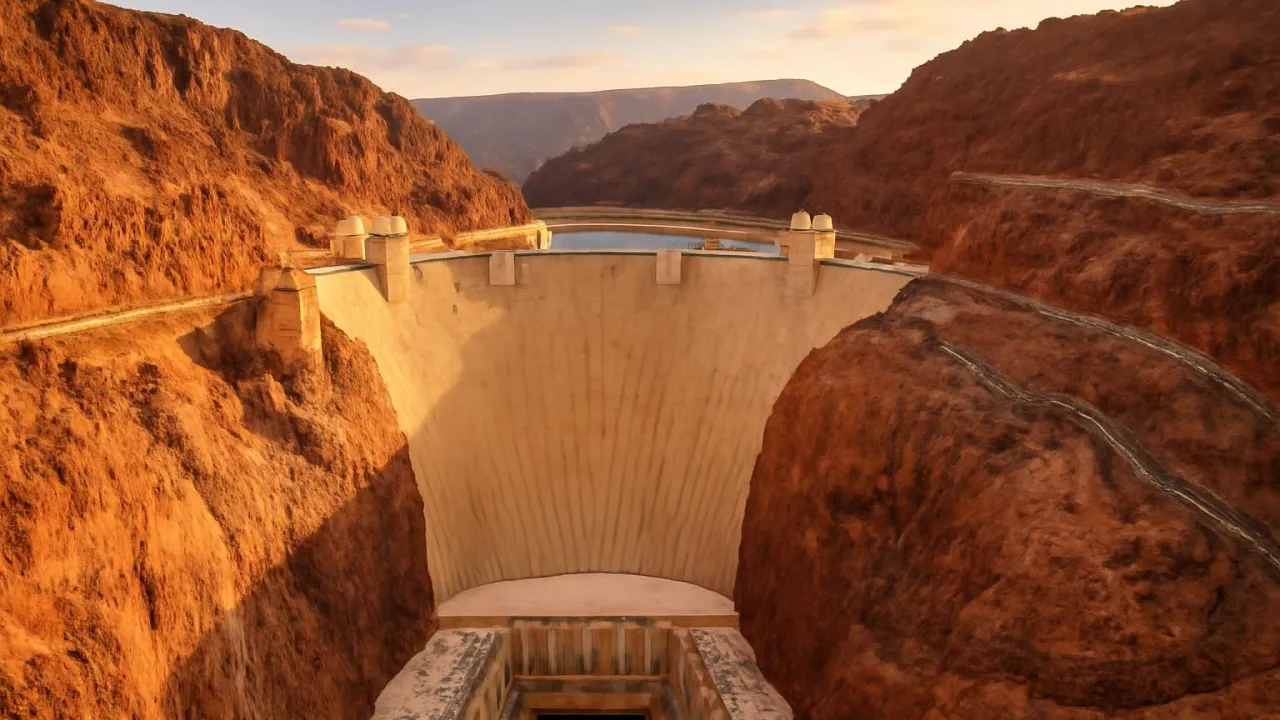
Hoover Dam can hold back enough water to fill 9 trillion bottles!
✨ Word Sparks (Grade 2 Glossary)
Tap 🔊 to hear
turbine
A machine that spins to make power
concrete
A strong, hard building material
tour
A special visit to learn more
🪝
What would it feel like to stand on top of a giant wall holding back a river?
1
A River Turned Into a Lake
Imagine hearing the Colorado River rushing through a deep canyon. Now picture a huge wall stopping the water and turning it into a giant lake. The dam’s thick keeps the water from flowing away.
2
Making Power with Spinning Turbines
Water rushes through tunnels inside the dam and spins big machines. These machines are called , and they help make electricity. The electricity travels to homes and cities far away.
3
Exploring the Dam Up Close
Many people visit Hoover Dam every year and walk along the top. They look down at the deep canyon and the sparkling water below. Some people take inside the dam to see how it works.
Hoover Dam contains enough concrete to build a highway from San Francisco to New York!
✨ Word Sparks (Grade 3 Glossary)
Tap 🔊 to hear
arch
A curved shape that is strong
penstock
A big pipe carrying water
vibration
A quick shaking or moving
🪝
Imagine hearing the roar of water echoing inside a canyon—how does a dam stop it?
1
A Marvel of Concrete and Steel
Hoover Dam stretches across the Colorado River, forming a huge barrier in Black Canyon. Its thick concrete walls rise higher than most skyscrapers. The dam’s shape helps it push against the powerful water. This design keeps the dam strong and steady.
2
Turning Water into Electricity
Water from Lake Mead flows through giant pipes called . As the water rushes down, it spins turbines deep inside the dam. The spinning turbines create , which helps make electricity. This electricity travels to cities and farms across the region.
3
Why the Dam Was Built
Hoover Dam was built during the Great Depression to control flooding and store water. It also provides irrigation for crops and drinking water for millions. The dam became a monument to American engineering and teamwork.
4
Visiting the Mighty Dam
Visitors walk along the top and peer over the edge at the blue lake. Guided tours show the turbines and tunnels inside. Many people are amazed by the dam’s size and the echoing sound of water below. The dam is a symbol of human ingenuity and power.
Lake Mead, created by Hoover Dam, is the largest reservoir in the United States.
✨ Word Sparks (Grade 4 Glossary)
Tap 🔊 to hear
arch-gravity
A curved, heavy wall that holds water
generator
A machine that makes electricity
innovation
A new idea or way to do things
🪝
What if you could walk inside a dam as it holds back a roaring river—how would it feel?
1
Engineering a Giant Barrier
Hoover Dam was engineered to hold back the powerful Colorado River and create Lake Mead. Its design uses both the curve and the weight of concrete to resist the water’s enormous pressure. Over 3.25 million cubic yards of concrete were poured to build the dam. This massive structure stretches 726 feet high and 1,244 feet across the canyon.
2
How the Dam Generates Power
Water from Lake Mead flows through enormous penstocks, dropping down to turbines in the power plant. As water rushes through, it causes the turbines to spin, creating mechanical energy. This energy is converted into electricity by , then sent to homes and cities across the Southwest. The dam’s acoustic tunnels echo with the sound of rushing water and humming machinery.
3
A Project of Hope and Hard Work
Built during the Great Depression, Hoover Dam provided jobs for thousands of workers and hope for families. The project required careful planning, new construction techniques, and teamwork from people all over the country. The dam now supplies water for farms, cities, and millions of people in the region. It stands as a monument to American determination and .
4
A Landmark for All to Visit
Today, Hoover Dam is a famous landmark visited by millions each year. Visitors can walk along the top, explore the power plant, and learn about the dam’s history in the visitor center. The dam’s sweeping views, roaring water, and towering walls inspire awe and curiosity. It remains a symbol of what people can achieve when they work together.
1. Why was Hoover Dam built during the Great Depression?
2. What happens inside the dam’s tunnels?
🤯 Mind-Blowing Fact • Grade 5
Hoover Dam’s generators have produced enough electricity to power every home in Nevada for over 50 years.
✨ Word Sparks (Grade 5 Glossary)
Tap 🔊 to hear
structural integrity
How strong and safe something is built
megawatt
A unit for measuring lots of electricity
resonance
When vibrations match and grow stronger
🪝
What forces must a dam withstand to hold back billions of gallons of water every day?
1
The Science Behind Hoover Dam’s Strength
Hoover Dam’s arch-gravity design combines two powerful engineering principles: the arch shape transfers water pressure into the canyon walls, while the dam’s immense weight resists the river’s force. The dam contains over 3.25 million cubic yards of concrete, which was poured in interlocking blocks to control heat and prevent cracks. Its base is 660 feet thick—wider than two football fields—tapering to 45 feet at the top. Engineers calculated the pressure from Lake Mead at over 45,000 pounds per square foot near the base, requiring extraordinary .
2
Harnessing Hydroelectric Power on a Massive Scale
Water from Lake Mead enters 30-foot-diameter penstocks, plunging nearly 600 feet to reach the power plant. The kinetic energy of falling water spins 17 massive turbines, each connected to a generator that converts mechanical energy into electrical energy. Hoover Dam’s power plant can produce up to 2,080 , supplying electricity to Nevada, Arizona, and California. The process demonstrates the principles of energy transformation and the importance of in turbine operation.
3
A Historic Feat of Human Ingenuity
Constructed between 1931 and 1936 during the Great Depression, Hoover Dam was one of the largest public works projects in U.S. history. Over 21,000 workers labored in extreme heat, using innovative techniques like refrigeration pipes to cool the concrete. The dam provided vital jobs, stabilized the Colorado River, and enabled the growth of cities such as Las Vegas and Los Angeles. Its completion marked a turning point in American engineering and infrastructure development.
4
Environmental and Social Impacts
Hoover Dam created Lake Mead, the largest reservoir in the United States, storing up to 28.9 million acre-feet of water. This water supports agriculture, provides drinking water for millions, and helps control floods downstream. However, the dam also changed river habitats, affecting fish migration and the natural landscape. Today, scientists and engineers work to balance human needs with environmental protection around the Colorado River basin.
5
A Global Landmark and Learning Destination
Millions of visitors from around the world come to Hoover Dam to marvel at its scale and design. Guided tours reveal the dam’s inner workings, from the echoing generator rooms to the dizzying heights above the river. The dam stands as a testament to human problem-solving, teamwork, and the power of science and engineering. Its legacy continues to inspire new generations to tackle challenges and imagine bold solutions for the future.