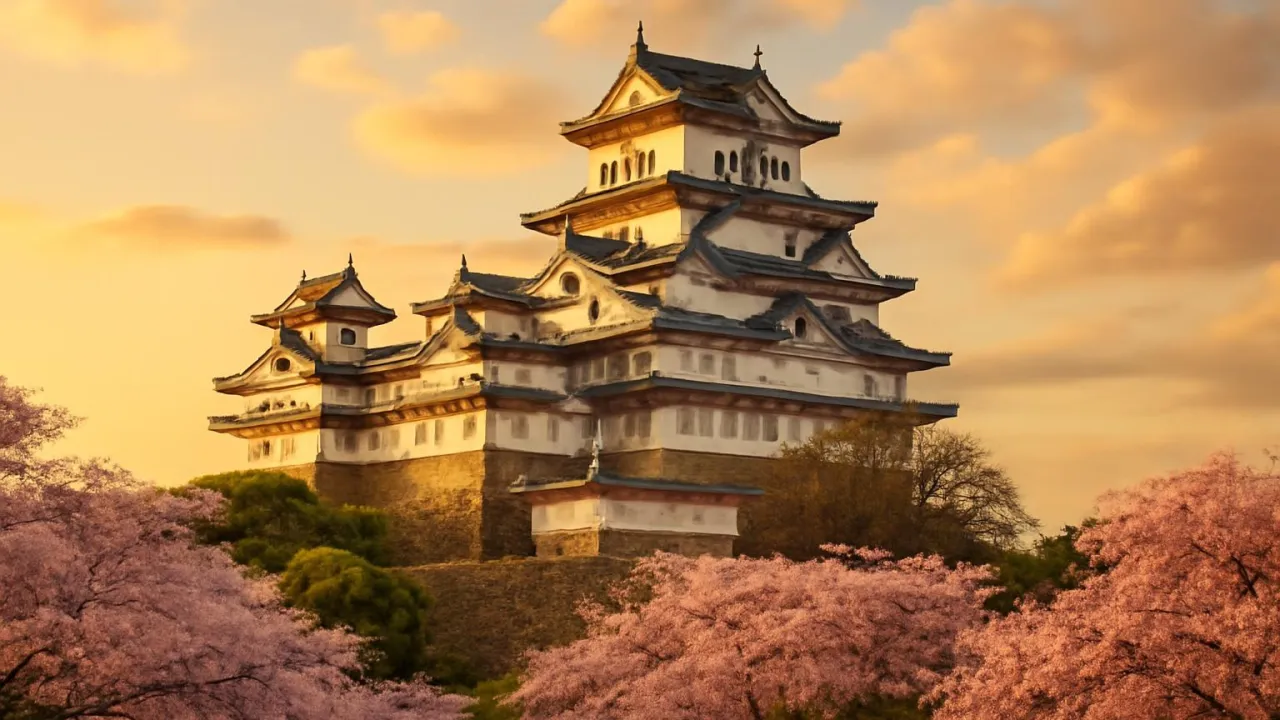
1. Why do people call Himeji Castle the White Heron Castle?
2. What do families see around the castle in spring?
🤯 Mind-Blowing Fact • Grade 2
Himeji Castle has over 1,000 cherry trees that bloom in spring!
✨ Word Sparks (Grade 2 Glossary)
Tap 🔊 to hear
heron
A tall, white bird with long wings
festival
A special party with music and fun
tower
A tall part of a building
🪝
Have you ever walked through a castle with secret paths and towers?
1
A Castle in the Sky
Himeji Castle stands tall on a hill, shining bright with white walls. Its rooftops curve up like a 's wings, making it look ready to fly. People travel from all over to see its beauty and learn its stories.
2
Secret Paths and Tricky Doors
Inside, the castle is full of twisty stairs and hidden doors. The paths are like a maze, built to confuse anyone who tried to sneak in. Visitors love exploring these clever tricks and secret rooms.
3
Blossoms and Festivals
Every spring, cherry blossoms bloom around the castle, turning it pink and white. Families come to take pictures and enjoy . Himeji Castle is a place full of history and fun.
2. What do people celebrate near Himeji Castle in spring?
🤯 Mind-Blowing Fact • Grade 3
Himeji Castle has survived wars, earthquakes, and even bombings without being destroyed!
✨ Word Sparks (Grade 3 Glossary)
Tap 🔊 to hear
plaster
A smooth, white wall covering
corridor
A long hallway or passage
engineer
A person who designs and builds things
🪝
Can you imagine getting lost in a real-life castle maze?
1
The White Heron on the Hill
Perched on a hilltop, Himeji Castle gleams with bright white walls. Its layered rooftops curve upward, resembling the wings of a heron in flight. This beautiful castle is famous across Japan for its elegant design. Visitors come from around the world to see its dazzling shape.
2
A Fortress Full of Secrets
Inside, Himeji Castle is a maze of twisting and steep wooden stairs. The architects designed it with clever traps and hidden doors to protect against attacks. These maze-like defenses made it difficult for intruders to find their way. Exploring the castle feels like solving a real-life puzzle.
3
Built to Last for Centuries
Himeji Castle was first built in the 1300s and rebuilt stronger in the 1600s. Its thick wooden beams and stone foundations help it survive earthquakes and fires. The white covering the walls is fire-resistant, protecting the wooden structure inside. This smart engineering has helped the castle stand for hundreds of years.
4
A Place of Beauty and Celebration
Every spring, over a thousand cherry trees bloom around the castle grounds. Families gather for hanami, or flower-viewing picnics, under the pink blossoms. The castle is also a UNESCO World Heritage Site, honored for its history and design. Himeji Castle is a symbol of Japanese culture and joyful celebrations.
Himeji Castle’s main keep stands 151 feet (46 meters) tall and has six floors inside!
✨ Word Sparks (Grade 4 Glossary)
Tap 🔊 to hear
resilience
The ability to stay strong and recover
feudal
A time when lords ruled the land
foundation
The strong base that holds up a building
🪝
What secrets would you find if you explored a castle built to trick invaders?
1
A Castle That Looks Ready to Fly
Himeji Castle stands high above the city, its brilliant white walls sparkling in the sun. The castle’s layered rooftops curve gracefully, giving it the nickname 'White Heron Castle' because it looks like a bird about to take flight. Built during the early 1600s, it is the largest and most complete surviving example of Japanese castle architecture. Today, it is a national treasure and a UNESCO World Heritage Site, admired for both its beauty and its clever design.
2
Ingenious Defenses and Engineering
The castle’s layout is a masterpiece of defensive engineering, designed to confuse and slow down attackers. Narrow, winding corridors force invaders to take confusing paths, while steep wooden stairs make it hard to rush upward. The white plaster coating is not just for beauty—it protects the wooden structure from fire and weather. Massive stone and thick wooden beams help the castle survive Japan’s frequent earthquakes.
3
A Fortress That Survived the Centuries
Himeji Castle has withstood centuries of wars, natural disasters, and even World War II bombings without being destroyed. Its survival is thanks to its strong construction and smart engineering. The castle complex includes 83 buildings, each with unique defensive features like hidden rooms and angled gates. These features made it nearly impossible for enemies to capture the main keep.
4
A Living Symbol of Japanese Culture
Every spring, over a thousand cherry trees blossom around the castle, turning the grounds into a sea of pink. Families and tourists gather for hanami, a traditional celebration of nature’s beauty. Himeji Castle is not just a monument of the past—it is a living symbol of Japanese culture, architecture, and that continues to inspire people today.
1. How did Himeji Castle’s design help protect it from attacks?
2. Why is Himeji Castle called a symbol of resilience?
🤯 Mind-Blowing Fact • Grade 5
During a major 2010–2015 restoration, engineers used 80,000 roof tiles and over 200 tons of plaster to preserve Himeji Castle’s brilliant white appearance.
✨ Word Sparks (Grade 5 Glossary)
Tap 🔊 to hear
tenshu
The main tower or central keep of a castle
slaked lime
A powder mixed with water to make plaster
joinery
The way wooden pieces fit together
🪝
What if you could decode the secrets of a castle that has outsmarted centuries of enemies and disasters?
1
The White Heron: Form and Symbolism
As sunlight glints off its dazzling white plaster, Himeji Castle appears to soar above the city like a heron in flight. This iconic fortress, built in the early 17th century, is renowned for its elegant layered roofs, which curve upward to resemble the wings and tail feathers of a bird. The castle’s symbolic design reflects both Japanese artistic ideals and the strategic importance of psychological intimidation. Its visibility from miles away reminded both allies and would-be invaders of the lord’s power and vigilance.
2
Defensive Engineering and Architectural Ingenuity
Himeji Castle’s complex defensive system is a marvel of feudal Japanese engineering. The main keep, or , rises six stories and is constructed atop a 46-foot (14-meter) stone foundation for earthquake resistance. The approach to the keep is intentionally confusing, with a labyrinth of winding paths, angled gates, and dead ends designed to disorient attackers. Defensive features include hidden rooms, loopholes for archers, and steep staircases that slow enemy advances. The white plaster, made from , not only creates a brilliant façade but also provides crucial fire resistance for the wooden interiors.
3
Survival Through Centuries of Upheaval
Unlike many castles, Himeji has survived nearly 700 years of conflict, natural disasters, and modernization. Its resilience is due to both its robust construction and continuous maintenance. During World War II, the city of Himeji was bombed, but the castle miraculously remained unharmed—even an incendiary bomb that landed on the top floor failed to ignite, thanks to the fireproof plaster. Today, Himeji Castle stands as one of only twelve original Japanese castles left intact from the feudal era.
4
Cultural Legacy and World Heritage
Himeji Castle was designated a UNESCO World Heritage Site in 1993, recognized for its outstanding universal value and preservation. The castle complex includes 83 buildings, each with unique architectural and defensive features, such as the watari-yagura (connecting towers) and masugata (box-shaped gates). Every spring, the grounds are transformed by over a thousand blooming cherry trees, drawing crowds for hanami festivals and reinforcing the castle’s role as a living cultural symbol.
5
Science, Restoration, and Modern Impact
Preserving Himeji Castle requires advanced conservation science and engineering. Restoration projects use traditional materials and techniques, such as hand-applied plaster and interlocking wooden beams, to maintain historical accuracy. Engineers study the castle’s earthquake-resistant foundations and wooden to inform modern building practices. Himeji Castle not only offers a window into Japan’s past but also inspires architects, engineers, and visitors worldwide with its blend of beauty, resilience, and innovation.