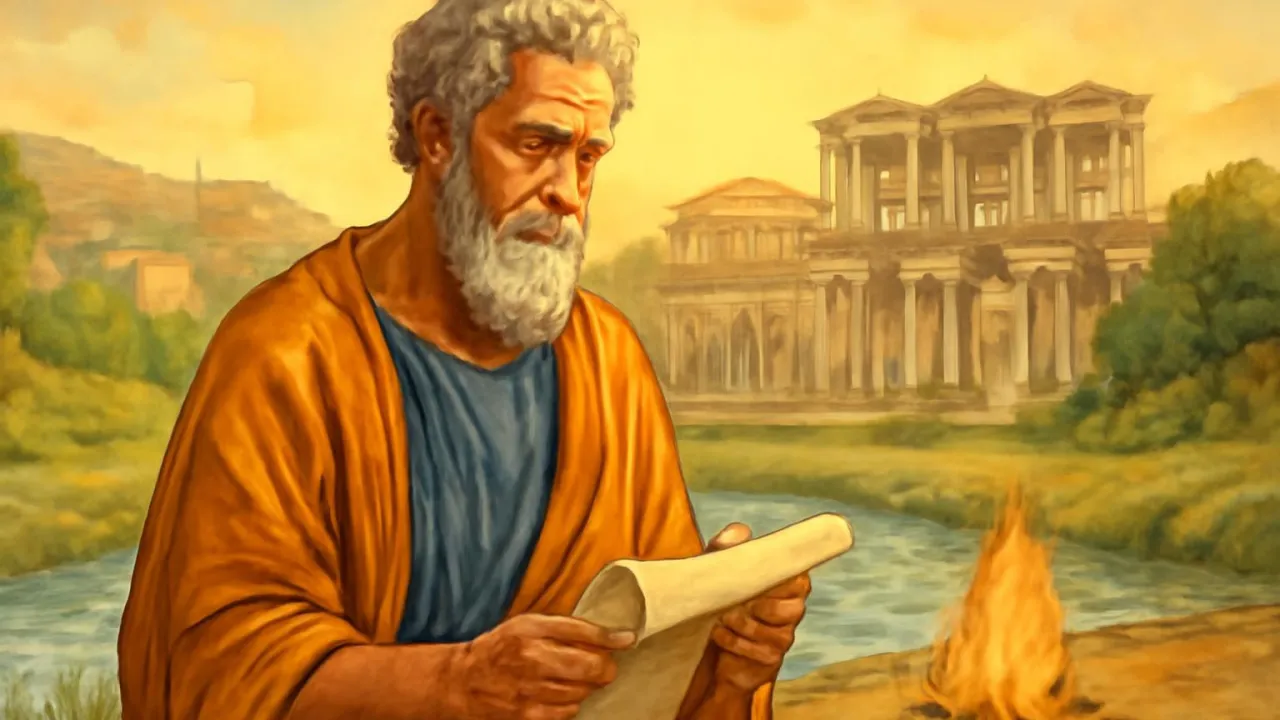
Heraclitus called fire the 'ever-living' because it never stops changing.
✨ Word Sparks (Grade 2 Glossary)
Tap 🔊 to hear
symbol
A thing that stands for something else
scroll
A rolled-up piece of writing
wisdom
Knowing and understanding many things
🪝
What if you could never step in the same river twice?
1
Watching the Water
Heraclitus spent time by the river, watching how the water moved. He noticed that the water was always different, even though the river stayed the same. This made him wonder about the world and how it changes.
2
Thinking About Change
He believed that everything changes, just like the river. Heraclitus said, 'Everything flows,' meaning nothing stays the same forever. He also thought fire was a of change, always moving and never still.
3
Sharing His Wisdom
Heraclitus wrote his ideas on for others to read. People found his thoughts puzzling but interesting, and many wanted to learn from him. His big questions helped people think in new ways about life and nature.
1. What did Heraclitus use as a symbol for change?
2. How did Heraclitus share his ideas?
🤯 Mind-Blowing Fact • Grade 3
Heraclitus’s nickname was 'The Obscure' because his ideas were hard to understand.
✨ Word Sparks (Grade 3 Glossary)
Tap 🔊 to hear
legacy
What someone leaves behind for others
transforming
Changing into something new
opposites
Things that are very different from each other
🪝
Have you ever wondered why the world never stays exactly the same?
1
Curious by the River
As a boy, Heraclitus watched the river near his home in Ephesus. He noticed the water was always moving and never the same twice. This made him curious about the nature of change. He started to ask, 'Why does everything change?'
2
Philosophy of Change
Heraclitus became a philosopher who believed change was the most important part of life. He said, 'Everything flows,' meaning nothing ever stays the same. He used fire as a symbol for this idea, since fire is always burning and . His ideas were different from other thinkers of his time.
3
Writing in Riddles
Heraclitus wrote his thoughts in short, puzzling sentences called riddles. People found his writings mysterious and sometimes hard to understand. He wanted people to think deeply about his words. His ideas made others question what they knew about the world.
4
A Lasting Legacy
Even though he lived long ago, Heraclitus’s ideas are still studied today. Many philosophers after him were inspired by his thoughts about change and . His famous saying about the river is remembered around the world. Heraclitus helped shape the way people think about nature and life.
2. What is Heraclitus’s famous river saying about?
🤯 Mind-Blowing Fact • Grade 4
Heraclitus’s words influenced famous philosophers like Plato and Aristotle, shaping Western thought for centuries.
✨ Word Sparks (Grade 4 Glossary)
Tap 🔊 to hear
unity of opposites
Different things that are connected together
philosophy
The study of big ideas and questions
influence
To have an effect on others
🪝
What if the secret to understanding life was hidden in the way a river flows?
1
The Young Observer
In the bustling city of Ephesus, young Heraclitus spent hours watching the river’s endless movement. He noticed that the water was never the same from one moment to the next, which sparked his lifelong curiosity about change. This simple observation led him to wonder if everything in the world was always shifting. Heraclitus began to believe that change was not just common, but the very nature of life itself.
2
Revolutionary Ideas
Heraclitus grew into a philosopher who challenged the ideas of other thinkers in ancient Greece. He famously declared, 'You cannot step into the same river twice,' using the river as a symbol for constant change. He also believed in the , arguing that things like day and night or hot and cold were connected. Fire became his favorite symbol because it is always active and transforming, just like life.
3
The Obscure Philosopher
Heraclitus wrote his thoughts in short, mysterious statements that made people think hard about their meaning. Because his writing was so puzzling, he earned the nickname 'The Obscure.' His ideas were not always popular during his lifetime, but they forced people to question what they believed about the world. Many later philosophers admired his deep thinking and unique style.
4
A Lasting Impact
Even centuries after his death, Heraclitus’s continues to how people understand change, nature, and even science. His belief that everything is always in motion inspired many other great thinkers. Today, students and scholars still study his writings to explore the mysteries of change and the balance of opposites. Heraclitus’s legacy reminds us to stay curious and open to new ideas.
2. What idea did Heraclitus use the river to explain?
🤯 Mind-Blowing Fact • Grade 5
Heraclitus’s writings survive only in fragments, but his ideas have shaped philosophy and science for over 2,500 years.
✨ Word Sparks (Grade 5 Glossary)
Tap 🔊 to hear
aphorism
A short, wise saying or idea
flux
A state of continuous change
legacy
What someone leaves for the future
🪝
Imagine standing on the banks of a river, realizing that every moment, the world—and even you—are transforming.
1
A Youthful Curiosity by the River
In ancient Ephesus, young Heraclitus spent countless hours observing the ceaseless flow of the local river, captivated by how its waters were never the same twice. This early fascination with movement and transformation sparked a lifelong quest to understand the nature of change. He began to question whether anything in the universe could truly remain unchanged, and his curiosity led him to challenge the traditional beliefs held by his fellow Greeks. Heraclitus’s keen observations became the foundation for his unique philosophical vision.
2
The Philosophy of Flux and Opposites
Heraclitus developed the groundbreaking idea that change, or ',' is the fundamental principle of reality, famously stating, 'Everything flows.' He argued that nothing in existence is permanent, and that the world is made up of processes rather than fixed things. Heraclitus also introduced the concept of the 'unity of opposites,' suggesting that seemingly contradictory forces—such as day and night or life and death—are actually interconnected and essential for balance in the universe. Fire, ever-changing and dynamic, became his central symbol for this philosophy.
3
A Puzzling and Provocative Writer
Heraclitus chose to express his ideas in brief, enigmatic statements known as , which often resembled riddles. His style was so cryptic that he earned the nickname 'The Obscure,' as even other philosophers found his writings difficult to interpret. Unlike many thinkers of his time, Heraclitus did not seek popularity or followers; instead, he challenged people to think deeply and question their assumptions. His work, though sometimes misunderstood, forced readers to confront the complexity and mystery of the world.
4
Influence on Western Thought
Although Heraclitus was not widely celebrated during his lifetime, his revolutionary ideas profoundly influenced later philosophers, including Plato and Aristotle. His belief that everything is in a state of constant change paved the way for new ways of thinking about science, nature, and human experience. The concept of the unity of opposites became a central theme in many philosophical traditions, shaping debates about logic, ethics, and the nature of reality. Heraclitus’s endures in classrooms and scholarly discussions around the world.
5
Why Heraclitus Still Matters
Today, Heraclitus’s philosophy encourages us to embrace change and to see connections between things that seem different or even opposite. His insights remind us that life’s challenges and transformations are natural and necessary parts of growth. By questioning what we take for granted, Heraclitus inspires curiosity and resilience in the face of uncertainty. His river metaphor continues to help people understand that nothing stays the same, and that wisdom comes from observing, questioning, and adapting to the world’s constant flow.