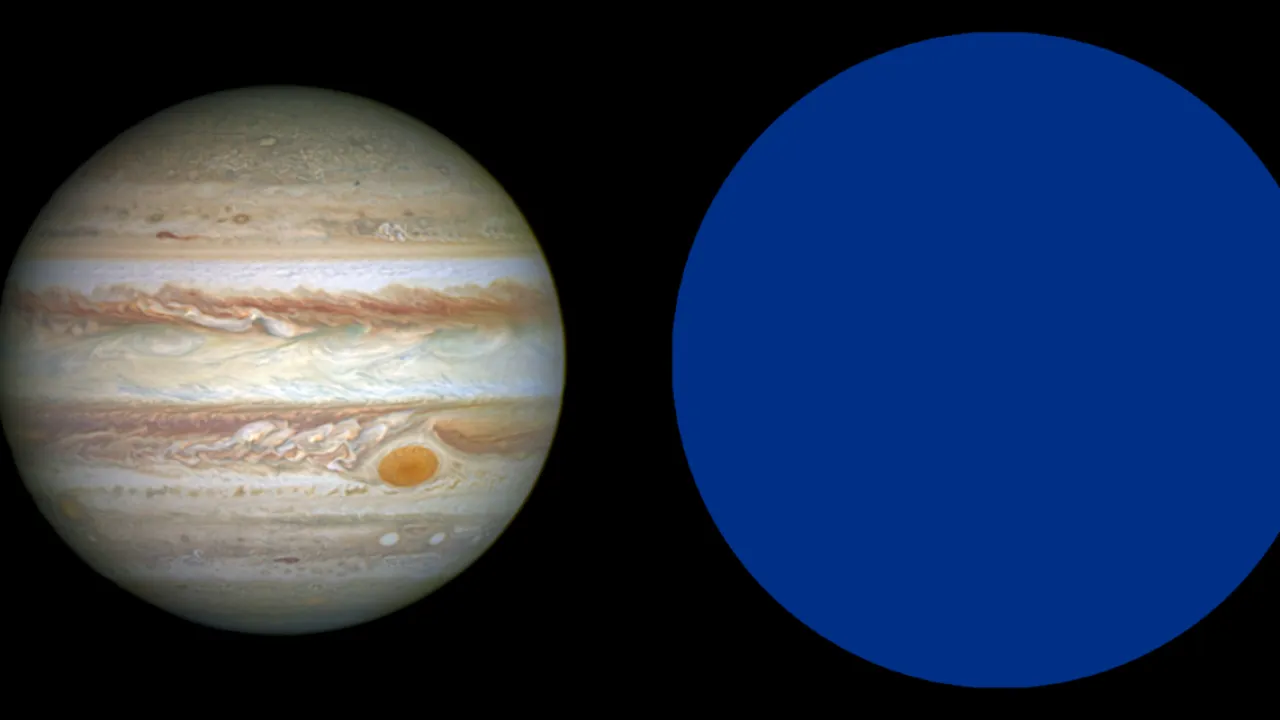
2. Which way does the melted glass rain blow on HD 189733b?
🤯 Mind-Blowing Fact • Grade 2
HD 189733b was the very first exoplanet ever to have its true visible-light color measured by astronomers!
✨ Word Sparks (Grade 2 Glossary)
Tap 🔊 to hear
azure
Bright blue like a clear sky
supersonic
Moving faster than the speed of sound
haze
Misty cloud of tiny floating particles
🪝
Why did Hubble scientists say this pretty blue marble has the wildest weather in space?
1
Not Another Earth
Peer 64.5 light-years away toward the little constellation Vulpecula the Fox. When NASA's Hubble Space Telescope measured the true color of exoplanet HD 189733b, it looked deep blue—just like Earth! Yet this giant world is actually a roasting Hot Jupiter.
2
Clouds of Liquid Glass
Orbiting less than three million miles from its orange star, HD 189733b bakes at 1,700 degrees Fahrenheit! Rock-forming minerals turn into tiny droplets of melted glass high in its hazy clouds, bouncing blue starlight into space.
3
Supersonic Hurricanes
Ferocious winds scream from the planet's hot day side to its dark night side at 5,400 miles per hour—blowing molten glass rain sideways!
2. Which space telescope measured HD 189733b's true cobalt-blue color?
🤯 Mind-Blowing Fact • Grade 3
Because HD 189733b orbits so close to its active orange star, fierce stellar flares boil off more than 100,000 tons of its upper gas atmosphere every single second!
✨ Word Sparks (Grade 3 Glossary)
Tap 🔊 to hear
jet stream
Fast river of wind high overhead
wavelength
Distance between peaks determining light color
hydrogen sulfide
Sulfur gas smelling like rotten eggs
🪝
How can astronomers measure the exact color and wind speed of a planet 64 light-years away?
1
Watching a Planet Hide
Every 2.22 days, the gas giant HD 189733b whips around an orange star in Vulpecula, 64.5 light-years from Earth. In 2013, astronomers used the Hubble Space Telescope to watch the planet duck behind its star. Blue light suddenly dropped while red light stayed steady—proving the planet itself glows cobalt blue!
2
Silicate Sparkle in the Clouds
Earth looks blue because ocean water absorbs red sunlight. HD 189733b looks blue for a completely different reason: its 1,700-degree-Fahrenheit sky is packed with silicate particles—the exact mineral ingredient of glass—that scatter blue .
3
Mapping Alien Weather
NASA's Spitzer Space Telescope even created the first heat map of an exoplanet using HD 189733b! Surprisingly, the hottest spot sat shifted east of noon because 5,400-mph blow scorching air eastward around the globe.
4
Smelly Skies Spotted by Webb
Recently, the James Webb Space Telescope sniffed out in its clouds—giving this wild glass-rain world the smell of rotten eggs!
1. How did Hubble prove HD 189733b is blue without snapping a close-up resolved photo?
2. What smelly gas did the James Webb Space Telescope detect in HD 189733b's atmosphere?
🤯 Mind-Blowing Fact • Grade 4
Even on HD 189733b's permanent dark night side, supersonic winds deliver so much heat that night temperatures still exceed 1,200 degrees Fahrenheit!
✨ Word Sparks (Grade 4 Glossary)
Tap 🔊 to hear
meteorology
Scientific study of atmospheres and weather
Rayleigh scattering
Tiny particles bouncing blue light most
Mach 7
Seven times the local speed of sound
🪝
Why is a scorching Hot Jupiter in Vulpecula considered the Rosetta Stone of exoplanet meteorology?
1
Bright Host Star Advantage
Discovered in 2005 just 64.5 light-years away in Vulpecula, HD 189733b orbits a bright K-type orange dwarf star every 2.22 days at a mere 0.031 astronomical units. Because the planet is slightly wider than Jupiter while its orange star is smaller than our Sun, HD 189733b blocks nearly three percent of the star's light every transit—offering astronomers crystal-clear atmospheric signals.
2
First Exoplanet Thermal Map
In 2007, researchers used NASA's Spitzer Space Telescope to record infrared heat across HD 189733b's entire orbit, constructing history's first weather map of an alien world. Instead of sitting directly beneath the star, the hottest 1,700-degree-Fahrenheit region was blown 30 degrees eastward by ferocious equatorial super-rotating winds screaming at 5,400 miles per hour!
3
Rayleigh Scattering in Molten Silicates
Six years later, Hubble's Space Telescope Imaging Spectrograph tracked reflected visible light vanishing when HD 189733b ducked behind its star during secondary eclipse. Only blue wavelengths dipped sharply while red stayed flat, revealing off micron-sized magnesium-silicate condensates—literally suspended droplets of liquid glass whipped sideways at !
4
Sulfur Chemistry via JWST
In 2024, NASA's James Webb Space Telescope analyzed infrared starlight filtering through the planet's atmospheric rim and detected water vapor, carbon dioxide, carbon monoxide, and smelly hydrogen sulfide—marking the first confirmed hydrogen sulfide detection on any exoplanet outside our Solar System and revealing how giant planets gather icy building blocks.
1. Why was the hottest spot on Spitzer's thermal map of HD 189733b shifted 30 degrees east of noon?
2. Why does HD 189733b create an unusually deep nearly 3% transit dip for telescopes?
🤯 Mind-Blowing Fact • Grade 5
Ground-based spectrographs directly measured the Doppler shift of sodium atoms blowing across HD 189733b's limb during transit—acting like a cosmic police radar gun from 64.5 light-years away!
✨ Word Sparks (Grade 5 Glossary)
Tap 🔊 to hear
albedo
Fraction of incoming light a world reflects
metallicity
Abundance of elements heavier than helium
phase curve
Brightness chart across a planet's full orbit
🪝
How did telescopes turn tiny dips and Doppler shifts from 64.5 light-years away into a 3D portrait of alien winds, color, and chemistry?
1
A Benchmark Transiting Laboratory
Located just 19.8 parsecs (64.5 light-years) away in Vulpecula, HD 189733b orbits an active K1-K2 main-sequence star accompanied by a wide binary M-dwarf companion orbiting roughly 216 astronomical units out. Spanning 1.13 Jupiter radii and 1.16 Jupiter masses in a scorching 2.2185-day orbit (0.031 AU), its rare combination of eighth-magnitude host-star brightness and a deep 2.4-to-3-percent transit signal quickly crowned it the benchmark observatory target for exoplanetary atmospheres.
2
Phase Curves and Equatorial Super-Rotation
Using NASA's Spitzer Space Telescope infrared detector array in 2007, astronomers recorded continuous thermal sweeping from ~970 kelvins on the permanent nightside to ~1,210 kelvins on the dayside, with peak thermal emission offset 16 to 30 degrees east of the substellar point—confirming 3D general circulation models of eastward equatorial super-rotating jets. High-resolution ground-based spectrographs in Chile and La Palma later directly resolved sodium Doppler shifts across the planet's leading and trailing limbs, clocking day-to-night wind velocities at 8,700 kilometers per hour (5,400 mph).
3
Albedo Spectrum and Silicate Condensates
In 2013, Hubble's Space Telescope Imaging Spectrograph measured secondary-eclipse geometric across visible wavelengths, showing a sharp drop in blue light behind the star while red wavelengths stayed flat—proving Rayleigh scattering off high-altitude enstatite and forsterite (magnesium silicate) condensates, or clouds of liquid glass droplets.
4
Atmospheric Escape and X-Ray Evaporation
Repeated Lyman-alpha ultraviolet transits observed by Hubble and X-ray monitoring from Chandra and XMM-Newton also caught giant comet-like plumes of neutral hydrogen boiling off HD 189733b at hundreds of millions of kilograms per second shortly after powerful stellar X-ray flares lashed its upper exosphere.
5
Heavy-Element Enrichment from JWST
In 2024, JWST NIRCam infrared transmission spectroscopy simultaneously pinned down water vapor, carbon dioxide, carbon monoxide, and hydrogen sulfide while ruling out abundant methane, demonstrating an atmospheric enriched three to five times above solar levels—remarkably similar to Jupiter's icy planetesimal enrichment.