1. How did Hayabusa2's little helper robots move across the low-gravity asteroid?
2. Where did the sample capsule parachute safely back to Earth?
🤯 Mind-Blowing Fact • Grade 2
Over 180,000 people from around the world had their names and hopeful messages engraved onto the shiny target markers now resting on asteroid Ryugu!
✨ Word Sparks (Grade 2 Glossary)
Tap 🔊 to hear
reflective
Bouncing light brightly back toward the viewer
boulder
A large chunk of rock on the ground
pellet
A tiny metal ball fired to stir dust
🪝
Why did Japan's asteroid explorer drop shiny silver balls before trying to touch down?
1
Welcome to Asteroid Ryugu
Named after a magical undersea palace in a Japanese folktale, asteroid Ryugu turned out to be covered from pole to pole in jagged black ! Finding a safe spot to touch down looked nearly impossible.
2
Dropping Shiny Target Markers
To guide itself with pinpoint care, the spacecraft dropped silver balls onto the dark rocks. Flashing its lights, it tracked those bright markers to hover within inches of !
3
Touch, Puff, and Fly Home
In one second, its sampler horn tapped the ground, fired a tiny to kick up gravel, caught 5.4 grams of ancient carbon dust, and rocketed home!
1. How did shiny target markers help the spacecraft collect samples safely?
2. How did the sampler horn kick pebbles up into its collection chamber without gravity's help?
🤯 Mind-Blowing Fact • Grade 3
Inside Ryugu's pitch-black grains, scientists found over twenty kinds of amino acids and uracil—one of the four chemical letters in RNA inside every living cell on Earth!
✨ Word Sparks (Grade 3 Glossary)
Tap 🔊 to hear
ion thruster
Super-efficient engine pushing electrically charged gas atoms
subsurface
Material hidden underneath the top layer of ground
RNA
Molecule carrying genetic instructions inside living cells
🪝
How do you dig up buried asteroid rock while hiding safely on the far side of the asteroid?
1
Blue Glow of Ion Engines
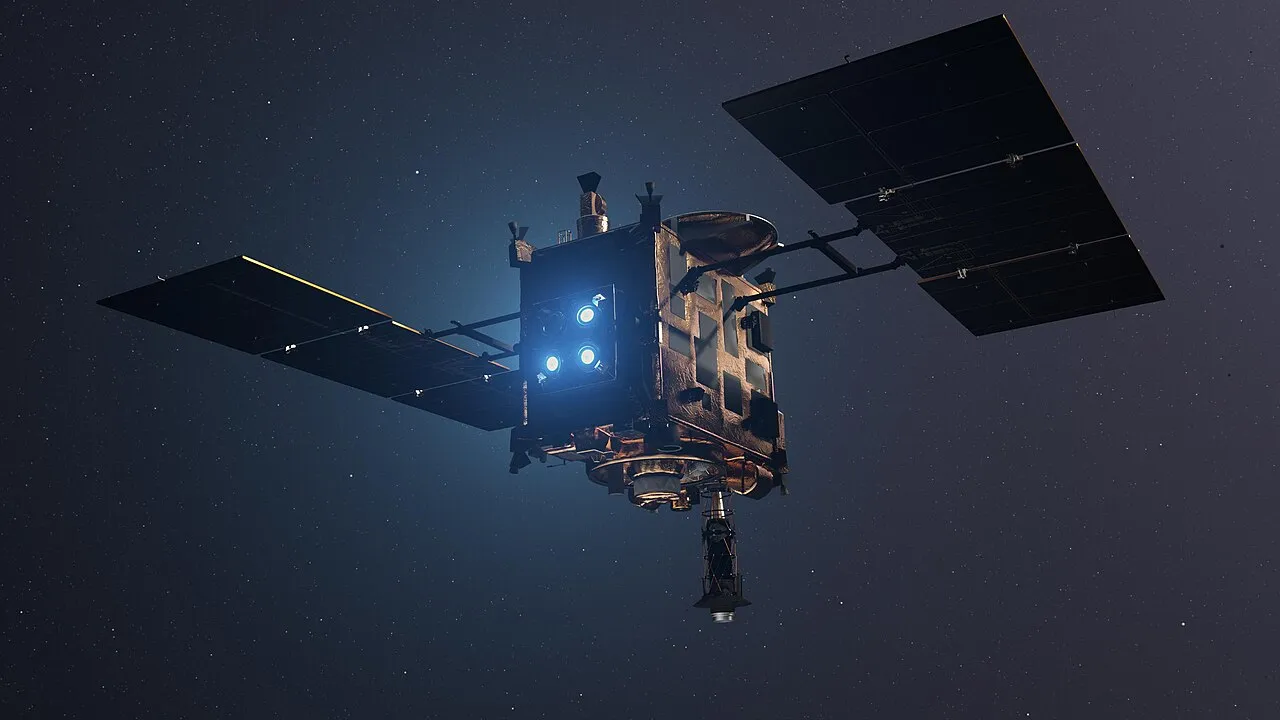
Powered by four electric glowing eerie blue as they pushed xenon atoms into space, JAXA's Hayabusa2 arrived at half-mile-wide asteroid Ryugu in June 2018 after a three-and-a-half-year journey.
2
Hopping Scouts Go First
Before touching down itself, the mothership deployed two cookie-tin-sized MINERVA-II1 rovers and a shoebox-sized European lander named MASCOT. Twisting internal motors sent them hopping fifteen minutes per jump across jagged stones!
3
Blasting an Artificial Crater
Surface rocks get weathered by harsh sunlight, so engineers wanted fresh underground pebbles too. Hayabusa2 released a copper cannonball device, ducked behind the far side of Ryugu for safety while a deployable camera watched the blast, then returned later to scoop untouched grains!
4
Drops of Life's Recipe
After dropping its treasure capsule in Australia in 2020, the thrifty probe still had half its fuel left—zooming off toward another tiny asteroid!
1. Why did Hayabusa2 fly around to the far side of asteroid Ryugu before its copper impactor fired?
2. What did Hayabusa2 do right after dropping off its sample capsule at Earth in December 2020?
🤯 Mind-Blowing Fact • Grade 4
Scientists found tiny droplets of actual carbonated liquid water sealed for billions of years inside microscopic crystals from Ryugu!
✨ Word Sparks (Grade 4 Glossary)
Tap 🔊 to hear
carbonaceous
Rich in ancient carbon, water minerals, and organics
rubble pile
Asteroid loosely held together from shattered rock fragments
contaminate
To spoil pure samples with outside dirt or germs
🪝
Why is fetching five grams of rock directly from space worth billions of times more to science than finding meteorites on Earth?
1
Why Meteorites Aren't Enough
Thousands of meteorites land on Earth each year, yet fiery entry through our atmosphere burns fragile carbon-rich rocks to dust, and Earth rain, air, and soil microbes instantly whatever survives. By sealing samples directly at C-type asteroid 162173 Ryugu inside a vacuum-tight container, JAXA's Hayabusa2 preserved fragile 4.6-billion-year-old minerals exactly as they existed before Earth's continents formed.
2
Rubble Pile Shaped Like a Spinning Top
Close-up mapping revealed Ryugu is not one solid boulder, but a porous ''—countless fragments reassembled by gravity after a parent asteroid shattered long ago, spun into a diamond bulge around its equator by ancient rapid rotation.
3
Two Chambers, Two Depths
During its February 2019 touchdown, Hayabusa2 filled Chamber A with surface gravel stirred up by a five-gram tantalum projectile fired at 670 miles per hour. Next, its Small Carry-on Impactor fired a two-kilogram copper liner at 4,500 miles per hour, carving a forty-eight-foot crater so July's second touchdown could fill Chamber C with shielded subsurface material.
4
Liquid Water and Prebiotic Treasures
Cleanroom labs later discovered over twenty thousand organic molecule varieties, vitamin B3 (niacin), uracil, and microscopic drops of carbonated liquid water still trapped inside ancient salt crystals!
1. Why are spacecraft-returned asteroid grains far more valuable to chemists than meteorites found on the ground?
2. What structure did Hayabusa2 discover asteroid Ryugu actually has inside?
🤯 Mind-Blowing Fact • Grade 5
Isotopic fingerprints inside Ryugu's grains shocked planetary scientists by proving its icy parent body originally formed out in the frigid realm beyond Saturn and Uranus before giant-planet gravity tossed it inward toward Earth!
✨ Word Sparks (Grade 5 Glossary)
Tap 🔊 to hear
chondrite
Primitive stony space rock unchanged since planet formation
ejecta
Curtain of rock and dust blasted out of a crater
retroreflector
Mirror surface bouncing light straight back to its source
🪝
How did Japan turn the near-disaster of its first asteroid mission into a flawless masterclass in autonomous deep-space robotics?
1
Redeeming and Surpassing a Pioneer
When JAXA's original Hayabusa returned microscopic grains from stony asteroid Itokawa in 2010 despite failed thrusters, leaked fuel, and a misfired sampler, Japanese engineers poured every hard-won lesson into Hayabusa2. Launched from Tanegashima in December 2014 with upgraded microwave-discharge xenon ion engines, dual-frequency Ka-band antennas, and four redundant reaction wheels, the 609-kilogram explorer targeted primitive Cg-type near-Earth asteroid 162173 Ryugu.
2
Swarm Exploration in Microgravity
Arriving in June 2018 to find surface gravitational acceleration ten thousand times weaker than Earth's and virtually zero boulder-free flats, Hayabusa2 orchestrated an international robotic fleet. Twin solar-powered MINERVA-II1 hoppers used internal torquers to leap across regolith, while the DLR-CNES MASCOT lander flipped itself upright to record thermal inertia and magnetic measurements—finding Ryugu holds no remnant magnetic field.
3
Ballistic Excavations and Sub-Meter Guidance
Autonomous optical navigation locked onto dropped retroreflective target markers, threading the one-meter sampler horn into a six-meter clearing dubbed Tamatebako on February 21, 2019. Weeks later, the Small Carry-on Impactor detonated 4.5 kilograms of shaped plastic explosive in midair to slam a copper projectile into Ryugu while free-flying camera DCAM3 documented the curtain, enabling a second pristine subsurface touch-and-go on July 11.
4
CI Chondrite Kinship and Solar System Origins
Parachuting into Woomera, Australia on December 6, 2020 with 5.4 grams—fifty-four times its hundred-milligram requirement—Ryugu's dark grains matched rare Ivuna-type CI chemically, proving its icy parent body formed beyond Jupiter before migrating inward.
5
Onward to Rapid Rotator 1998 KY26
Still healthy under mission extension Hayabusa2#, the main spacecraft zipped past asteroid Torifune in 2026 en route to a 2031 rendezvous with 30-meter ultra-fast-spinning asteroid 1998 KY26.