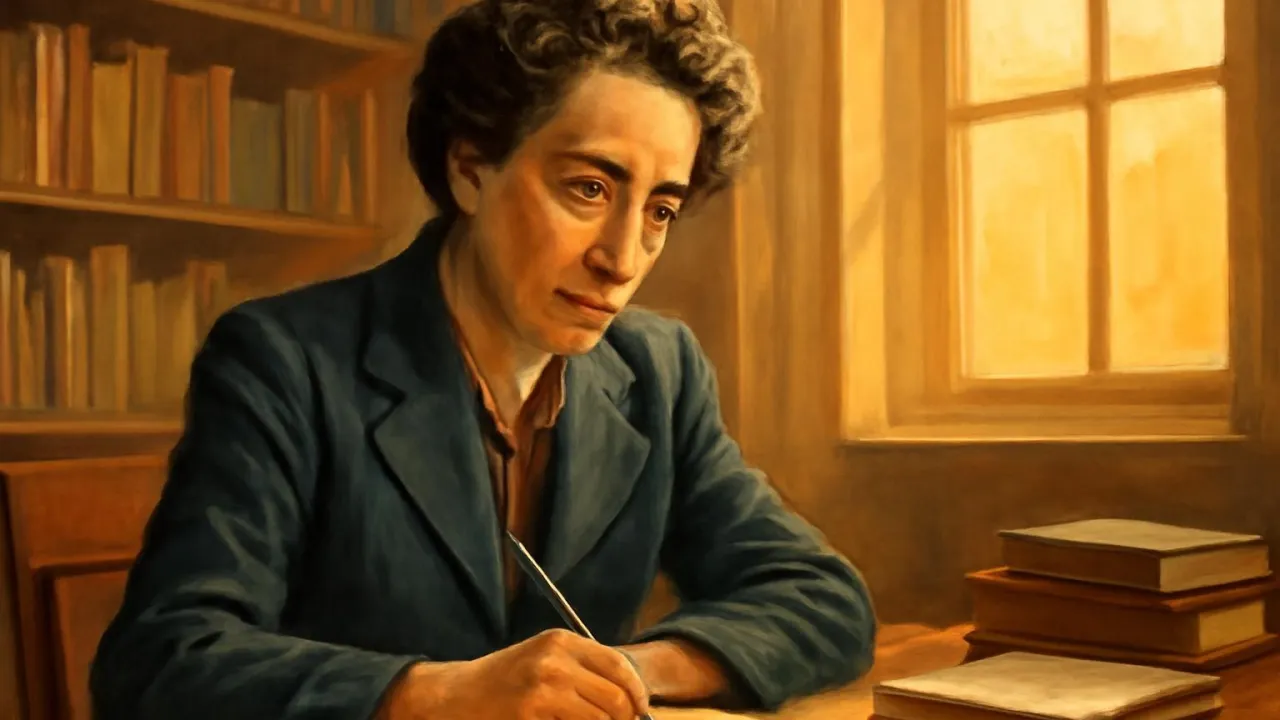
Hannah Arendt could speak and write in German, French, and English!
✨ Word Sparks (Grade 2 Glossary)
Tap 🔊 to hear
curious
Wanting to know and learn more
languages
Different ways people speak and write
history
Stories about what happened before
🪝
What would you write if you wanted to change the world?
1
Curious Hannah
Hannah was a child who loved stories and big questions. She read every book she could find, and she always wondered why people acted in certain ways. Her teachers noticed her smart questions and encouraged her to keep thinking.
2
A Life of Learning
Hannah studied hard in school and learned many , including German and French. She wrote her ideas in a notebook and talked with other thinkers about right and wrong. Even when life was hard, she kept asking important questions.
3
Her Big Achievement
Hannah wrote famous books that helped people understand and choices. Her most famous book, 'The Human Condition,' made people think about how we live together. Today, students all over the world read her words.
Hannah Arendt was the first woman to teach at Princeton University!
✨ Word Sparks (Grade 3 Glossary)
Tap 🔊 to hear
philosopher
Someone who thinks about life’s big questions
justice
Fairness and doing what is right
perseverance
Not giving up, even when it’s hard
🪝
Have you ever wondered what makes people do good or bad things?
1
A Childhood Full of Questions
As a young girl, Hannah Arendt loved to read stories and ask deep questions. She grew up in Germany, where she often wondered why people made certain choices. Her mother encouraged her to be curious and to never stop learning. Hannah’s favorite place was the library, surrounded by books.
2
Facing Hard Times
When Hannah was older, her country changed in scary ways. She had to leave Germany because it was not safe for her. Even in new countries, she kept thinking and writing about freedom and . Her helped her share her ideas with the world.
3
A Philosopher’s Work
Hannah became a , which means she studied big ideas about life and society. She wrote books like 'The Origins of Totalitarianism' and 'The Human Condition.' These books explored how people work together and why it is important to think for ourselves.
4
Changing How We Think
Hannah’s ideas helped people understand history and the power of choices. She believed thinking for yourself is very important. Her work inspired students and leaders all over the world. Today, her books are still read in many schools and universities.
Hannah Arendt created the idea of the 'banality of evil' after watching a famous trial.
✨ Word Sparks (Grade 4 Glossary)
Tap 🔊 to hear
refugee
A person who leaves home for safety
totalitarianism
A government with too much control
legacy
What someone leaves behind for others
🪝
What would you do if you saw something unfair happening around you?
1
Growing Up with Curiosity
Hannah Arendt’s childhood in Germany was filled with books, questions, and lively conversations about the world. Her mother taught her to be independent and to always seek the truth, even when it was difficult. As she grew older, Hannah became deeply interested in understanding why people sometimes chose to do wrong. Her curiosity about human nature led her to study philosophy at university.
2
Escaping Danger and Finding Her Voice
When unfair laws and dangerous leaders took over Germany, Hannah bravely escaped to other countries in Europe and then to the United States. Despite facing many challenges as a , she continued to write and think about freedom, justice, and responsibility. These experiences shaped her belief that everyone must speak up against injustice.
3
Innovative Ideas About Power and Responsibility
Hannah Arendt’s most famous books, 'The Origins of ' and 'The Human Condition,' explored how societies can lose freedom and how people can protect it. She introduced important ideas like the 'banality of evil,' which means that ordinary people can do harm if they stop thinking for themselves. Her work challenged people to reflect on their own choices and actions.
4
A Lasting Global Impact
Arendt became the first woman to teach at Princeton University, inspiring students with her fearless thinking. Her books are still studied around the world by people who want to understand politics, history, and ethics. Hannah’s reminds us that asking questions and standing up for what’s right can change the world.
Hannah Arendt’s books have been translated into over forty languages and are studied worldwide.
✨ Word Sparks (Grade 5 Glossary)
Tap 🔊 to hear
intellectual
A person who uses deep thinking and learning
propaganda
Information spread to shape people’s opinions
political theory
Ideas about how governments and societies work
🪝
How can careful thinking and brave questions help prevent injustice in society?
1
A Childhood of Questions and Books
Hannah Arendt’s early years in Germany were shaped by her mother’s encouragement to question everything and seek understanding. She was a voracious reader, often spending hours in libraries exploring philosophy, literature, and history. Even as a child, Hannah was fascinated by why people made certain choices and how societies could change for better or worse. This curiosity led her to study philosophy at the University of Marburg, where she learned from famous thinkers like Martin Heidegger and Karl Jaspers. Her early education built the foundation for her lifelong commitment to independent thinking.
2
Escaping Oppression and Redefining Freedom
When the Nazi regime rose to power in Germany, Hannah Arendt faced increasing danger as a Jewish . She was arrested for investigating anti-Jewish but managed to escape to France and later to the United States. As a refugee, she experienced firsthand the loss of rights and the importance of freedom. These experiences deeply influenced her philosophical work, especially her focus on totalitarianism, justice, and the responsibilities of individuals in society. Despite facing discrimination and hardship, Arendt continued to write and speak out about the dangers of unchecked power.
3
Groundbreaking Ideas and Major Works
Arendt’s most influential books include 'The Origins of Totalitarianism,' which analyzed how dictatorships rise and threaten freedom, and 'The Human Condition,' which explored the nature of work, action, and political life. She introduced the concept of the 'banality of evil' after covering the trial of Adolf Eichmann, arguing that ordinary people can commit terrible acts when they fail to think critically about their actions. Her writing combined historical analysis, philosophy, and , challenging readers to reflect on their own roles in society.
4
Legacy as a Trailblazing Philosopher
Hannah Arendt became the first woman to teach at Princeton University, breaking barriers for women in academia. Her lectures and books inspired generations of students, scholars, and leaders to value independent thought and moral courage. Arendt’s ideas about responsibility, freedom, and the importance of questioning authority remain central topics in philosophy and political science classes around the world. She showed that philosophy is not just about abstract ideas but about real choices that shape our world.
5
Inspiration for Future Thinkers
Hannah Arendt’s life teaches us that asking difficult questions and thinking for ourselves are essential for a fair and just society. Her work reminds us that everyone has a role in protecting freedom and speaking out against injustice, no matter how ordinary they may seem. Today, her books are read in many languages, and her ideas continue to spark debates about ethics, politics, and human rights. By following Arendt’s example, young thinkers can help build a better, more thoughtful world for everyone.