2. Where can you find gypsum right inside your school or house?
🤯 Mind-Blowing Fact • Grade 2
White Sands National Park in New Mexico is the largest gypsum sand dune field on Earth, covering 275 square miles!
✨ Word Sparks (Grade 2 Glossary)
Tap 🔊 to hear
Desert Rose
Gypsum crystals shaped like blooming flower petals
Plaster
Smooth paste made from heated gypsum powder
Drywall
Flat gypsum boards that build indoor walls
🪝
How can one mineral grow into clear crystal swords, silky threads, and sandy flower petals?
1
Named After the Moon
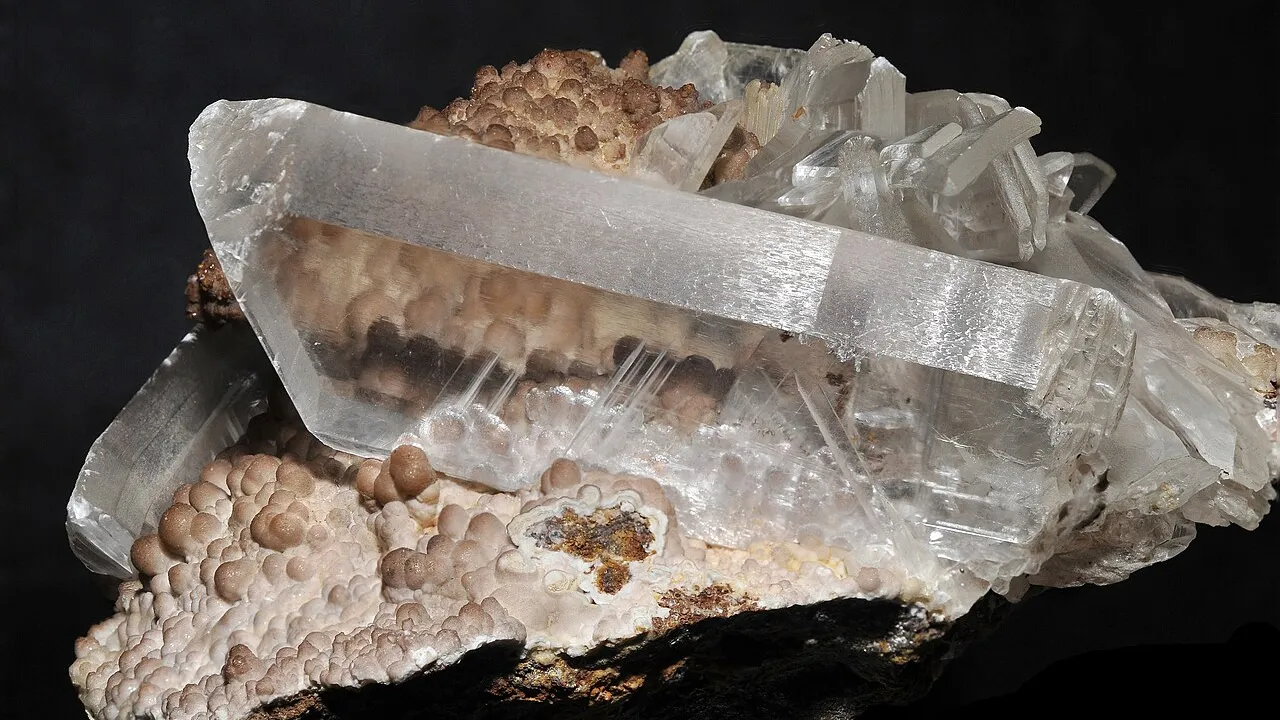
Imagine shining a flashlight through a clear crystal blade that glows like pale moonbeams! Ancient storytellers named these glassy crystals selenite after Selene, the Greek goddess of the moon. Selenite is the clear, sparkling form of a soft mineral called gypsum.
2
Desert Roses and White Sands
Gypsum forms when salty lakes and shallow seas dry up under hot sunshine. In dry deserts, gypsum mixes with sand grains to grow into flower-shaped clusters called . In New Mexico, wind tumbles tiny gypsum crystals into dazzling white dunes.
3
Helpful Every Day
Even though your fingernail can scratch gypsum, it is super useful to builders and doctors. Factories bake gypsum into for broken-bone casts, sidewalk chalk, and sturdy inside millions of buildings.
1. Why did people long ago name clear gypsum crystals 'selenite'?
2. What happens when gypsum crystals grow mixed with desert sand?
🤯 Mind-Blowing Fact • Grade 3
Ancient Egyptian sculptors carved smooth alabaster gypsum into glowing lamps and royal jars more than 4,000 years ago!
✨ Word Sparks (Grade 3 Glossary)
Tap 🔊 to hear
Alabaster
Smooth, fine-grained gypsum used for stone carvings
Satin Spar
Silky, thread-like gypsum that shines like ribbon
Mohs Scale
A 1-to-10 chart comparing mineral scratch hardness
🪝
Why don't the blazing white dunes at White Sands burn your bare feet in summer?
1
One Mineral, Many Disguises
Step into a mineral museum and you might see four rocks that look completely different—yet all four are gypsum! Glassy transparent blades are called selenite. Fibrous silky strands are called . Fine-grained carving stone is , and flat petal clusters are desert roses.
2
Water Trapped in Stone
Gypsum is an evaporite mineral made of calcium, sulfur, oxygen, and water molecules locked right inside its crystal structure. Because gypsum reflects bright sunlight and holds locked-in water, the gypsum dunes at White Sands National Park stay cool to touch even on hot summer afternoons.
3
Number Two on the Hardness Scale
Geologists use gypsum as the official benchmark for level 2 on the Mohs hardness scale. Your human fingernail measures about 2.5, so you can easily leave a scratch mark on a gypsum crystal without using any metal tools.
4
Built-In Fire Protection
That trapped water gives drywall a hidden superpower! If a fire breaks out inside a building, heat turns the water inside gypsum wallboard into cool steam, slowing down flames and giving families extra time to get outside safely.
1. Which substance is locked inside gypsum's crystal structure and helps drywall slow down fires?
2. Which variety of gypsum grows in silky fibers that shimmer like a ribbon?
🤯 Mind-Blowing Fact • Grade 4
Scientists exploring Mexico's Cave of the Crystals had to wear ice-cooled suits and breathing gear because the 99% humidity and 136°F air could overwhelm a human in ten minutes!
✨ Word Sparks (Grade 4 Glossary)
Tap 🔊 to hear
Hydrous
Containing water molecules inside a mineral's crystal
Anhydrite
Calcium sulfate mineral containing zero water molecules
Closed Basin
A valley where water cannot flow to oceans
🪝
How did an underground cavern in Mexico grow crystal beams heavier than five full-grown elephants?
1
The Chemistry of Hydrous Calcium Sulfate
Shine a light across a slab of selenite, and pearly reflections ripple through layers as clear as pond ice. Chemically, gypsum is calcium sulfate (CaSO4·2H2O), meaning every unit of calcium sulfate holds two molecules of water inside its monoclinic crystal lattice. If gypsum is buried deeply or heated strongly, those water molecules escape, transforming soft gypsum into a harder waterless mineral called .
2
Naica's Cave of the Crystals
In 2000, miners pumping water nearly 300 meters beneath Naica Mountain in Chihuahua, Mexico, broke into an extraordinary chamber packed with colossal selenite beams. Heated from below by a deep magma chamber, mineral-rich groundwater stayed steadied near 58°C (136°F) for roughly half a million years. At that exact temperature threshold, sulfur-bearing fluids dissolved and ultra-slowly crystallized giant selenite pillars up to 11 meters (36 feet) long and weighing 55 tons!
3
Why Gypsum Dunes Rarely Exist
Unlike tough quartz beach sand, gypsum dissolves slightly in rainwater, so rivers usually wash dissolved gypsum straight out to sea. New Mexico's Tularosa Basin is a rare with no river outlet to the ocean. Rain and snowmelt wash gypsum down from surrounding mountains into Lake Lucero; when summer sun evaporates the lake, southwest winds shatter fragile selenite crusts into dazzling snow-white sand dunes.
4
Reversible Plaster Chemistry
When factories heat crushed gypsum to about 150°C, three-quarters of its water steams away, creating dry powder called Plaster of Paris. The moment an artist, dentist, or builder stirs water back into that powder, millions of microscopic interlocking gypsum needles re-crystallize and harden into any shape.
1. Why did selenite crystals in Mexico's Naica cave grow to such colossal sizes?
2. Why are gypsum sand dunes much rarer on Earth than quartz sand dunes?
🤯 Mind-Blowing Fact • Grade 5
NASA's Curiosity rover photographed bright white veins of pure calcium sulfate gypsum crisscrossing ancient mudstones inside Mars's Gale Crater, proving groundwater once flowed beneath the Martian surface!
✨ Word Sparks (Grade 5 Glossary)
Tap 🔊 to hear
Calcination
Heating a mineral to drive out trapped water
Monoclinic
A crystal system with one tilted axis
Biosignature
Chemical or fossil clue left by ancient life
🪝
What can gypsum deposits locked on the surface of Mars tell astrobiologists about ancient Martian lakes?
1
Crystal Architecture and Diagnostic Cleavage
Run a fingertip along the flat face of a transparent selenite prism, and you are touching layers held together by delicate hydrogen bonds. Gypsum (CaSO4·2H2O) crystallizes in the system and defines rank 2 on Friedrich Mohs's hardness scale. While calcium and sulfate ions form sturdy sheet-like layers, water molecules sit between those sheets, creating one direction of perfect micaceous cleavage that splits into paper-thin, slightly flexible folia alongside two secondary fracture directions that yield diamond-shaped rhomboidal plates.
2
Marine Evaporites and Sulfuric Speleogenesis
On Earth, thick gypsum beds precipitate when evaporating seawater shrinks to roughly one-fifth of its initial volume—ahead of halite's crystallization point. Yet gypsum also forms inside limestone cave systems like New Mexico's Lechuguilla Cave and Carlsbad Caverns through sulfuric acid speleogenesis. When hydrogen sulfide gas rising from deep petroleum reservoirs meets oxygenated groundwater, it forms sulfuric acid that dissolves calcium carbonate limestone and leaves behind glittering chandeliers and delicate curling gypsum flowers on cave walls.
3
Thermodynamics of the Naica Megacrystals
Beneath Chihuahua's Sierra de Naica, crystallographers measured the slowest crystal growth rates ever recorded in nature—roughly the thickness of a human hair every century! Because groundwater lingered just fractionally below the 58°C anhydrite-to-gypsum transition point, very few crystal nuclei formed. Instead, dissolved calcium and sulfate ions fed the few existing nuclei for 500,000 years, constructing translucent selenite beams 11 meters long. After mining operations ended, engineers allowed the cavern to re-flood with groundwater so those colossal crystals can stay supported and continue growing.
4
Calcination, Agriculture, and Circular Industry
Industrial heats gypsum to 150°C to drive off 75 percent of its structural water, producing calcium sulfate hemihydrate (CaSO4·0.5H2O)—the reactive binder in surgical casts, ceramic molds, and fire-rated drywall. Farmers also spread unheated crushed gypsum across clay-heavy soils; dissolved calcium ions flocculate tight clay particles into crumbly aggregates that absorb rainwater and reduce phosphorus runoff into watersheds.
5
Sulfate Clues Across the Red Planet
Orbiting spectrometers and NASA's Curiosity and Perseverance rovers have discovered bright veins of gypsum and vast sulfate-rich sand dunes near Mars's north polar cap, Olympia Undae. Because gypsum cannot form without liquid water at moderate temperatures, these Martian selenite veins prove that mineral-bearing groundwater once circulated through fractures beneath ancient craters—making Martian gypsum prime targets in the search for preserved .