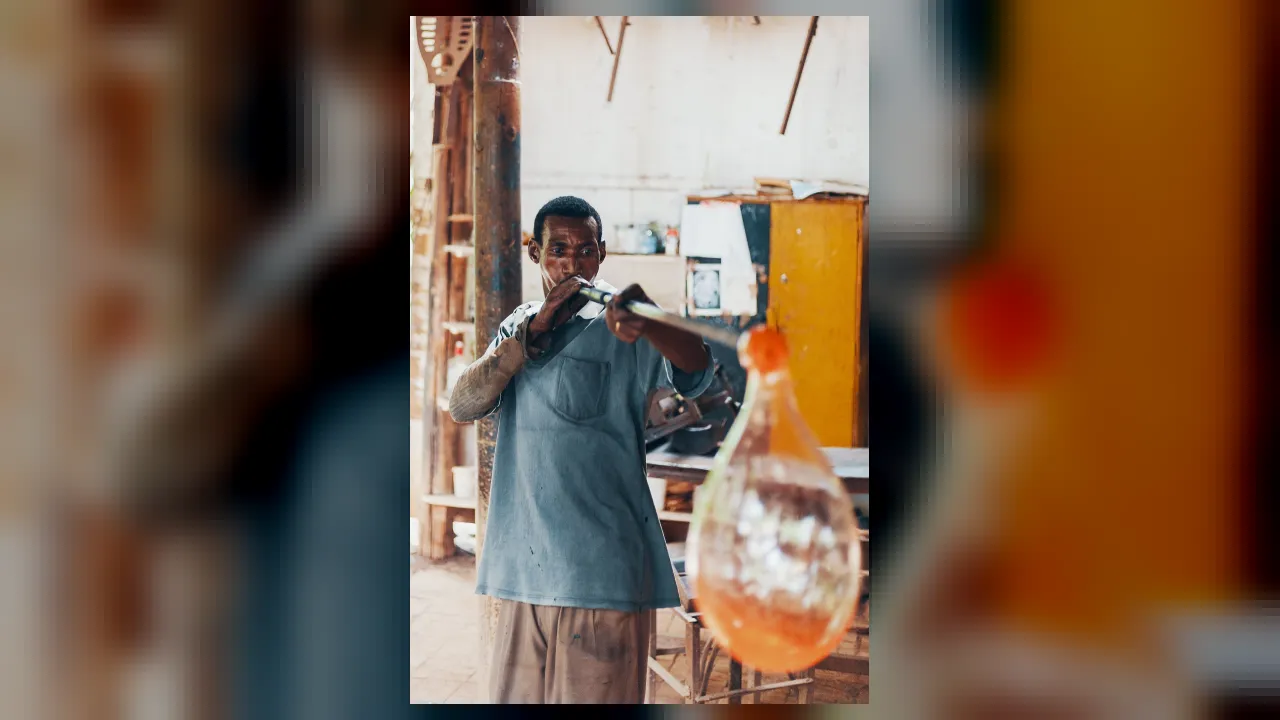
🏢 WorkplaceGlowing glass "hot shops," art studios, and university chemistry-glass workshops
⚡ Everyday Impact SparkGathers molten orange glass as thick as honey on a hollow pipe and breathes shimmering vases and lab flasks to life
🤯 Mind-Blowing Fact • Grade 1
Glassblowers never touch hot glass with their hands—they shape it using wet cherrywood spoons and folded wet newspapers that hiss with steam!
✨ Word Sparks (Grade 1 Glossary)
Tap 🔊 to hear
molten
melted into glowing liquid by intense heat
blowpipe
a long hollow steel tube for blowing glass
furnace
a super-hot brick oven that melts sand
🪝
Did you know hard, clear glass starts out as hot orange goo made from sand?
1
Glowing Like Honey!
Roar! Inside a super-hot oven, melted sand glows bright orange like thick warm honey! A glassblower dips a long metal tube in to gather a glowing blob.
2
Puff Into the Pipe
Puff! Gently blowing air down the hollow pipe swells the hot blob like a soap bubble! Artists spin the pipe nonstop so the soft glass never drips.
3
Sparkling Colors
When it cools down slowly, soft goo turns into hard, rainbow-bright bowls and vases!
1. Why must a glassblower keep spinning the metal pipe while the glass is hot?
2. What everyday beach material melts inside a hot furnace to become glass?
🤯 Mind-Blowing Fact • Grade 2
In 1608 at Jamestown, Virginia, skilled glassblowers built one of the very first workshops and factories anywhere in English North America!
✨ Word Sparks (Grade 2 Glossary)
Tap 🔊 to hear
hot shop
a glassblower's studio filled with glowing furnaces
frit
crushed pebbles of colored glass rolled onto bubbles
jacks
giant tweezer-like metal blades for shaping glass
🪝
Why does a glass vase crack into pieces if you let it cool down too fast on a table?
1
Welcome to the Hot Shop
Step inside a glowing studio called a "," where brick furnaces roar at 2,100 degrees Fahrenheit—hotter than volcanic lava! Turning melted sand into shimmering art is the dazzling craft of a glassblower.
2
Colors From Crushed Minerals
To add swirls of color, artists roll the clear hot bubble across crushed bits of colored glass called . Cobalt mineral makes deep ocean blue, while tiny pinches of real gold create ruby red! Tweezers-like blades called pinch in graceful necks and rims.
3
Cooling Down Gently Overnight
If hot glass cools too fast in room air, it cracks! So every finished piece rests overnight inside a warm oven that cools down degree by degree.
1. Why do glassblowers place finished hot vases inside a special cooling oven overnight?
2. Where in colonial Virginia did early glassblowers set up a glasshouse workshop in 1608?
🤯 Mind-Blowing Fact • Grade 3
On the famous Italian island of Murano near Venice, Renaissance glassmakers moved all their furnaces across the water in 1291 so stray sparks wouldn't set Venice's wooden buildings on fire!
✨ Word Sparks (Grade 3 Glossary)
Tap 🔊 to hear
gaffer
the lead glassblower directing a studio team
annealing
slowly cooling glass in a kiln for strength
punty
a solid metal rod holding a vase's base
🪝
How can holding a wet folded newspaper in your bare hand protect you from 1,800-degree molten glass?
1
Steam Cushions and Teamwork
Watch a glassblower cup a glowing 1,800-degree orb right in their palm using nothing more than ten layers of soaking-wet newspaper! Sizzling water instantly flashes into a thin cushion of steam that blocks the heat while shaping smooth curves without leaving tool scratches.
2
A Choreographed Studio Dance
Large glass sculptures require a synchronized team led by a head artist called the . One partner reheats the piece in a barrel-shaped "glory hole" furnace every two minutes to keep it pliable, while another brings a solid steel rod called a to transfer the vase and open its top lip.
3
Annealing for Strength
Once tapped free, pieces enter a computer-controlled kiln for 12 to 24 hours so outer and inner layers shrink evenly.
4
Scientific Glassblowers in Labs
Not all glassblowers make vases! Scientific glassblowers use tabletop flame torches to craft custom coiled tubes and flasks for chemistry and medicine labs.
1. How does a thick pad of soaking-wet newspaper protect a glassblower's hand?
2. What do scientific glassblowers build for universities and medical researchers?
🤯 Mind-Blowing Fact • Grade 4
To turn clear molten glass a rich cranberry-ruby red, glassmakers mix in tiny trace amounts of 24-karat pure gold—a recipe called Gold Ruby glass!
✨ Word Sparks (Grade 4 Glossary)
Tap 🔊 to hear
silica
pure quartz sand forming the base of glass
flux
a mineral like soda ash lowering melting heat
borosilicate
heat-shock-resistant glass used for science labware
🪝
Why doesn't ordinary beach sand melt in your kitchen oven—and what secret ingredient unlocked 2,000 years of glassblowing?
1
The Chemistry of Melted Sand
Pure quartz sand refuses to melt until temperatures pass a blistering 3,100 degrees Fahrenheit—far too hot for ancient brick ovens! Over two thousand years ago along the Mediterranean coast, craftspeople discovered that mixing soda ash (sodium carbonate) with silica acted as a "," dropping the melting point by nearly a thousand degrees, while adding limestone kept the finished glass from dissolving in water. Every modern glassblower still relies on that three-part chemistry recipe!
2
Jamestown's 1608 Industry
In Virginia history, glassmaking holds a proud distinction: when Polish and German artisans arrived at Jamestown in autumn 1608, they built glass furnaces in the woods using James River sand and potash burned from hardwood trees—producing America's earliest manufactured export shipped back to England.
3
Soft Soda-Lime Versus Tough Borosilicate
Today's glassworkers choose formulas carefully. Hot-shop sculptors blow soda-lime glass because it stays soft and workable longer. Scientific lampworkers, meanwhile, melt glass over 3,000-degree oxygen-propane torches because boron resists thermal shock—allowing a chemistry beaker to go straight from ice to a Bunsen burner without shattering!
4
Safety Shields Against Radiant Heat
Because glowing 2,100-degree furnaces emit invisible infrared waves alongside dazzling sodium-yellow glare, glassblowers wear specialized didymium lenses that protect their eyes.
1. Why do glassmakers mix soda ash (a flux) and limestone into pure silica sand?
2. Why do chemists prefer borosilicate glass flasks made by scientific glassblowers?
🤯 Mind-Blowing Fact • Grade 5
Contrary to an old urban legend, antique cathedral windows are NOT thicker at the bottom because solid glass "flowed" downhill over centuries—medieval glassblowers simply spun flat crown-glass discs that were naturally uneven and set the heavier edge downward for stability!
✨ Word Sparks (Grade 5 Glossary)
Tap 🔊 to hear
amorphous solid
a solid whose atoms stay randomly arranged like liquid
viscosity
how thick and slowly a liquid flows
Leidenfrost effect
a protective vapor layer formed on super-hot surfaces
🪝
What strange state of matter is glass—neither a true crystal nor an ordinary liquid—and how do glassblowers tame its physics?
1
Mastering an Amorphous Solid
Look through a microscope at an ice cube or a grain of table salt and you see atoms locked in neat, repeating geometric rows—a crystal. Cool molten silica past its glass-transition range, however, and its silicon-oxygen molecules freeze in place before they can line up, forming an "" whose disordered atomic structure lets light rays pass straight through transparently! Exploiting that continuous, gradual shift—where glass never snaps instantaneously from liquid to solid like water—is the physical secret of every master glassblower.
2
Two Millennia from Roman Syria to Studio Art
Invented by Syrian and Phoenician artisans along the eastern Mediterranean around 50 BCE, free-hand glassblowing revolutionized civilization by turning rare luxury vessels into everyday storage jars, windowpanes, and optical lenses. In the 1960s, American innovators Harvey Littleton and Dominick Labino engineered compact studio furnaces, sparking the modern Studio Glass Movement championed by visionary sculptors like Dale Chihuly and Lino Tagliapietra.
3
Leidenfrost Physics and Coefficient of Expansion
Every hot-shop maneuver relies on thermodynamics. When a gaffer cups molten glass in wet newspaper or shapes it in soaked fruitwood blocks, the vaporizes water into a low-conductivity steam film. Equally critical is matching the Coefficient of Thermal Expansion (COE) whenever fusing colored canes or murrine patterns: if two glass colors shrink by even tiny differing fractions inside the 900°F annealing lehr, internal tensile stresses will cleave the sculpture apart.
4
Scientific Glassblowing on the Frontier of Discovery
From Thomas Edison's vacuum lightbulbs and X-ray tubes to custom cryogenic distillation columns and laser cavities in modern physics universities, scientific glassblowers fuse quartz and borosilicate tubing within tenths of a millimeter—building bespoke apparatus no 3D printer or metal lathe can replicate.
5
Breath, Gravity, and Centrifugal Grace
Balancing gravity's pull against centrifugal spin and human breath, glassblowers transform Earth's humblest sand into luminous art and instruments of scientific discovery.