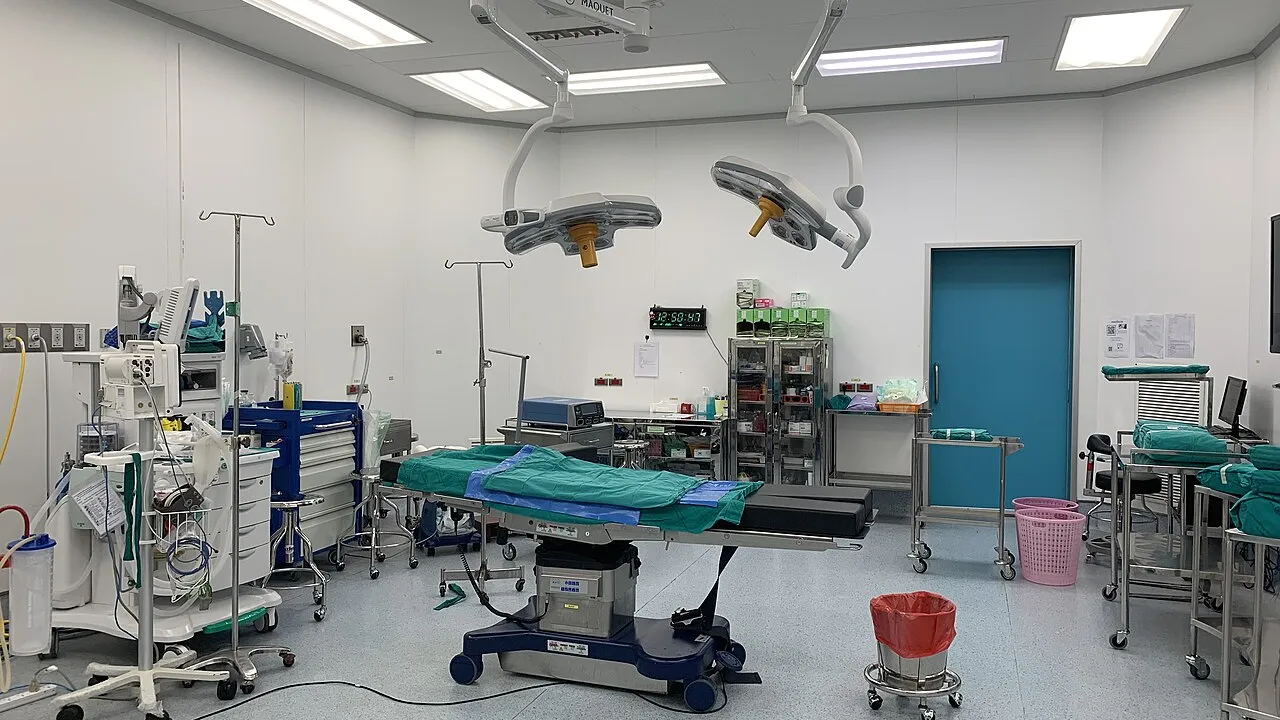
1. Why do surgeons scrub their hands and wear masks, gowns, and sterile gloves?
2. Does a surgeon work all alone in the operating room, or with a team?
🤯 Mind-Blowing Fact • Grade 2
Special operating room lamps use dozens of angled LED beams so the surgeon's hands and head never cast a shadow on the work area!
✨ Word Sparks (Grade 2 Glossary)
Tap 🔊 to hear
anesthesia
Medicine letting patients sleep pain-free during surgery
suture
Special medical thread used for stitches
appendix
Small pouch near the large intestine
🪝
What happens behind the double doors of a hospital operating room?
1
Preparing for Surgery
Step beneath the bright, shadow-free lamps of a hospital operating room! Before any surgery begins, the team double-checks X-rays and scans so everyone knows the exact game plan. An anesthesiologist gives special medicine so the patient sleeps peacefully without feeling a thing.
2
Tiny Tools and Cameras
With super-steady hands, a surgeon might remove an inflamed , set a fractured arm bone, or repair a tiny heart valve. Many modern operations use slender tubes with tiny lighted cameras so patients heal faster.
3
Checking on Recovery
After closing the skin neatly with dissolvable stitches, the surgeon visits the recovery room to cheer on healing!
1. Why don't operating room ceiling lights make dark shadows when a surgeon leans forward?
2. What is the special medical name for the thread surgeons use to stitch tissue together?
🤯 Mind-Blowing Fact • Grade 3
Robotic surgical arms do not operate by themselves—a human surgeon guides every single movement, and the robot scales motions down so a one-inch hand move becomes a tiny fraction-of-an-inch tool move!
✨ Word Sparks (Grade 3 Glossary)
Tap 🔊 to hear
incision
Small, precise opening made during surgery
laparoscope
Thin tube with camera for surgery
orthopedic
Medical specialty focused on bones and joints
🪝
How do modern surgeons steer robotic arms and fiber-optic cameras to repair organs without large cuts?
1
Inside the Operating Theater
Beep, beep, beep hums the heart monitor inside a sterile operating room, where air filters scrub away dust and microscopic bacteria. At the table stands a focused team: the surgeon, surgical nurses, a surgical technologist passing sterilized instruments, and an anesthesiologist monitoring breathing and comfort.
2
Minimally Invasive Marvels
Instead of making long , surgeons often perform laparoscopic surgery. They slide a thin fiber-optic camera and micro-tools through keyhole openings, watching a magnified high-definition screen while repairing tissue with millimeter accuracy. Some surgeons even sit at a console steering multi-wristed robotic arms that filter out the tiniest hand tremor!
3
Many Kinds of Surgeons
surgeons mend bones and joints, neurosurgeons protect the brain and spine, cardiothoracic surgeons repair hearts and lungs, and pediatric surgeons operate on newborns and kids.
4
A Long Road of Practice
Surgeons complete college, four years of medical school, and five to seven years of surgical residency practicing thousands of procedures.
1. Who controls the movements of a surgical robot during an operation?
2. Which type of surgeon specializes in repairing broken bones, ligaments, and joints?
🤯 Mind-Blowing Fact • Grade 4
Operating rooms use 'positive air pressure,' meaning air gently rushes outward whenever the door opens so hallway dust and germs can never float inward!
✨ Word Sparks (Grade 4 Glossary)
Tap 🔊 to hear
antisepsis
Destroying harmful germs to prevent infection
loupes
Magnifying glasses worn by precision surgeons
trauma
Sudden serious injury needing immediate care
🪝
How did two nineteenth-century breakthroughs—anesthesia and antisepsis—transform surgery from a last resort into modern lifesaving science?
1
Two Discoveries That Changed Medicine
Before the 1840s, surgery was terrifyingly painful and risky because doctors did not yet know about anesthesia or invisible germs! Everything changed after 1846, when Boston doctors demonstrated painless anesthesia, and the 1860s, when British surgeon Joseph Lister applied Louis Pasteur's germ theory by sterilizing surgical tools and dressings—dramatically slashing infection rates.
2
Pioneers of Modern Operations
Trailblazers kept pushing boundaries: in 1893 in Chicago, Dr. Daniel Hale Williams performed one of the world's first successful open-heart repairs on a pericardium wound, and in the 1940s surgeon Alfred Blalock, cardiologist Helen Taussig, and laboratory surgical innovator Vivien Thomas teamed up to pioneer lifesaving pediatric heart surgery.
3
Precision Tools of Today's OR
Modern surgeons study 3D CT and MRI scans before making a single incision. Inside positive-pressure operating suites—where clean filtered air flows outward whenever a door opens—they use magnifying , ultrasonic scalpels that seal tiny blood vessels instantly, endoscopic cameras, and computer-assisted robotic instruments.
4
Calm Focus Under Pressure
Whether reconstructing a torn knee ligament in a scheduled clinic procedure or stopping internal bleeding in a midnight center, surgeons combine deep three-dimensional anatomy knowledge, hand-eye coordination, checklists, and calm leadership.
1. How did British surgeon Joseph Lister make operations dramatically safer in the 1860s?
2. Why are modern hospital operating rooms engineered with positive air pressure?
🤯 Mind-Blowing Fact • Grade 5
Microsurgeons repairing tiny nerves and blood vessels inside fingers or eyes use specialized suture needles and threads so fine—less than twenty-five micrometers thick—that they are nearly invisible without a surgical microscope!
✨ Word Sparks (Grade 5 Glossary)
Tap 🔊 to hear
asepsis
Complete absence of disease-causing microorganisms
microvascular
Involving the body's tiniest blood vessels
ergonomic
Designed for comfortable, efficient human movement
🪝
What scientific knowledge, team safety protocols, and thirteen-plus years of training prepare a surgeon to repair microscopic blood vessels or transplant a human organ?
1
Anatomy in Three Living Dimensions
Peer through a pair of 3.5x prismatic surgical loupes as a surgeon sutures together a blood vessel just one millimeter wide using nylon thread thinner than a human eyelash! Unlike textbook diagrams printed in tidy colors, living human anatomy pulses and shifts with every heartbeat and breath. Surgeons master three-dimensional spatial anatomy, pathology, fluid balance, and tissue healing so they can repair congenital heart defects, excise tumors cleanly, reconstruct shattered joints, or transplant donor kidneys, livers, and hearts.
2
Safety Checklists and Sterile Engineering
Every modern operation follows the World Health Organization Surgical Safety Checklist, beginning with a spoken 'Time-Out' where the attending surgeon, anesthesiologist, circulating nurse, and scrub technologist verify the patient's identity, imaging, antibiotic prophylaxis, and exact surgical site—modeled directly on aviation cockpit checklists. HEPA-filtered laminar airflow exchanges operating-room air twenty times per hour under positive pressure, maintaining strict inherited from nineteenth-century pioneers Ignaz Semmelweis and Joseph Lister.
3
From Open Incisions to Image-Guided Robotics
Surgical engineering has steadily minimized tissue disruption. Laparoscopic, thoracoscopic, and arthroscopic techniques pass high-definition fiber-optic cameras and articulated forceps through five-millimeter ports, reducing recovery times from weeks to days. Neurosurgeons pair intraoperative MRI navigation with stereotactic frames accurate to sub-millimeter coordinates, while robotic-assisted platforms translate a surgeon's hand motions at an console into tremor-filtered micro-movements deep inside tight anatomical spaces.
4
Training One of Medicine's Longest Pathways
Becoming a board-certified surgeon demands extraordinary stamina and lifelong study: four years of undergraduate pre-medical science, four years of medical school (M.D. or D.O.), and five to seven years of general or specialized surgical residency—often followed by one to three additional fellowship years in fields like pediatric surgery, transplant surgery, cardiothoracic surgery, or plastic reconstructive surgery.
5
Judgment Beyond the Scalpel
Experienced surgeons often share a famous clinical proverb: 'A good surgeon knows how to operate; a better surgeon knows when to operate; and the best surgeon knows when non-surgical care will heal the patient even more safely.'