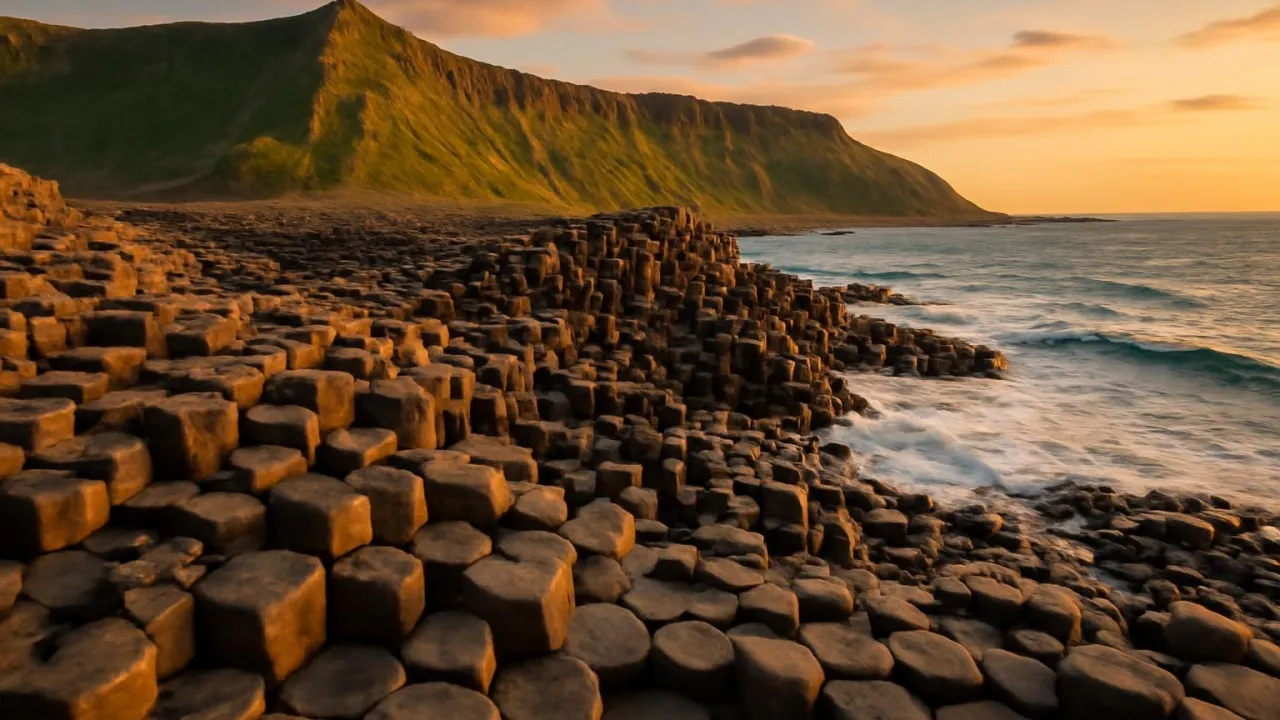
There are about 40,000 stone columns at Giant’s Causeway!
✨ Word Sparks (Grade 2 Glossary)
Tap 🔊 to hear
volcano
A mountain that can erupt hot lava
hexagon
A shape with six sides
erupt
To burst out suddenly
🪝
Have you ever seen rocks that look like giant puzzle pieces?
1
Nature’s Stone Puzzle
Giant's Causeway is made of thousands of stone columns. These rocks fit together like a big puzzle. Many people think they look like giant steps.
2
From Fire to Stone
Long ago, hot lava poured out from and cooled quickly. When the lava cooled, it cracked into neat shapes. Most columns have six sides, which is called a .
3
A Place for Adventure
People visit to climb, explore, and look at the sea. The rocks are fun to walk on, but they can be slippery. The sound of waves makes the place feel magical.
The tallest basalt column at Giant’s Causeway stands about 39 feet (12 meters) high!
✨ Word Sparks (Grade 3 Glossary)
Tap 🔊 to hear
basalt
A hard, dark rock from cooled lava
erosion
Wearing away by wind or water
column
A tall, straight shape like a post
🪝
Can you imagine walking across a path built by ancient volcanoes?
1
A Rocky Wonder by the Sea
Giant’s Causeway stretches along the wild coast of Northern Ireland. The area is famous for its thousands of tightly packed . These columns look like stepping stones leading into the ocean. Visitors love to explore the unique shapes and listen to the crashing waves.
2
How Lava Made the Columns
About 50 million years ago, volcanoes erupted and lava flowed across the land. As the lava cooled, it shrank and cracked into long, hexagonal . This process is called columnar jointing, and it creates the Causeway’s special shapes. Most columns are six-sided, but some have four, five, or even eight sides.
3
Nature’s Puzzle Pieces
The fit together like a giant puzzle, making the ground bumpy and fun to climb. from wind and water shapes the rocks over time. Some columns are as tall as twelve meters, while others are short and stubby. Scientists study the site to learn about volcanic activity and erosion.
4
A Place of Legends
Stories say a giant named Finn built the Causeway to cross the sea. Today, the site is protected as a UNESCO World Heritage Site. People come from all over the world to see its beauty and mystery. The Giant’s Causeway inspires both scientists and storytellers alike.
Columnar jointing also creates hexagonal rocks at Devil’s Tower in the USA and Fingal’s Cave in Scotland.
✨ Word Sparks (Grade 4 Glossary)
Tap 🔊 to hear
columnar jointing
How lava cracks into columns
heritage
Something important from the past
reserve
A protected area for nature
🪝
What secrets do the hexagonal stones of Giant’s Causeway hold beneath your feet?
1
A Volcanic Masterpiece
On the rugged coast of Northern Ireland, Giant’s Causeway sparkles with over 40,000 basalt columns. These tightly packed, mostly hexagonal stones stretch from the cliffs into the Atlantic Ocean, creating a natural staircase. The unique formation draws thousands of visitors each year, all eager to walk across its geometric landscape. The sound of waves crashing against the rocks adds to the magic of the site.
2
The Science of Stone Columns
The Causeway’s columns were formed about 50–60 million years ago during the Paleogene Period. Intense volcanic activity caused molten basalt lava to flow and cool rapidly, leading to contraction and cracking. This process, called , produced the characteristic hexagonal shapes. While most columns have six sides, some display four, five, or even eight sides due to variations in cooling rates.
3
Erosion and Ever-Changing Shapes
Over millions of years, erosion by wind, rain, and sea waves has shaped and smoothed the columns. Some columns tower up to 39 feet (12 meters) high, while others are much shorter. The ongoing erosion continues to change the appearance of the Causeway, revealing new patterns and features. Scientists study these changes to better understand the forces that shape our planet.
4
Legends, Heritage, and Global Fame
According to Irish legend, the giant Finn McCool built the Causeway as a bridge to Scotland. Today, the site is recognized as a UNESCO World Site and a National Nature . Its striking beauty and scientific importance attract tourists, geologists, and storytellers from around the world. Giant’s Causeway remains a symbol of both natural wonder and cultural heritage.
The precise hexagonal shapes at Giant’s Causeway form naturally—no tools or humans shaped them.
✨ Word Sparks (Grade 5 Glossary)
Tap 🔊 to hear
polygonal
Having many sides, like a hexagon
conservation
Protecting nature for the future
geologic
Related to rocks and Earth's history
🪝
What story does each six-sided stone at Giant’s Causeway tell about Earth’s fiery past?
1
An Iconic Geologic Formation
Along the dramatic Antrim coast of Northern Ireland, Giant’s Causeway presents a breathtaking landscape of about 40,000 interlocking basalt columns. These columns, primarily hexagonal, stretch from the foot of steep cliffs into the crashing Atlantic surf, forming a natural wonder that has fascinated scientists and storytellers alike. The site’s geometric regularity and sheer scale make it one of the world’s most remarkable volcanic landforms, inspiring both awe and curiosity in all who visit.
2
Volcanic Origins and Columnar Jointing
Giant’s Causeway was formed during intense volcanic activity approximately 50 to 60 million years ago, in the Paleogene Period. As vast sheets of molten basalt lava erupted and flowed across the landscape, they cooled rapidly upon exposure to air and water. This cooling caused the lava to contract and fracture in a process called columnar jointing, producing the iconic columns. Most columns are hexagonal, but some display four, five, seven, or even eight sides, depending on cooling conditions and the composition of the lava.
3
Erosion: Sculpting the Causeway Over Time
Over millions of years, erosion by relentless Atlantic waves, wind, and rain has sculpted and exposed the basalt columns, gradually altering their shapes and heights. Some columns rise up to 39 feet (12 meters) above sea level, while others form flat stepping stones close to the water’s edge. Erosion continues to reveal new features, such as the famous 'Wishing Chair' and 'Organ Pipes,' and scientists study these changes to better understand Earth’s dynamic surface processes.
4
Cultural Legends and Scientific Significance
Irish mythology claims that the giant Finn McCool built the Causeway as a bridge to Scotland, weaving folklore into the site’s identity. In reality, Giant’s Causeway’s unique geology has made it a UNESCO World Heritage Site and a National Nature Reserve, recognized for its outstanding scientific and educational value. The site attracts geologists, artists, and tourists from around the globe, serving as a living classroom for volcanic processes and Earth history.
5
Global Connections and Conservation
Similar columnar basalt formations are found at Fingal’s Cave in Scotland and Devil’s Tower in the United States, highlighting the global reach of volcanic forces. The Giant’s Causeway is carefully managed for , balancing tourism with the protection of its fragile ecosystem and geological features. Its preservation ensures that future generations can marvel at this ancient record of Earth’s fiery beginnings and the powerful forces that continue to shape our planet.