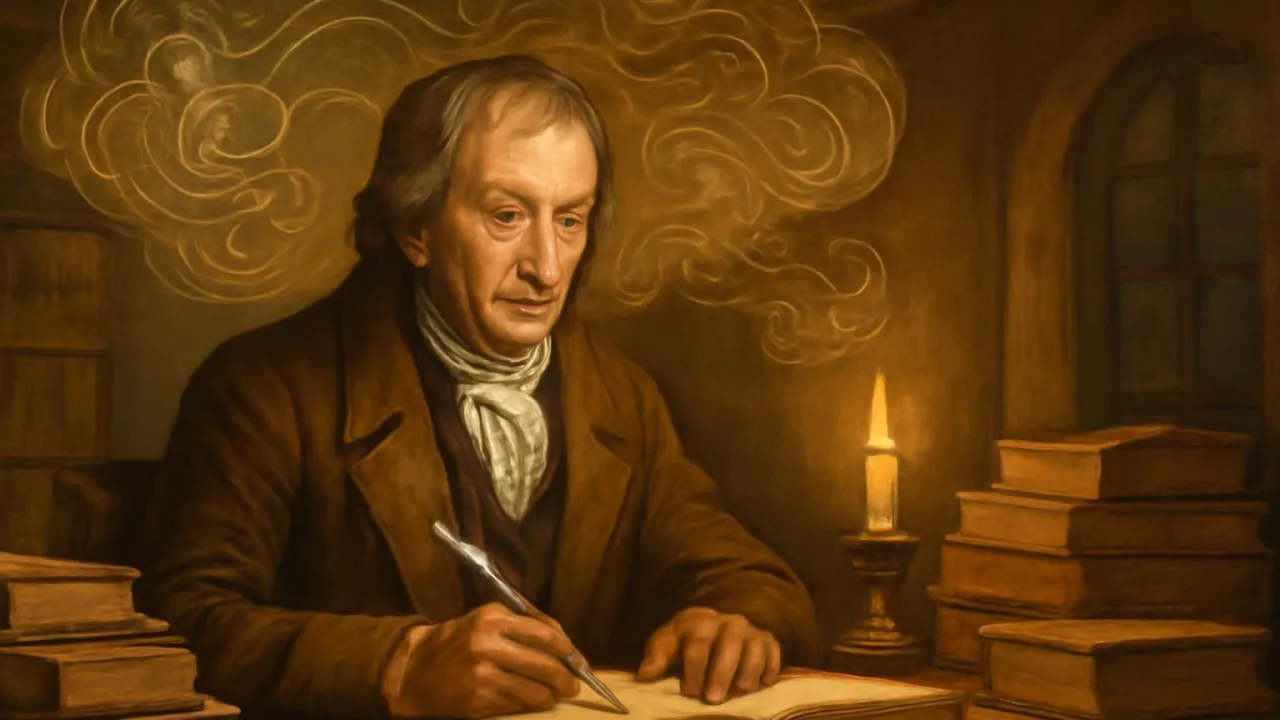
Hegel’s way of thinking helps people debate and learn from each other.
✨ Word Sparks (Grade 2 Glossary)
Tap 🔊 to hear
notebook
A book for writing ideas
history
Stories about the past
method
A way to do something
🪝
What if you could solve puzzles with your mind?
1
Curious Georg
Young Georg loved reading and asking questions about everything he saw. He wondered how people think, learn, and grow every day. He spent hours with books and ideas, filling his mind with new thoughts. Sometimes, he even wrote down questions to ask his family and friends.
2
Growing Up Thinking
Georg studied hard to understand big questions and tricky problems. He wrote his thoughts in many and liked to talk about them with others. He wanted to help people think better and find answers together. Georg believed sharing ideas made everyone a better thinker.
3
A New Way to Solve
He created the dialectic, a special way to solve problems and understand the world. The dialectic uses two different ideas that join together to make a new idea. People use it to understand , solve arguments, and learn about life. Hegel’s helps us see how ideas can grow and change.
Hegel’s dialectic inspired famous thinkers like Karl Marx and shaped modern philosophy.
✨ Word Sparks (Grade 3 Glossary)
Tap 🔊 to hear
debate
A friendly talk about ideas
opposite
Something very different from another thing
society
A group of people living together
🪝
Can asking tough questions change how the world thinks?
1
A Boy Full of Wonder
As a child, Georg always asked why things happened. He read every book he could find in his father’s library. His curiosity made him want to understand people and the world. He dreamed of finding answers to life’s biggest questions.
2
Learning and Growing
Georg worked hard in school and loved to ideas. He studied philosophy, which means thinking deeply about life and knowledge. He often wrote down his thoughts and shared them with friends. These talks helped him shape his own way of thinking.
3
Inventing the Dialectic
Georg created a new method called the dialectic. It means starting with one idea, finding its , and then combining them for a new answer. This way of thinking helps people solve problems and see different sides. Many philosophers still use the dialectic today.
4
Changing How We See History
Hegel believed history moves forward through big changes and new ideas. He taught that people learn from mistakes and improve over time. His ideas helped others understand how societies grow and change. Today, his work shapes how we study history and philosophy.
Hegel’s dialectic method became famous for shaping both philosophy and modern political thought.
✨ Word Sparks (Grade 4 Glossary)
Tap 🔊 to hear
thesis
A main idea or starting point
antithesis
An idea that is the opposite
synthesis
A new idea that combines both
🪝
What happens when you mix two different ideas together?
1
A Young Philosopher’s Curiosity
In the late 1700s, young Georg Wilhelm Friedrich Hegel filled his days with reading and questioning everything around him. He grew up in Germany, where books and learning were very important in his family. Hegel’s curiosity led him to explore philosophy, a field that asks deep questions about life, truth, and society. Even as a boy, he enjoyed writing down his thoughts and discussing them with friends.
2
The Path to New Thinking
As Hegel grew older, he studied at the University of Tübingen, where he met other future philosophers. He loved debating and challenging old ideas, believing that knowledge grows through discussion and disagreement. Hegel wrote many books, sharing his thoughts about how people and societies change over time. His passion for learning helped him become a respected teacher and thinker.
3
The Dialectic: Hegel’s Signature Method
Hegel invented the dialectic, a method of thinking that starts with a main idea, finds its opposite, and then blends them to create something new. This process, called , , and , helps people solve difficult problems by understanding different sides. The dialectic became a powerful tool for studying history, philosophy, and even politics. It encouraged people to see change as a natural part of life.
4
A Lasting Impact on the World
Hegel’s ideas changed the way people study history and society, showing that progress often comes from conflict and new solutions. Many later thinkers, including Karl Marx, used Hegel’s dialectic to build their own theories. Today, Hegel is remembered as one of the most important philosophers of the 1800s. His work still inspires people to ask questions and search for deeper understanding.
Hegel’s dialectic method influenced not only philosophy but also political movements and scientific thinking worldwide.
✨ Word Sparks (Grade 5 Glossary)
Tap 🔊 to hear
phenomenology
The study of how we experience things
critical thinking
Carefully judging and understanding ideas
legacy
What someone leaves behind for others
🪝
How can one person’s way of thinking transform the world’s understanding of history and ideas?
1
Early Curiosity and the Seeds of Philosophy
Imagine a young boy in late 18th-century Germany, surrounded by shelves of books and a mind bursting with questions about the world. Georg Wilhelm Friedrich Hegel’s childhood was filled with curiosity, as he eagerly read everything from ancient myths to the latest scientific discoveries. His family valued education, encouraging him to write his thoughts and debate with friends. This early love for learning set the stage for his lifelong journey into philosophy, where he would challenge old ways of thinking and inspire generations to come.
2
Academic Pursuits and the Power of Conversation
At the University of Tübingen, Hegel formed close friendships with other future philosophers, such as Friedrich Schelling and Friedrich Hölderlin. Together, they spent countless hours discussing philosophy, literature, and the nature of reality. Hegel believed that true understanding comes from dialogue and the clash of different ideas. He wrote detailed notebooks and essays, developing his own theories about how people and societies grow. These university years shaped his belief that progress is made through questioning, debate, and the search for truth.
3
The Dialectic: A Revolutionary Method
Hegel’s most famous contribution to philosophy is the dialectic, a method for understanding how ideas develop and change. The dialectic begins with a thesis (an original idea), then encounters its antithesis (an opposite idea), and finally reaches a synthesis (a new idea that combines both). This process, he argued, drives history and human knowledge forward. Hegel used the dialectic to explain how societies evolve, how conflicts lead to progress, and how people learn from their experiences. His method is still taught in philosophy classes around the world.
4
Influence on History, Politics, and Modern Thought
Hegel’s ideas had a profound impact on many fields, including history, politics, and education. He believed that history moves in stages, each one shaped by struggles and new solutions. His work inspired later philosophers like Karl Marx, who used the dialectic to develop theories about society and economics. Hegel’s books, such as 'The of Spirit' and 'The Philosophy of Right,' remain influential in universities today. His thinking helped people see that change is a natural part of life and that every challenge can lead to growth.
5
A Lasting Legacy of Big Questions
Georg Wilhelm Friedrich Hegel’s lives on in the way people study ideas, solve problems, and understand history. His dialectic method encourages and open-minded discussion, reminding us that even disagreements can lead to new discoveries. Hegel showed that asking 'why' and exploring different perspectives are keys to wisdom. Today, students, teachers, and leaders around the world continue to learn from his bold questions and creative thinking, proving that one person’s curiosity can truly change the world.