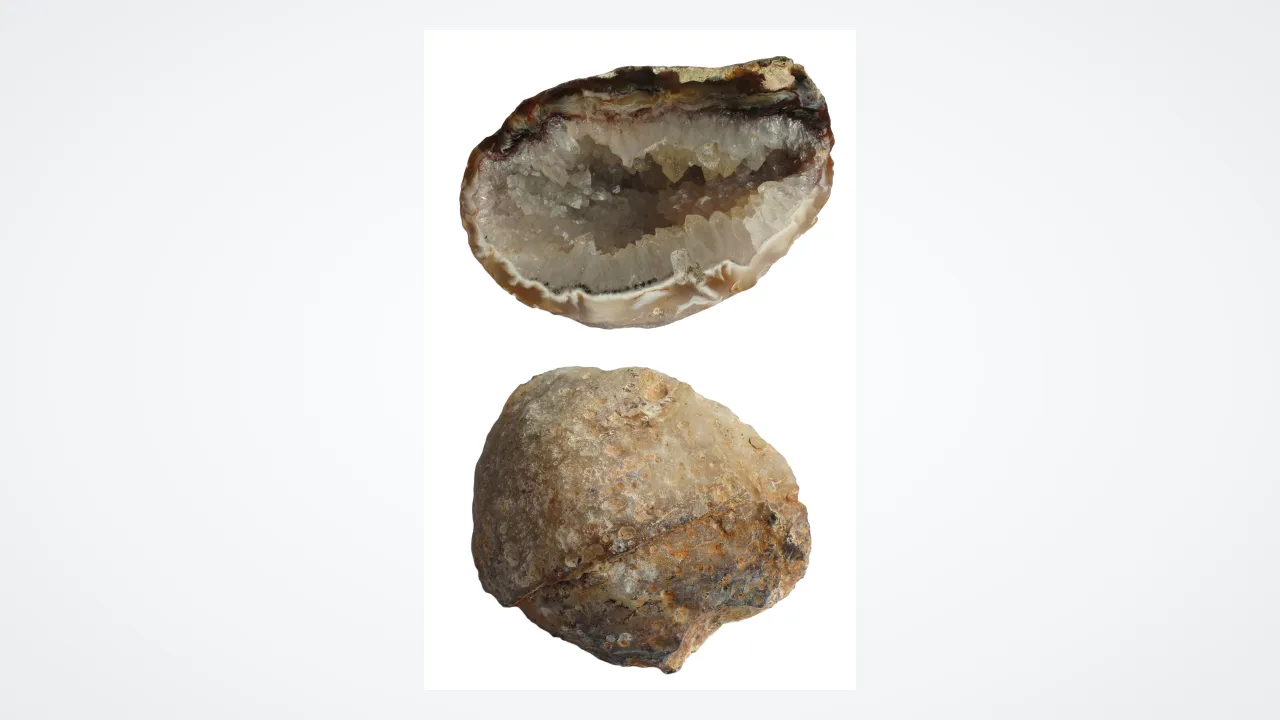
1. Why does an unopened geode feel lighter than a solid rock of the same size?
2. Which way do the crystals inside a geode point as they grow?
🤯 Mind-Blowing Fact • Grade 2
In Brazil and Uruguay, miners uncover towering 'cathedral geodes' lined with purple amethyst that stand taller than a grown-up!
✨ Word Sparks (Grade 2 Glossary)
Tap 🔊 to hear
Agate
Banded colorful stone lining many geode walls
Pore
A tiny microscopic opening in rock
Nodule
A rounded rock filled completely solid inside
🪝
How do sparkly purple crystals get inside a solid rock that has no door?
1
Starting With a Bubble
Imagine blowing bubbles in thick pancake batter before it bakes! Millions of years ago, gas bubbles got trapped inside cooling volcanic lava, or empty pockets formed inside muddy ocean limestone.
2
Microscopic Doorways
Even though a rock looks solid to your eyes, groundwater can sneak through tiny microscopic in its outer rind! That water carries dissolved silica and minerals into the hollow pocket.
3
Growing Rings and Points
Over thousands of years, colorful stripes coat the wall first, and pointed crystals of clear quartz, purple amethyst, or sky-blue celestite grow inward. If crystals fill every bit of space with no hollow left, geologists call it a or thunder egg!
Why can rough gray limestone erode away to mud while bumpy geodes pop right out on creek beds?
1
Two Ways to Make a Cavity
Crack open two geodes from different states and they may have completely different origin stories! Volcanic geodes start as trapped steam and gas bubbles—called —inside cooling basalt or rhyolite lava flows. Sedimentary geodes form inside limestone or shale where buried animal burrows, tree roots, or salty mineral lumps dissolve away and leave rounded cavities.
2
Tough Chalcedony Armor
Before big crystals sprout, -rich groundwater usually coats the inside of the pocket with a tough, waxy layer of microcrystalline quartz called or banded agate. Because chalcedony has a Mohs hardness of 7, it acts like armor! Centuries later, when softer surrounding limestone weathers away into soil, intact round geodes roll straight into creek beds.
3
Why Sizes and Colors Change
Fast changes in water chemistry create colourful bands of agate, while slow, steady mineral flow grows large six-sided quartz points. Trace iron kissed by natural underground radiation turns clear quartz into royal-purple amethyst!
4
How Rock Hounds Spot One
Out in geode country—like Iowa, Indiana, Kentucky, or Utah—collectors look for cauliflower-bumpy round stones that feel surprisingly light when tossed gently in their palm.
1. Why do whole geodes survive in stream beds long after the limestone around them has worn away?
2. What gives purple amethyst crystals inside volcanic geodes their rich violet color?
🤯 Mind-Blowing Fact • Grade 4
Near Pulpí in southern Spain, geologists discovered an 8-meter-long underground geode completely lined with glass-clear selenite crystals so transparent you can read a book page right through a half-meter-thick crystal wall!
✨ Word Sparks (Grade 4 Glossary)
Tap 🔊 to hear
Flood Basalt
Giant volcanic eruption covering vast land with lava
Drusy
Blanketed in thousands of tiny glittering crystals
Supersaturated
Water holding extra dissolved mineral ready to crystallize
🪝
How could a solid lump of salt mineral inside ancient ocean mud inflate like a rock balloon to become a hollow geode?
1
Igneous Vesicles Along Ancient Flood Basalts
Step inside a mineral warehouse in southern Brazil or northern Uruguay, and you will see amethyst-lined geodes standing two meters tall! About 130 million years ago, massive Paraná erupted as South America and Africa began rifting apart. Huge gas bubbles rose through thick, syrupy lava flows and froze in place as almond- and tube-shaped vesicles. Later, warm silica-rich groundwater from underlying sandstones seeped through porous basalt, coating vesicle walls first with green celadonite clay, then banded agate, and finally inward-pointing amethyst prisms.
2
Sedimentary Geodes and Osmotic Expansion
Midwestern sedimentary geodes—like the famous Keokuk geodes of Iowa, Illinois, and Missouri—formed without a drop of lava! Roughly 340 million years ago in a shallow Mississippian sea, nodules of calcium sulfate (anhydrite and gypsum) grew inside soft lime mud. As fresher groundwater later infiltrated the rock, silica gel formed a semi-permeable chalcedony skin around each sulfate lump while acidic fluids dissolved the anhydrite core from within—leaving cauliflower-textured spheres lined with sparkling quartz, golden calcite, pyrite, and pink dolomite.
3
Reading Crystal Growth Speeds
A sliced geode works like a geologic diary from outside in! silica solutions precipitate millions of microscopic crystals all at once, building smooth banded agate rinds. As dissolved silica drops to lower, steadier concentrations, fewer crystal nuclei compete—allowing large, sharp hexagonal quartz terminations or sugar-like coatings to sparkle in the hollow center.
4
Safe Cracking in Science Class
Geologists always slip safety goggles over their eyes and wrap a geode inside an old sock before tapping with a chisel or tightening a soil-pipe cutter so sharp quartz shards stay safely contained.
1. Why does banded microcrystalline agate usually form on a geode's outer wall before big quartz points grow in the center?
2. How did Keokuk sedimentary geodes in the American Midwest gain their hollow spaces without volcanic gas bubbles?
🤯 Mind-Blowing Fact • Grade 5
Ohio's famous Crystal Cave on South Bass Island in Lake Erie is actually a single giant hollow geode lined from floor to ceiling with sky-blue celestite crystals up to 18 inches wide!
✨ Word Sparks (Grade 5 Glossary)
Tap 🔊 to hear
Nucleation
Initial birth step where tiny crystals begin
Euhedral
Crystal grown with sharp, flat geometric faces
Fluid Inclusion
Microscopic ancient water droplet sealed inside crystal
🪝
What controls whether mineral-laden groundwater builds banded rainbow agate, hair-thin millerite needles, or towering cathedral amethyst inside a geode?
1
Nucleation Kinetics From Chalcedony to Euhedral Quartz
Slice a Brazilian basalt geode with a diamond-bladed trim saw, and its polished cross-section reveals a textbook transition in crystallization kinetics! The etymology of 'geode' comes from the Greek 'geoides' ('earth-like'), referencing its rounded planetary shape. When dissolved monomeric silicic acid (H4SiO4) first enters a rock cavity at high supersaturation, rates vastly exceed crystal growth rates: fibrous nanometers-wide chalcedony bundles precipitate concentrically along the cavity wall, trapping iron or manganese oxides in rhythmic Liesegang-style agate bands. Once outer chalcedony slows fluid diffusion and lowers silica supersaturation inside the chamber, existing crystal tips outcompete new nuclei—growing well-formed () hexagonal alpha-quartz prisms inward.
2
Paraná Flood Basalts and Artesian Guarani Fluids
World-famous cathedral amethyst geodes of Rio Grande do Sul (Brazil) and Artigas (Uruguay) owe their scale to a rare intersection of volcanism and hydrogeology. Beneath Lower Cretaceous Serra Geral basalt flows lies the vast Guarani Aquifer sandstone! Upwelling artesian groundwater warmed to roughly 50°C–120°C leached dissolved silica from sandstone and volcanic glass, rising into meter-scale gas vesicles trapped beneath impermeable lava flow tops. Gamma radiation emitted naturally by trace potassium and thorium in the host basalt oxidized Fe3+ impurities inside growing quartz into Fe4+ color centers—producing deep Siberian-grade royal violet amethyst (and golden citrine where later volcanic heat annealed those centers).
3
Diagenetic Replacement in Carbonate Platforms
In marine carbonate basins like the Warsaw Formation of Iowa and Indiana, geode genesis is driven by diagenesis rather than volcanism. Early evaporitic anhydrite concretions grew displacively in dolomitic muds, creating the characteristic knobby 'cauliflower' exterior. Silicifying fluids later replaced the outer anhydrite rim with quartzine and chalcedony; as acidic groundwater dissolved the sulfate interior, changes in pH, Eh (redox state), and metal ions precipitated secondary paragenetic sequences—sparkling quartz overgrown by rhombohedral calcite, saddle dolomite, iridescent goethite, sphalerite, and golden hair-like needles of nickel sulfide (millerite)!
4
Mega-Geodes: Put-in-Bay and Pulpí
Not all geodes are silica-dominated! Beneath South Bass Island in Lake Erie, Ohio's Crystal Cave is an 11-meter celestite (strontium sulfate, SrSO4) geode lined with sky-blue orthorhombic crystals half a meter wide. In Almería, Spain, the giant Pulpí Geode formed via slow Ostwald ripening—where temperature cycles dissolved tiny gypsum grains and redeposited them onto mammoth two-meter-long transparent selenite prisms.
5
Fluid Inclusions as Ancient Thermometers
Inside clear geode crystals, microscopic bubbles of ancient water and gas——remain sealed for tens of millions of years. By gently heating wafer-thin crystal slices under a microscope until vapor bubbles vanish, geochemists measure the exact temperature and salinity of the ancient groundwater that built the geode!