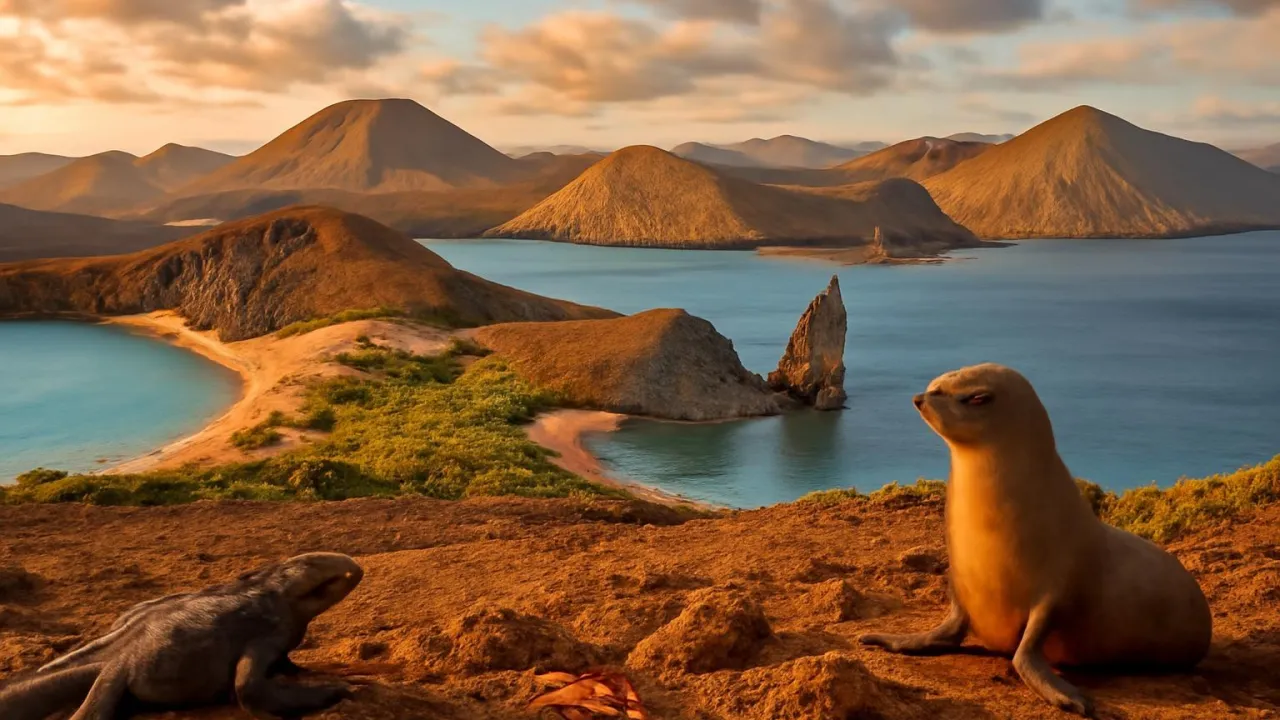
Some marine iguanas in the Galapagos can dive over 30 feet underwater!
✨ Word Sparks (Grade 2 Glossary)
Tap 🔊 to hear
tortoise
A big, slow-moving land turtle
lava
Hot, melted rock from a volcano
evolution
How living things slowly change over time
🪝
What would you see if you sailed to wild islands made by volcanoes?
1
Born from Lava
The Galapagos Islands rose from the sea. Hot cooled and turned to rock, making new land. Some volcanoes are still active today, and smoke sometimes rises from their tops. The islands look black and rocky from the lava, and some beaches are made of dark sand.
2
A Special Animal World
Giant slowly munch on plants, carrying heavy shells on their backs. Blue-footed boobies show off their bright feet while dancing on the rocks. Marine iguanas swim and bask on hot rocks, warming up in the sun. Many animals here are not found anywhere else in the world.
3
Visiting the Islands
People travel by boat to explore the islands and see amazing animals. Scientists study the animals and plants to learn about nature and . Visitors must protect the islands and their wildlife by following special rules. The Galapagos are far from other land, so every visit feels like an adventure.
The Galapagos is the only place where marine iguanas live and swim in the sea!
✨ Word Sparks (Grade 3 Glossary)
Tap 🔊 to hear
magma
Melted rock deep inside Earth
crater
A big hole made by a volcano
biodiversity
Many different living things in one place
🪝
What if you could walk on land that was once bubbling lava?
1
Volcanoes Build New Land
The Galapagos Islands were formed by underwater volcanoes. When reached the surface, it cooled and hardened into volcanic rock. Some volcanoes are still active, and eruptions can change the islands’ shapes. The islands’ black rocks and show their fiery beginnings.
2
Unique Creatures Everywhere
The islands are famous for their strange and wonderful animals. Giant Galapagos tortoises roam slowly, munching on cactus and grass. Marine iguanas dive into the salty ocean to eat seaweed. Blue-footed boobies perform funny dances with their bright blue feet.
3
A Living Laboratory
Scientists call the Galapagos a 'living laboratory' because of its . Charles Darwin visited in 1835 and studied the islands’ finches. His observations helped him develop the theory of evolution. Today, scientists still study how animals adapt to their environment.
4
Protecting a Natural Treasure
The Galapagos Islands are a UNESCO World Heritage Site. Special rules protect the rare animals and plants living there. Only a limited number of tourists may visit each year. People work together to keep the islands safe and wild.
2. Why are the Galapagos Islands special for scientists?
🤯 Mind-Blowing Fact • Grade 4
Some Galapagos tortoises can weigh over 500 pounds and live longer than most people!
✨ Word Sparks (Grade 4 Glossary)
Tap 🔊 to hear
eruption
When a volcano explodes with lava
adaptation
A change that helps living things survive
conservation
Protecting nature and living things
🪝
Imagine standing on a black beach where volcanoes still shape the land—what might you discover?
1
Volcanoes Above and Below
The Galapagos Islands were created by volcanic deep beneath the Pacific Ocean over millions of years. As magma pushed up through the ocean floor, it cooled and built new land, forming the islands we see today. Some volcanoes, like Sierra Negra, remain active and occasionally erupt, changing the islands’ shapes. The rocky landscape is covered with lava flows, craters, and black sand beaches.
2
A Haven for Unique Wildlife
Animals on the Galapagos Islands have adapted to survive in harsh volcanic conditions. The giant Galapagos tortoise can live for over 100 years and stores water in its shell. Marine iguanas are the only lizards that swim and feed in the ocean. Many birds, such as the flightless cormorant and Darwin’s finches, are found nowhere else on Earth.
3
A Natural Laboratory for Science
Charles Darwin’s visit in 1835 led to his famous theory of natural selection. He observed how different finches’ beaks were adapted to the food on each island. Today, scientists study how species evolve and survive in this isolated environment. The islands’ biodiversity teaches us about , evolution, and .
4
Protecting a World Heritage Site
The Galapagos Islands are protected as a UNESCO World Heritage Site and Ecuadorian National Park. Strict rules limit tourism and fishing to protect the rare wildlife and fragile habitats. Conservationists work to stop invasive species and pollution from harming the islands. People around the world help keep the Galapagos wild and wonderful for the future.
1. Why do scientists call the Galapagos a 'natural laboratory'?
2. How are the islands protected today?
🤯 Mind-Blowing Fact • Grade 5
The Galapagos Islands’ volcanic hotspot has created at least 127 eruptive events in the last 200 years!
✨ Word Sparks (Grade 5 Glossary)
Tap 🔊 to hear
hotspot
A place where magma rises under Earth's crust
endemic
A species found only in one place
upwelling
When deep ocean water rises, bringing nutrients
🪝
What if you could watch a volcanic island rise from the ocean, then see animals evolve to fit its wild new world?
1
The Fiery Origins of the Galapagos
The Galapagos Islands are a volcanic archipelago formed by a geologic beneath the Pacific Ocean, where magma rises through the Earth's crust. Over the past five million years, repeated eruptions built up the islands layer by layer, with some volcanoes like Fernandina and Sierra Negra still active today. The islands’ rugged terrain features basaltic lava flows, massive calderas, and dramatic black sand beaches. Because the hotspot remains fixed while the Nazca tectonic plate drifts, new islands slowly form to the west as older ones erode and sink to the east. This ongoing volcanic process creates a dynamic landscape that is still changing.
2
A Living Showcase of Evolution
The Galapagos Islands are world-famous for their extraordinary biodiversity and high rate of endemism, meaning many species exist nowhere else. Giant tortoises, marine iguanas, and flightless cormorants have all adapted to the islands’ harsh volcanic environment. Charles Darwin’s observations of finch beak variations during his 1835 voyage provided crucial evidence for his theory of natural selection. Today, scientists continue to study how isolation, adaptation, and environmental pressures drive evolution on the islands. The Galapagos remain a living laboratory for evolutionary biology.
3
Volcanic Forces and Island Ecology
The islands’ volcanic soils are low in nutrients, so plants and animals must adapt to survive. Cacti and salt-tolerant shrubs dominate the arid lowlands, while lush forests grow in the humid highlands. Erosion from wind and rain shapes the islands’ coasts, creating cliffs, lava tubes, and tide pools. The surrounding ocean is rich in nutrients due to currents, supporting a complex food web that includes penguins, sea lions, and sharks. The interplay between volcanic activity, erosion, and ocean currents makes the Galapagos a for ecological research.
4
A Global Conservation Challenge
The Galapagos Islands face serious threats from invasive species, climate change, and increasing tourism. Conservationists use scientific monitoring, habitat restoration, and strict biosecurity to protect native wildlife and habitats. The islands are managed as a national park and marine reserve, with limited visitor numbers and sustainable tourism practices. International cooperation is essential to preserve the islands’ unique ecosystems for future generations. The Galapagos serve as a model for balancing human activity with environmental protection.
5
Legacy and Inspiration for the World
The Galapagos Islands inspire scientists, artists, and nature lovers with their dramatic landscapes and remarkable wildlife. They are recognized as a UNESCO World Heritage Site for their outstanding universal value to science and nature. Ongoing research on the islands advances our understanding of evolution, adaptation, and conservation. By protecting the Galapagos, we learn how to care for other fragile ecosystems around the globe. The islands remind us that nature’s wonders are both ancient and ever-changing.