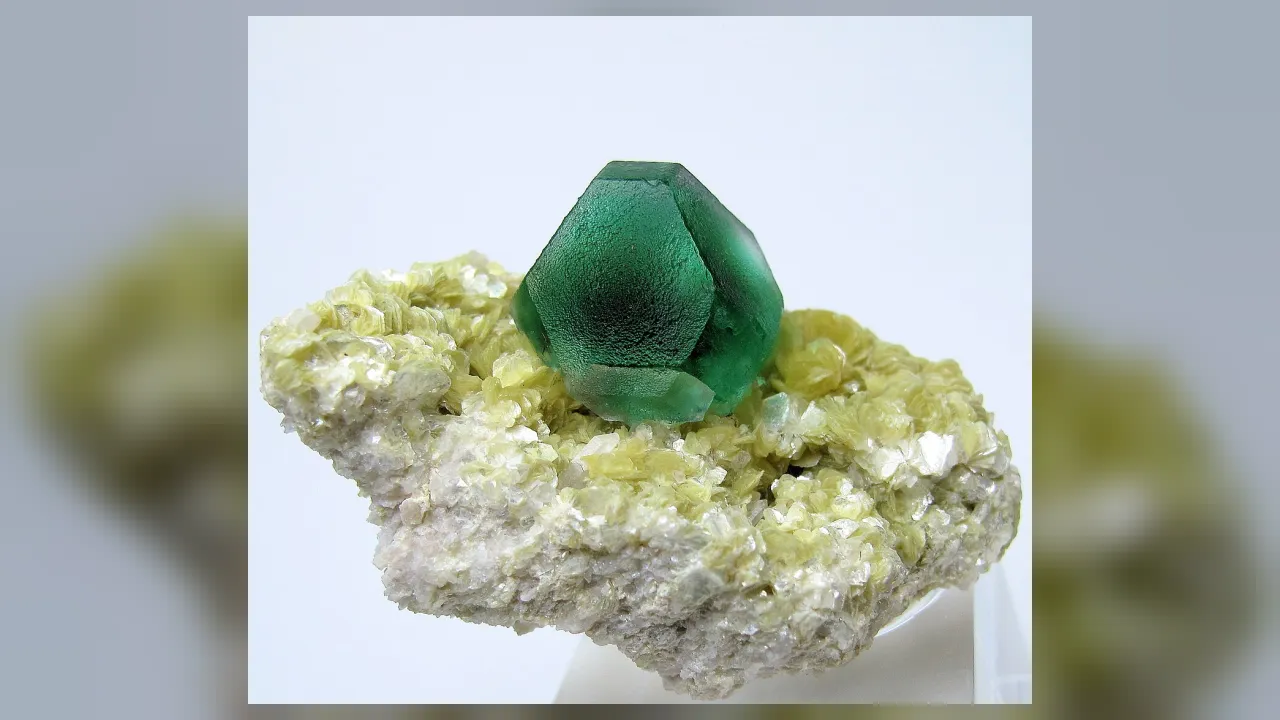
1. Why do people call fluorite the rainbow mineral?
2. How does an ingredient from fluorite help your smile every morning?
🤯 Mind-Blowing Fact • Grade 2
Ancient Romans carved prized striped purple-and-yellow fluorite into fancy drinking cups they believed could keep flavors fresh!
✨ Word Sparks (Grade 2 Glossary)
Tap 🔊 to hear
Fluorescence
Glowing brightly under invisible ultraviolet light
Octahedron
An eight-sided crystal shaped like two pyramids
Ultraviolet
Invisible light rays beyond the color purple
🪝
Where did scientists get the word 'fluorescent' for glowing markers and lights?
1
The Glow That Named Fluorescence
Step into a darkened museum room when a special lamp clicks on! Right before your eyes, purple and green fluorite crystals light up electric violet-blue. Scientists were so amazed by fluorite's glow that they named the whole glowing effect '' after it!
2
Cubes That Hide Diamonds
Fluorite usually grows as smooth, glassy cubes in underground cracks filled with hot water. Yet if a geologist carefully taps off all the corners of a fluorite cube, an eight-sided diamond shape called an pops out!
3
From Steel Mills to Toothpaste
Workers mine fluorite to help melt iron smoothly in steel factories, craft super-clear camera lenses, and supply cavity-fighting fluoride for healthy teeth.
Miners' traditional name for industrial fluorite rock
🪝
Why does fluorite grow in square cubes on the outside, yet break into eight-sided pyramids on the inside?
1
Color-Banded Phantoms
Hold a slice of polished fluorite up to a sunny window, and you might spot 'phantom' squares nested inside each other like colorful picture frames! Pure fluorite—made of calcium and fluorine—is actually clear as glass. Tiny pinches of other elements trapped as hot water flowed through underground veins tint each growth layer emerald green, royal purple, golden yellow, or sky blue.
2
Number Four on the Mohs Scale
Fluorite holds down spot number 4 on the Mohs hardness scale. It easily scratches calcite (3) and copper pennies (3.5), while a steel pocketknife or iron nail (around 5) will scratch fluorite. Even better, fluorite splits cleanly along four angled cleavage directions to form eight-sided octahedrons.
3
Why Steelmakers Call It 'Fluorspar'
Fluorite's name comes from the Latin word 'fluere,' meaning 'to flow.' For centuries, metalworkers tossed crushed fluorite into fiery furnaces because it helped thick rocky waste melt and flow smoothly off pure liquid iron and steel.
4
Telescopes and Healthy Smiles
Today, ultra-pure synthetic fluorite crystals sit inside space telescopes and wildlife cameras because fluorite bends colors cleanly without blurry rainbow fringes, while fluoride protects millions of smiles.
1. Why did metalworkers name fluorite after the Latin word meaning 'to flow'?
2. What causes fluorite to display stripes of purple, green, and yellow inside a single crystal?
🤯 Mind-Blowing Fact • Grade 4
Some fluorite crystals exhibit 'daylight fluorescence'—containing so much natural europium that ultraviolet rays in ordinary outdoor sunshine turn a green crystal bright violet-blue the moment you step outside!
✨ Word Sparks (Grade 4 Glossary)
Tap 🔊 to hear
Dispersion
Spreading white light into separate rainbow colors
Europium
Rare-earth element making fluorite glow electric blue
Thermoluminescence
Glowing with light when gently warmed up
🪝
How does invisible ultraviolet light make electrons jump inside a fluorite crystal and shine back in neon blue?
1
Calcium Fluoride and Four-Way Cleavage
Peer inside a glowing specimen from northern England or southern Illinois, and you will see sharp geometric cubes stacked like a futuristic skyline. Chemically, fluorite is calcium fluoride (CaF2), a halide mineral that crystallizes in the isometric system. Although its outer crystal faces almost always grow as six-sided cubes, its weakest atomic planes slice diagonally across all eight cube corners! That gives fluorite four directions of perfect octahedral cleavage—a rare diagnostic trait that distinguishes Mohs-4 fluorite from Mohs-3 calcite and Mohs-7 quartz.
2
The Physics Behind Fluorescence
In 1852, British physicist George Gabriel Stokes shone invisible ultraviolet rays beyond the violet end of a sunlight prism onto blue-purple English fluorite and watched the stone emit eerie blue visible light. Trace rare-earth elements—especially —tucked inside fluorite's lattice absorb high-energy UV photons, boosting electrons to an excited energy level. Microseconds later, those electrons drop back down and release visible blue light! Some rare varieties, called chlorophane, even exhibit —glowing emerald green simply when warmed gently!
3
Hydrothermal Veins and Blue John Caverns
Fluorite precipitates when hot, fluorine-bearing hydrothermal fluids rise from cooling magma chambers and react with calcium-rich limestone walls, often crystallizing alongside galena, sphalerite, barite, and quartz. In Derbyshire, England, uniquely banded purple-and-gold 'Blue John' fluorite forms in just one limestone hillside cavern system.
4
Apochromatic Lenses for Deep Space
Ordinary glass lenses bend blue light more sharply than red light, creating blurry color halos around bright stars. Because calcium fluoride has extraordinarily low optical , engineers grow flawless lab crystals of CaF2 for high-powered telephoto lenses, microscopes, and astronomical telescopes.
1. Why do telescope and camera makers prize ultra-pure calcium fluoride crystals for lenses?
2. How can you tell a cube of fluorite apart from a crystal of quartz using simple mineral tests?
🤯 Mind-Blowing Fact • Grade 5
Computer chip factories use lenses grown from ultra-pure synthetic fluorite crystals because ordinary glass blocks the intense deep-ultraviolet laser beams needed to carve billion-transistor processors!
✨ Word Sparks (Grade 5 Glossary)
Tap 🔊 to hear
Color Center
Crystal gap trapping an electron that creates color
Flux
Mineral added to furnaces to help slag melt
Apochromatic
Lens design focusing all colors without rainbow blur
🪝
How can a completely colorless chemical compound like CaF2 produce almost every hue in the visible spectrum through missing electrons?
1
Fluorite-Structure Lattice and Color Centers
Hold a zoned cubic crystal from Virginia's Amelia County pegmatites or Illinois's Cave-in-Rock district, and you are looking at a masterclass in solid-state physics. Chemically pure calcium fluoride (CaF2) is colorless from deep ultraviolet through infrared wavelengths. Its isometric lattice arranges calcium cations in a face-centered cubic array with fluoride anions occupying every tetrahedral site. Fluorite's kaleidoscopic palette arises from two mechanisms: trace rare-earth substitutions (such as samarium yielding emerald green or yttrium and europium triggering UV fluorescence) and 'Frenkel defects' or ''—tiny lattice vacancies where natural background radiation knocks a fluoride ion out of position and traps a lone electron that selectively absorbs specific wavelengths of light!
2
Mississippi Valley-Type Hydrothermal Deposits
Economically significant fluorite deposits often form in Mississippi Valley-Type (MVT) settings and granite-related greisens. When warm (100°C–200°C) basinal brines carrying dissolved hydrogen fluoride migrate into fractured carbonate platforms, calcium ions liberated from dissolving limestone combine immediately with fluoride to precipitate banded fluorite cubes, sphalerite, barite, and galena. Sequential pulses of fluid leave concentric 'phantom' growth zones that record changing temperature and trace-metal chemistry across millennia.
3
Metallurgical Flux and Fluorochemical Gateways
In basic oxygen steelmaking and aluminum smelting, metallurgical-grade fluorspar serves as an indispensable , breaking silicon-oxygen polymer chains in molten slag so impurities separate cleanly at lower furnace temperatures—saving vast amounts of thermal energy. Acid-grade fluorite (>97% CaF2) is reacted with sulfuric acid to produce hydrogen fluoride, the primary industrial precursor for synthetic cryolite in aluminum production, non-stick fluoropolymers, high-efficiency refrigerants, and cavity-preventing sodium fluoride.
4
Deep-UV Lithography and Space Optics
Because ordinary silica glass absorbs deep-ultraviolet laser beams and suffers chromatic aberration, semiconductor engineers grow giant defect-free synthetic CaF2 boules to focus 193-nanometer excimer lasers that etch nanometer-scale transistors onto computer microchips, while planetary observatories pair fluorite elements into refractors for razor-sharp planetary imaging.
5
Critical Mineral Stewardship
Because high-purity fluorite underpins clean-energy batteries (via lithium hexafluorophosphate electrolytes), solar-grade silicon refining, and microchip lithography, geological surveys worldwide classify fluorspar as a critical mineral—spurring recycling of fluorine from phosphate rock processing to conserve rare natural crystal veins.