🌌 COSMOS
🔭 Fermi Gamma-ray Space Telescope • NASA High-Energy Astrophysics Observatory
VA Science SOL 1.6, 4.5, 4.6 (Solar System, Stars & Space Exploration)
Fermi Gamma-Ray Telescope
Catching the Universe's Most Energetic Flashes
Grade 2 • Developing • 92 words
🌌 Cosmic Location & DistanceLow Earth Orbit • 332 mi (535 km) Altitude Above Earth
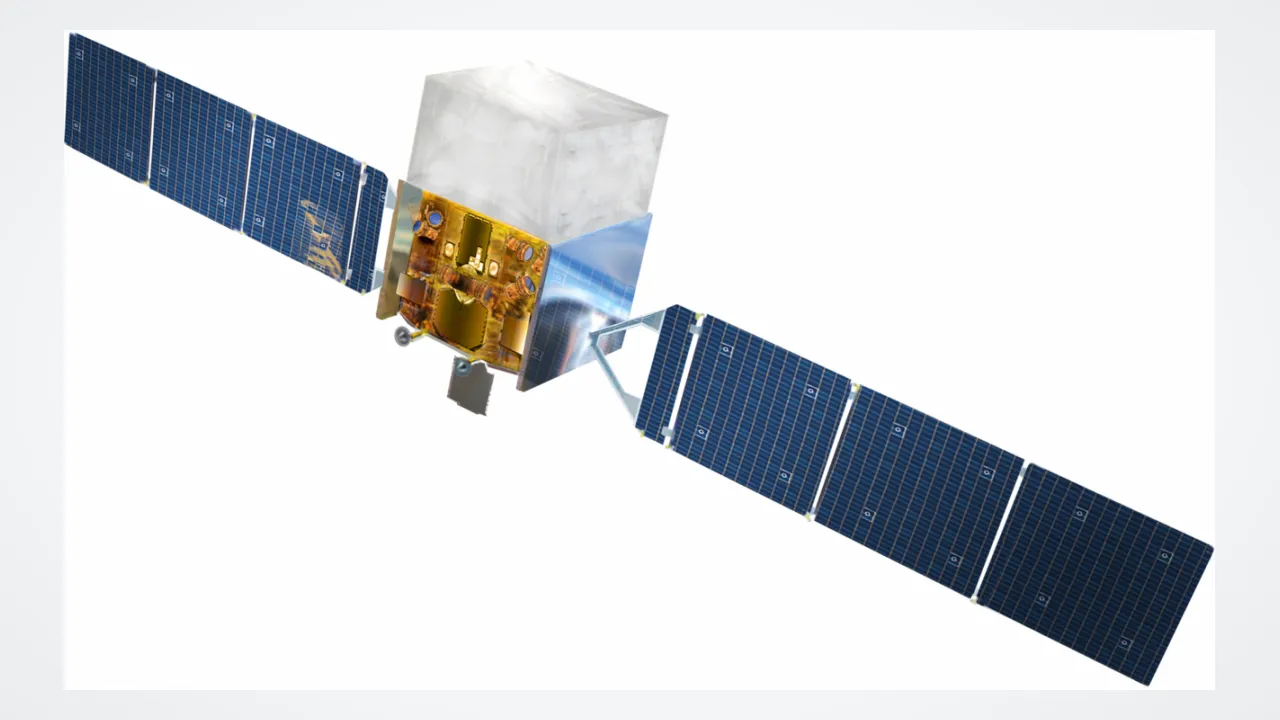
🪐 Scale / Diameter9.2 ft (2.8 m) tall • 49 ft (15 m) solar wingspan • 9,486 lbs (4,303 kg)
1. Why did scientists have to launch Fermi into space to see gamma rays?
2. How fast does Fermi zip all the way around Earth?
🤯 Mind-Blowing Fact • Grade 2
One gamma-ray photon caught by Fermi can pack billions of times more energy than the light shining from your bedroom lamp!
✨ Word Sparks (Grade 2 Glossary)
Tap 🔊 to hear
detector
a machine that senses hidden energy
pulsar
a fast-spinning crushed core of a star
energy
the power to move, heat, or shine
🪝
Why can't regular mirrors bounce the fiercest light beams in the universe?
1
Light That Passes Through Mirrors
Flash! Imagine a beam of light so powerful that it zips straight through an ordinary glass mirror instead of bouncing! Those beams are called gamma rays, and they carry more than X-rays or sunlight.
2
A Smart Space Detector
Launched in 2008, the Fermi Gamma-Ray Telescope orbits 332 miles above Earth. Instead of curved mirrors, Fermi uses special metal layers and silicon strips to track gamma rays when they hit the .
3
Watching Every Three Hours
Fermi scans the entire sky every three hours! It catches gamma-ray bursts from distant star crashes, spinning , and even powerful thunderstorms right here on Earth.
1. Why doesn't the Fermi Gamma-Ray Telescope use regular glass mirrors?
2. Surprising discovery alert! Besides space stars, what earthly weather can make gamma rays that Fermi detects?
🤯 Mind-Blowing Fact • Grade 3
In 2017, Fermi spotted a gamma-ray flash just 1.7 seconds after gravitational-wave detectors felt two neutron stars collide 130 million light-years away!
✨ Word Sparks (Grade 3 Glossary)
Tap 🔊 to hear
tungsten
a super-dense heavy metal element
spectrum
the full range of all light wavelengths
black hole
space region with gravity trapping even light
🪝
How do you build a telescope when the light you want to study refuses to focus through lenses?
1
Beyond the Rainbow
Picture all light as a giant musical keyboard. Our eyes only see one tiny octave of rainbow colors in the middle! Way up at the highest notes sit gamma rays, born inside the universe's wildest cosmic engines. Named after physicist Enrico Fermi, NASA's Fermi Gamma-Ray Telescope has patrolled Low Earth Orbit since June 2008.
2
Trapping Gamma Rays with Physics
Because gamma rays punch straight through lenses and mirrors, Fermi's main instrument—the Large Area Telescope—works like a particle physics detector. Incoming gamma rays strike thin plates and transform into pairs of tiny particles whose paths reveal the exact direction and energy of the ray.
3
The Gamma-ray Burst Monitor
Fermi also carries twelve sodium-iodide and two bismuth-germanate sensors watching every unblocked direction at once. Whenever a sudden gamma-ray burst erupts billions of light-years away, Fermi alerts telescopes worldwide within seconds!
4
Towering Fermi Bubbles
In 2010, astronomers sifting Fermi's maps uncovered twin 'Fermi Bubbles' of super-hot gas stretching 25,000 light-years above and below our Milky Way's central .
1. What giant structure did Fermi discover towering above and below the center of our Milky Way galaxy?
2. What happens inside Fermi's Large Area Telescope when a gamma ray hits a thin tungsten foil?
🤯 Mind-Blowing Fact • Grade 4
Fermi discovered that terrestrial thunderstorms hurl tiny beams of antimatter positrons upward into low Earth orbit!
✨ Word Sparks (Grade 4 Glossary)
Tap 🔊 to hear
antimatter
particles with opposite charge to normal matter
blazar
black hole firing a jet toward Earth
calorimeter
detector block that measures total particle energy
🪝
How did Einstein's famous E = mc² equation allow engineers to build an eye that sees cosmic explosions across the universe?
1
Turning Pure Light into Matter
Imagine catching an invisible cannonball by letting it transform into two glowing sparks whose trails point straight back to the cannon! Albert Einstein proved with E = mc² that pure energy can convert into matter. Inside Fermi's Large Area Telescope (LAT), high-energy gamma-ray photons—packing 20 million to over 300 billion electron volts—strike ultra-thin tungsten sheets and convert into an electron and its twin, a positron.
2
Precision Silicon Tracking
Thirty-six layers of silicon strip detectors trace the exact V-shaped tracks of the electron and positron before a cesium-iodide at the base absorbs them to measure their total energy. An outer plastic shield ignores charged cosmic rays, ensuring Fermi counts genuine gamma-ray photons rather than background space particles.
3
Cosmic Accelerators and Blazars
Scanning the entire celestial sphere every two orbits, Fermi revealed that more than half of all known gamma-ray sources outside our galaxy are —supermassive black holes firing relativistic particle jets almost directly toward Earth. Closer to home, Fermi cataloged nearly three hundred gamma-ray pulsars spinning up to hundreds of times per second.
4
Birth of Multi-Messenger Astronomy
On August 17, 2017, Fermi's Gamma-ray Burst Monitor caught a two-second burst moments after LIGO sensed ripples in spacetime from colliding neutron stars—uniting light and gravitational waves for the first time in scientific history.
1. How does Einstein's E = mc² work inside Fermi's Large Area Telescope?
2. Why was Fermi's August 17, 2017 gamma-ray burst detection a historic milestone?
🤯 Mind-Blowing Fact • Grade 5
By timing photons of wildly different energies racing across 7.3 billion light-years from burst GRB 090510, Fermi proved spacetime stays smooth and un-foamy even below the tiny Planck scale!
✨ Word Sparks (Grade 5 Glossary)
Tap 🔊 to hear
pair production
photon energy transforming into electron and positron
anticoincidence
shield system rejecting unwanted background cosmic rays
non-thermal
radiation driven by magnetic acceleration, not heat
🪝
What extreme cosmic laboratories can accelerate particles far beyond humanity's largest atom smashers—and how does Fermi unmask them?
1
Observing the Extreme Non-Thermal Universe
Most optical and infrared telescopes study thermal radiation—light emitted simply because stars, dust clouds, or planets are warm. Gamma-ray astronomy unveils a radically different realm: the universe, where titanic magnetic fields, shockwaves, and relativistic gravity hurl subatomic particles near the speed of light. Launched on June 11, 2008, and named honoring nuclear pioneer Enrico Fermi, this international NASA-Department of Energy observatory explores photon energies from 8 kiloelectron volts past 300 gigaelectron volts.
2
Pair-Conversion Architecture
At GeV energies, wavelengths shrink smaller than an atomic nucleus, rendering grazing-incidence mirrors useless. Instead, Fermi's four-by-four modular grid—the Large Area Telescope—relies on quantum electrodynamics. When an astrophysical gamma ray encounters the electric field of a heavy tungsten nucleus, yields an electron-positron duo. Precision silicon microstrips reconstruct the incident trajectory within arcminutes, a cesium-iodide hodoscopic calorimeter totals the electromagnetic shower energy, and a segmented plastic scintillator dome vetoes 99.997 percent of distracting cosmic-ray protons.
3
Supernova Shockwaves and the Fermi Bubbles
For a century, physicists suspected supernova remnants accelerated galactic cosmic rays, yet charged protons curve in magnetic fields and conceal their birthplaces. Fermi settled the mystery by detecting the unmistakable 'pion-decay bump'—gamma rays radiating straight from proton collisions inside supernova shockwaves IC 443 and W44. Meanwhile, subtracting foreground Milky Way glow exposed the colossal 50,000-light-year Fermi Bubbles, likely inflated millions of years ago by an outburst from Sagittarius A*, our galaxy's four-million-solar-mass black hole.
4
Testing Spacetime and Kilonovae
Complementing the LAT, fourteen Gamma-ray Burst Monitor scintillators continuously watch the unocculted sky. During event GRB 170817A, photons of differing energies arrived after a 130-million-year journey simultaneously with gravitational waves, confirming to one part in a quadrillion that gravity and light travel at identical speeds.
5
An Ongoing High-Energy Legacy
Still surveying the heavens every three hours, Fermi probes dark-matter annihilation limits, millisecond pulsar timing arrays, and active galactic nuclei at the edge of observable time.