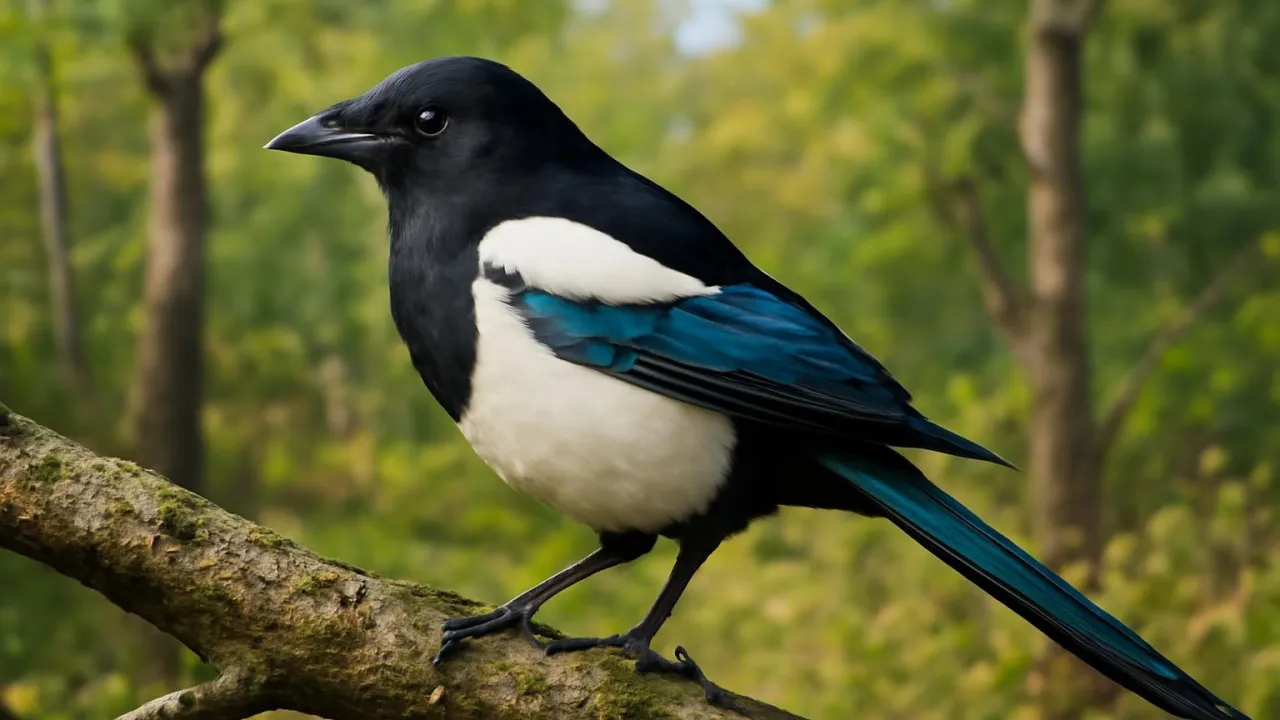
Eurasian magpies can recognize themselves in mirrors, a rare skill in animals!
✨ Word Sparks (Grade 2 Glossary)
Tap 🔊 to hear
feathers
Soft parts that cover a bird’s body.
nest
A bird’s home made of sticks and leaves.
puzzle
A problem that needs smart thinking to solve.
🪝
Have you ever heard a bird that can remember your face?
1
Bright Black and White Feathers
The Eurasian magpie has shiny black and white that look very bright. It has a long tail that helps it balance when flying. This bird is about eighteen inches long from beak to tail tip.
2
Where Magpies Live
Magpies live in many places like Europe and Asia in open woodlands and farms. They like places with trees and open fields where they can find food and build . They often live near people but stay in wild areas.
3
Smart Bird with Special Skills
Magpies are very smart birds that can solve and remember faces. They use their sharp beaks to find insects and small animals to eat. Their loud calls help them talk to other magpies nearby.
Eurasian magpies are one of the few non-mammals that can recognize themselves in mirrors!
✨ Word Sparks (Grade 3 Glossary)
Tap 🔊 to hear
camouflage
Colors that help animals hide from others.
predator
An animal that hunts other animals for food.
ecosystem
A community of living things and their home.
🪝
Did you know Eurasian magpies use their bright feathers to warn predators?
1
Striking Colors and Camouflage
The Eurasian magpie’s black and white feathers create a bold pattern that helps it blend in the dappled light of woodlands. This protects it from by breaking up its shape among branches and leaves. Its long tail helps with balance and quick turns in flight.
2
Habitat and Survival
Magpies live in open woodlands, farmlands, and parks across Europe and Asia. They build nests high in trees using twigs and grass. This location keeps eggs safe from many ground and provides good views to spot danger early.
3
Smart Problem Solvers
Eurasian magpies are known for their intelligence and problem-solving skills. They use tools and remember human faces to avoid threats. Their ability to learn helps them find food and protect their young from .
4
Role in the Ecosystem
These birds help control insect populations by eating many bugs and small animals. They also spread seeds by eating fruits, aiding plant growth. Magpies play an important role in keeping balanced and healthy.
1. How do magpies use their feathers to stay safe?
2. What role do magpies play in the ecosystem?
🤯 Mind-Blowing Fact • Grade 4
Eurasian magpies are among the few bird species that pass the mirror self-recognition test, showing high intelligence.
✨ Word Sparks (Grade 4 Glossary)
Tap 🔊 to hear
plumage
The feathers covering a bird’s body.
symbiotic
A helpful relationship between two living things.
persecution
When animals are harmed or chased by people.
🪝
How does the Eurasian magpie’s intelligence affect its survival and environment?
1
Intelligent Adaptations
The Eurasian magpie’s intelligence allows it to solve complex problems and remember human faces, which helps it avoid dangers. This bird’s striking black and white serves as both camouflage and a warning signal to predators. Its long tail aids in agile flight, allowing quick escapes from threats.
2
Ecosystem Roles and Food Webs
Magpies play a key role in food webs by controlling insect populations and dispersing seeds through their diet of insects, small animals, and fruits. Their scavenging behavior helps clean the environment by eating carrion and waste. This relationship benefits many plants and animals in their habitat.
3
Geographic Distribution and Habitat
Eurasian magpies inhabit a wide range across Europe and Asia, thriving in open woodlands, farmlands, and urban parks. They adapt well to human presence but require tree cover for nesting and protection. Their flexible diet and habitat preferences make them successful in diverse environments.
4
Human Impact and Conservation
While magpies face threats from habitat loss and , they are generally common and adaptable birds. Conservation efforts focus on protecting woodland habitats and reducing conflicts with humans. Understanding their intelligence helps people appreciate their ecological importance.
1. Why does the magpie’s intelligence help it survive?
2. What is one way magpies help their ecosystem?
🤯 Mind-Blowing Fact • Grade 5
Eurasian magpies are one of the few bird species that can recognize themselves in mirrors, showing rare self-awareness.
✨ Word Sparks (Grade 5 Glossary)
Tap 🔊 to hear
Corvidae
A family of smart birds like crows and ravens.
cognitive
Related to thinking and understanding skills.
persecution
When animals are harmed or chased by people.
🪝
What scientific secrets make the Eurasian magpie one of the smartest birds on Earth?
1
Scientific Classification and Evolution
The Eurasian magpie, scientifically named Pica pica, belongs to the family, which includes crows and ravens known for advanced intelligence. Its evolutionary adaptations include complex brain structures that support problem-solving and social behaviors uncommon in most birds. These traits have helped magpies survive in diverse environments for thousands of years.
2
Physiological Mechanics of Flight and Vision
This bird’s long tail feathers and strong wing muscles enable agile flight with precise maneuvering through dense woodlands. Its keen eyesight allows detection of small prey and predators from great distances, while its vocal organs produce varied calls for communication and social interaction. These physical features work together to enhance survival and social bonding.
3
Cognitive Abilities and Behavioral Ecology
Eurasian magpies demonstrate remarkable skills such as mirror self-recognition, tool use, and memory of human faces, indicating advanced self-awareness and social intelligence. These behaviors enhance survival by improving foraging efficiency and predator avoidance in complex environments. Their social groups use calls and body language to communicate complex messages.
4
Conservation Status and Human Interaction
Currently classified as Least Concern by conservation organizations, Eurasian magpies face localized threats from habitat destruction and . Conservation programs emphasize habitat preservation and public education to reduce conflicts and promote coexistence with humans. Protecting woodland habitats is crucial for maintaining healthy magpie populations.
5
Quantitative Comparisons and Unique Traits
Measuring about eighteen inches in length and weighing up to 250 grams, Eurasian magpies can fly at speeds near 30 miles per hour. Their brain-to-body size ratio rivals that of some primates, highlighting their exceptional intelligence among avian species worldwide. Their ability to remember faces and solve puzzles is rare among birds.