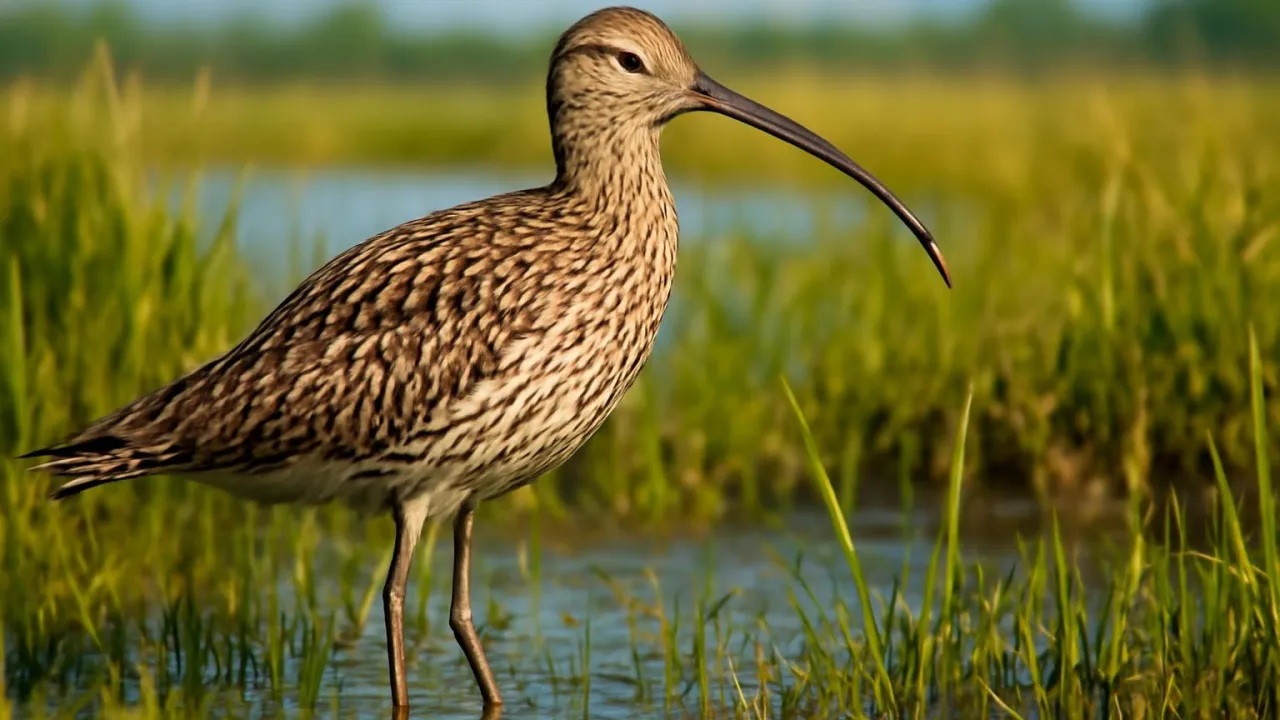
1. What does the Eurasian Curlew use its long beak for?
2. Where does the Eurasian Curlew like to live?
🤯 Mind-Blowing Fact • Grade 2
The Eurasian Curlew’s curved beak can reach up to 5 inches long!
✨ Word Sparks (Grade 2 Glossary)
Tap 🔊 to hear
wetlands
Places with lots of water and soft mud.
nest
A bird’s home where eggs are kept safe.
aquatic
Living in or near water.
🪝
Have you ever seen a bird with a beak that curves like a hook?
1
Amazing Curved Beak
The Eurasian Curlew has a long, curved beak that helps it find food. It uses this special beak to dig deep into mud and water. This bird’s beak is one of the longest among shorebirds. It helps the curlew catch worms and small creatures hiding underground.
2
Where It Lives and Grows
This bird lives in and coastal areas across Europe and Asia. It builds its on the ground near water. The eggs hatch into chicks that quickly learn to walk and find food. Wet and grassy places give the curlew a safe home to grow.
3
What It Eats
The Eurasian Curlew feeds on insects, worms, and small animals. It probes the mud with its long beak to find hidden prey. Its diet helps keep wetland ecosystems balanced. This bird plays an important role in nature’s food web.
1. Why does the Eurasian Curlew have a long curved beak?
2. Where do Eurasian Curlews build their nests?
🤯 Mind-Blowing Fact • Grade 3
The Eurasian Curlew’s curved beak can probe up to 4 inches deep in mud to find food!
✨ Word Sparks (Grade 3 Glossary)
Tap 🔊 to hear
adaptation
A body change that helps survival.
camouflage
Colors that help hide from predators.
predator
An animal that hunts other animals.
🪝
Did you know the Eurasian Curlew’s long beak helps it survive in muddy wetlands?
1
Curved Beak Adaptation
The Eurasian Curlew has a long, curved beak that acts like a probe to find food hidden deep in mud. This helps it reach worms and small aquatic animals that other birds cannot catch. The curved shape allows it to dig without moving too much mud. This special beak is key to its survival in wetland habitats.
2
Wetland Habitat and Life Cycle
These birds live in wetlands and coastal areas across Europe and Asia where water and mud are abundant. They build nests on the ground, camouflaged with grass and mud to hide from . The chicks hatch and quickly learn to walk and feed themselves. Wetlands provide nutrients and shelter that support the curlew’s life cycle.
3
Role in the Ecosystem
As a of insects and worms, the Eurasian Curlew helps control populations of small animals in wetlands. Its feeding behavior aids in mixing mud and nutrients, improving soil health. This bird also serves as prey for larger animals, linking it to the food web. Its presence indicates a healthy wetland ecosystem.
4
Physical Features and Camouflage
The Eurasian Curlew’s brown and white feathers help it blend into muddy and grassy environments. This protects it from while it feeds or nests. Its long legs allow it to wade through shallow water easily. These physical features work together to help it survive and thrive.
1. How does the Eurasian Curlew’s beak help it survive?
2. Why is camouflage important for the Eurasian Curlew?
🤯 Mind-Blowing Fact • Grade 4
Eurasian Curlews migrate thousands of miles each year to find suitable wetlands for feeding and breeding.
✨ Word Sparks (Grade 4 Glossary)
Tap 🔊 to hear
ecosystem
A community of plants and animals living together.
migration
Moving to a new place for food or weather.
symbiosis
Two species helping each other to survive.
🪝
How does the Eurasian Curlew’s long beak affect its role in wetland ecosystems?
1
Beak Shape and Feeding Strategy
The Eurasian Curlew’s long, curved beak allows it to probe deep into muddy wetlands for hidden invertebrates, which are its main food source. This specialized feeding strategy reduces competition with other birds that cannot reach such depths. By extracting worms and small aquatic animals, the curlew helps maintain a balanced . Its beak shape is a perfect example of evolutionary adaptation to its environment.
2
Habitat and Geographic Range
This species inhabits wetlands, estuaries, and coastal mudflats across Europe and Asia, from the British Isles to Siberia. Seasonal takes the curlew to warmer coastal areas in winter. Wetlands provide essential resources such as food, nesting grounds, and shelter. However, habitat loss due to human activities threatens these vital areas, impacting curlew populations.
3
Ecosystem Roles and Symbiosis
As a predator, the Eurasian Curlew controls populations of insects and worms, which helps maintain soil and water quality. Its feeding also aerates the mud, promoting nutrient cycling. The curlew’s presence supports other species by contributing to a healthy food web. Additionally, it may benefit from symbiotic relationships with other wetland species that share its habitat.
4
Human Impact and Conservation
Human development, pollution, and wetland drainage have reduced the Eurasian Curlew’s habitat significantly. Conservation efforts focus on protecting wetlands and creating reserves to support breeding and feeding. Public awareness campaigns help reduce disturbances during nesting seasons. Protecting this bird also safeguards many other wetland species, highlighting its ecological importance.
1. Why is the Eurasian Curlew’s beak shape important?
2. What human activity threatens the Eurasian Curlew’s habitat?
🤯 Mind-Blowing Fact • Grade 5
The Eurasian Curlew’s bill can measure up to 13 centimeters, making it one of the longest bills among all shorebirds.
✨ Word Sparks (Grade 5 Glossary)
Tap 🔊 to hear
taxonomic
How scientists group living things by traits.
mechanoreceptors
Body parts that sense touch and pressure.
migration
Seasonal movement to new places for survival.
🪝
What makes the Eurasian Curlew’s bill a remarkable evolutionary tool in wetland survival?
1
Scientific Classification and Taxonomy
The Eurasian Curlew, scientifically known as Numenius arquata, belongs to the family Scolopacidae within the order Charadriiformes. It is the largest curlew species and is characterized by its distinctive long, down-curved bill. Taxonomically, it is closely related to other shorebirds that share similar feeding adaptations. Understanding its classification helps scientists study its evolutionary history and ecological niche.
2
Physiological Mechanics of Feeding
The Eurasian Curlew’s bill is highly sensitive and flexible, enabling it to detect prey beneath muddy substrates through . This physiological adaptation allows the bird to probe several centimeters deep without visual cues. The curvature of the bill reduces resistance when inserted into mud, making feeding efficient. Such specialized mechanics are crucial for exploiting wetland invertebrates that other birds cannot access.
3
Conservation Status and Historical Context
Currently classified as Near Threatened by the IUCN, the Eurasian Curlew faces population declines due to habitat loss and human disturbance. Historically, its wetlands habitats have been drained for agriculture and urban development. Conservation programs focus on habitat restoration and legal protection measures. Public education campaigns emphasize the importance of preserving wetlands for this species’ survival.
4
Ecological Impact and Quantitative Comparisons
Eurasian Curlews consume thousands of invertebrates annually, significantly influencing wetland nutrient cycles. They migrate up to 3,000 miles between breeding and wintering grounds, demonstrating remarkable endurance. Adults weigh between 500 and 1,000 grams and measure up to 65 centimeters in length. Their bill length can reach 13 centimeters, making it one of the longest among shorebirds worldwide.
5
Human Interactions and Future Research
Human activities such as wetland reclamation and pollution continue to threaten curlew populations, necessitating ongoing research into habitat use and patterns. Satellite tracking and banding studies provide data on movement ecology and population dynamics. Future conservation efforts may include habitat corridors and international cooperation to protect migratory routes. Understanding human impact is vital for the species’ long-term survival.