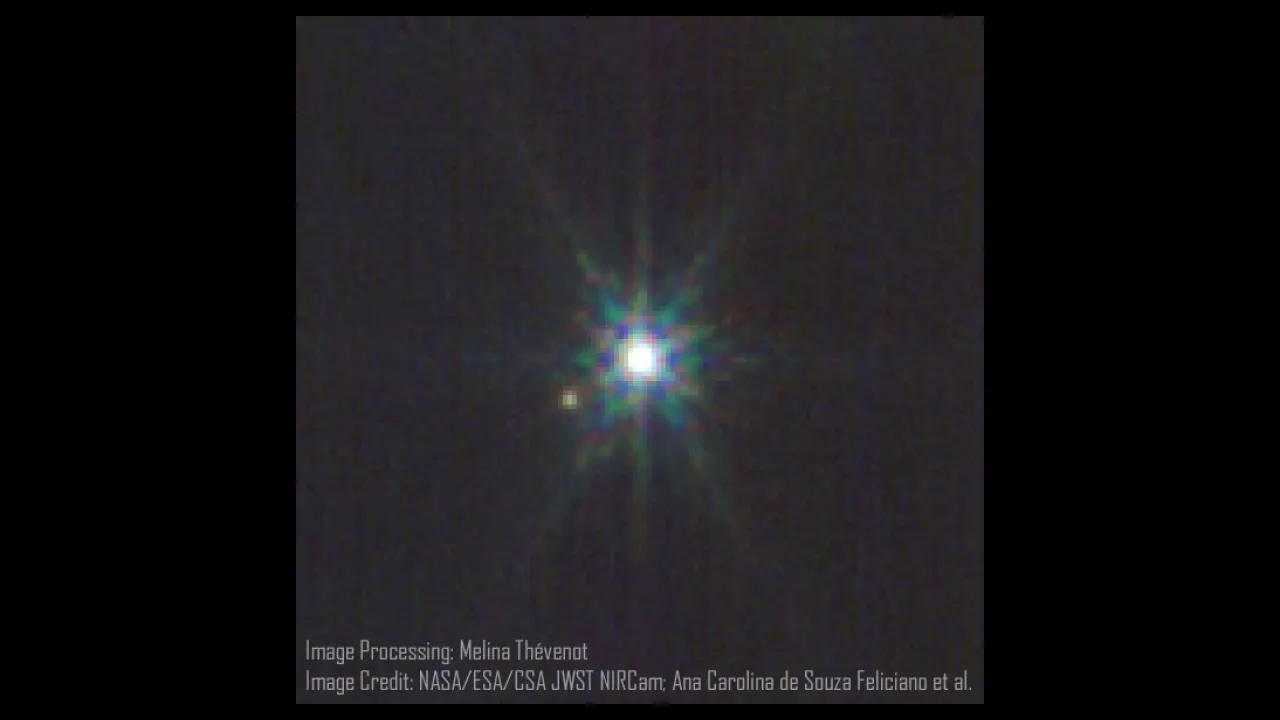
1. How does Eris compare to Pluto in weight (mass)?
2. Why does Eris shine so bright white out in dark space?
🤯 Mind-Blowing Fact • Grade 2
Scientists fittingly named Eris after the ancient Greek goddess of arguments and commotion because its discovery sparked lively debates at astronomy meetings worldwide!
✨ Word Sparks (Grade 2 Glossary)
Tap 🔊 to hear
Debate
A big discussion where people share different ideas.
Scattered Disk
Far-flung zone of tilted icy orbits past Neptune.
Frost
Sparkling frozen coating of super-cold gases.
🪝
How did spotting Eris in 2005 spark the biggest space debate of the century?
1
The World That Shook Textbooks
In January 2005, astronomer Mike Brown and his team spotted a slow-moving dot nearly three times farther from the Sun than Pluto! Was it the tenth planet? Because Eris turned out to be heavier than Pluto, astronomers had to decide what 'planet' truly meant—creating the brand-new dwarf planet family in 2006!
2
A 559-Year Trip
Eris loops along a steeply tilted oval path through the , taking 559 Earth years to circle the Sun once!
3
Meet Little Dysnomia
One moon named Dysnomia circles Eris every sixteen days, helping scientists weigh Eris using gravity math!
1. What happened in astronomy right after Eris was discovered in 2005?
2. What is the name of the moon orbiting Eris?
🤯 Mind-Blowing Fact • Grade 3
Last time Eris reached the closest point to the Sun in its 559-year orbit, painters like Leonardo da Vinci and Michelangelo were working during the Renaissance in the late 1600s!
✨ Word Sparks (Grade 3 Glossary)
Tap 🔊 to hear
Aphelion
Farthest point from the Sun in an orbit.
Perihelion
Closest point to the Sun in an orbit.
Glaze
A thin, smooth, shiny coating of frost.
🪝
How does Eris grow a brand-new sky every five centuries and then freeze it back down again?
1
Shiniest Dwarf Planet
Right now, Eris glides near the farthest point of its long orbit—96 times farther from the Sun than Earth! At minus 405 degrees Fahrenheit, Eris reflects 96 percent of all sunlight that touches it, tying Saturn's moon Enceladus as the brightest snowball in our Solar System.
2
A Breathing Atmosphere
Why is its snow so fresh? Over two centuries from now, Eris's oval orbit will carry it much closer to the Sun—right near Pluto's distance! Milder sunlight will sublimate surface frost into a thin gas atmosphere, then refreeze clean white snow across the whole globe when Eris heads back out!
3
Measured by Starlight Shadow
In 2010, Eris passed in front of a faint star over South America. Timing its shadow proved Eris is 1,445 miles wide—just thirty-two miles narrower than Pluto!
4
Heavy Rocky Heart
Even though Pluto is a hair wider, Eris is packed with eighty-five percent dense rock underneath a thin icy !
1. How do Pluto and Eris compare in physical width versus total mass?
2. What happens to Eris's frozen surface frost when its 559-year orbit swings closer to the Sun?
🤯 Mind-Blowing Fact • Grade 4
Radio telescopes in Chile proved in 2023 that Eris and its moon Dysnomia stare permanently face-to-face every 15.8 days—making them a giant tidally locked pair just like Pluto and Charon!
✨ Word Sparks (Grade 4 Glossary)
Tap 🔊 to hear
Geothermal
Driven by natural heat deep inside rocky cores.
Deuterium
Heavy version of hydrogen carrying an extra neutron.
Slingshot
Gravitational boost flinging an icy world far outward.
🪝
How did the James Webb Space Telescope prove warm chemistry cooked methane deep inside freezing Eris?
1
Geothermal Methane From Deep Inside
For years, astronomers assumed the frozen methane blanketing distant Eris was leftover primordial ice collected from the birth cloud of our Solar System. In 2024, the James Webb Space Telescope measured heavy hydrogen atoms () inside Eris's methane—and delivered a stunner! Eris has far less deuterium than comets do, proving its methane was cooked up geothermally by hot water-rock reactions deep inside Eris's rocky core and vented upward!
2
Convective Slushy Mantle
Measuring 2.43 grams per cubic centimeter—significantly denser than Pluto's 1.85—Eris packs enormous radioactive heat inside its silicate core. That warmth softens its overlying water-ice shell into a slowly convecting glacier that flattens big mountains and continually refreshes surface methane.
3
Locked Face-to-Face With Dysnomia
In 2023, radio-telescope measurements from Chile's ALMA array weighed 430-mile-wide Dysnomia and proved Eris has slowed down from tidal friction until both Eris and Dysnomia are mutually tidally locked—spinning once every 15.79 days just like Pluto and Charon!
4
Flung Into the Scattered Disk
Tilted 44 degrees to the planetary plane and swinging from 38 to 97.5 AU, Eris was gravitationally slingshotted into the Scattered Disk by migrating Neptune four billion years ago.
1. What did JWST's 2024 deuterium measurements reveal about the methane frost on Eris?
2. How long is one single day (rotation) on tidally locked Eris?
🤯 Mind-Blowing Fact • Grade 5
Even at minus 405 degrees Fahrenheit on the surface, radioactive rock inside Eris's oversized core heats its deep interior above 300 degrees Fahrenheit (150°C)—hot enough to cook up methane gas!
✨ Word Sparks (Grade 5 Glossary)
Tap 🔊 to hear
Thermogenic
Produced by high heat breaking down carbon compounds.
Geometric albedo
Brightness reflected straight back toward the light source.
Viscous creep
Slow glacier-like flow of solid ice under weight.
🪝
Why does Eris lack Pluto's rugged water-ice mountains despite outweighing Pluto by four quintillion tons?
1
Palomar Survey and Stellar Occultation Precision
Identified on January 5, 2005, from October 2003 Palomar Observatory survey frames by Mike Brown, Chad Trujillo, and David Rabinowitz, Eris initially appeared larger than Pluto based on extreme optical brightness near 97 astronomical units. Not until November 6, 2010, when Eris occulted a seventeenth-magnitude star across Chilean telescopes, did astronomers pin its spherical diameter at 2,326 kilometers with a of 0.96—yielding a dense 2.43-gram-per-cubic-centimeter interior holding 1.27 times Pluto's mass.
2
Dissipative Spin-Down With Collisional Dysnomia
Millimeter thermal emissions from Dysnomia (diameter roughly 615 to 700 kilometers, albedo just 0.05) measured by ALMA constrained the moon-to-Eris mass ratio between 0.008 and 0.018. For Dysnomia's tidal torque to have despun massive Eris into exact 15.786-day synchronous lock over 4.5 billion years, Eris's water-ice mantle must be warm, deformable, and actively convecting rather than cold and rigid!
3
Isotopic Fingerprints of Hydrothermal Core Metamorphism
High-signal-to-noise JWST Near-Infrared Spectrograph observations in 2024 measured a methane deuterium-to-hydrogen ratio on Eris near 0.00025 alongside carbon-13 ratios consistent with abiotic cracking or serpentinization above 150 degrees Celsius inside a massive chondritic core—confirming volatile outgassing through a convecting 100-to-200-kilometer ice shell.
4
Viscous Relaxation vs. Pluto's Rugged Topography
Paradoxically, planetary geophysicists model Eris's outer shell as much smoother and softer than Pluto's: higher radiogenic heat flux from its 85-percent-mass rocky core warms its ice shell enough that flattens multi-kilometer topography over millions of years.
5
Collisional Volatile Stripping
Why is Eris so rock-rich compared to Pluto? An energetic giant impact in the early Scattered Disk likely stripped away much of proto-Eris's outer icy mantle while launching dark, ice-poor Dysnomia into equatorial orbit!