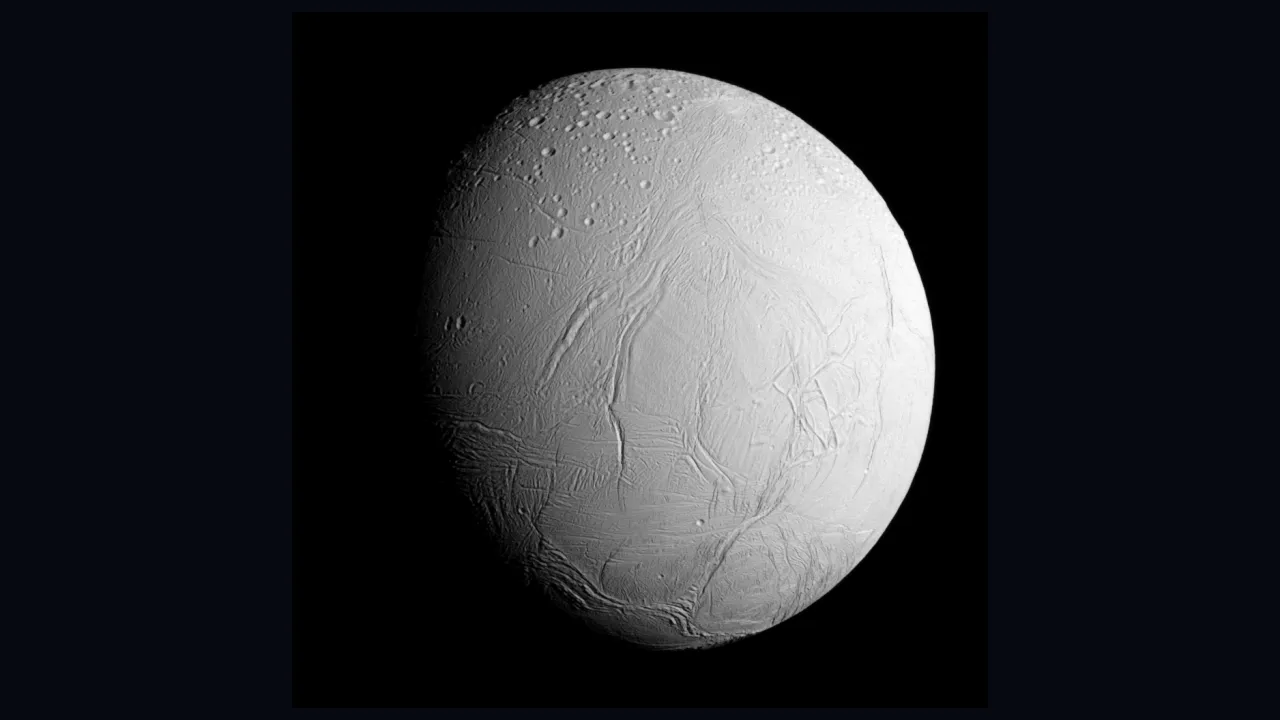
1. What shoots out of cracks at the south pole of Enceladus?
2. Why does Enceladus look so bright in space?
🤯 Mind-Blowing Fact • Grade 2
NASA's Cassini spacecraft actually flew straight through Enceladus's giant water plumes and 'tasted' salt and ocean chemicals in space!
✨ Word Sparks (Grade 2 Glossary)
Tap 🔊 to hear
Plume
A tall cloud of icy spray rising into space.
Tiger Stripes
Four warm parallel cracks at Enceladus's south pole.
Vapor
Water in the form of an invisible gas.
🪝
How can a moon small enough to fit inside Arizona build an entire planetary ring?
1
Small Size, Giant Surprise
Enceladus is only 313 miles wide—you could drive across its whole width in five hours! Because its clean white ice reflects almost all sunlight, its surface drops to a freezing minus 330 degrees Fahrenheit.
2
Warm Tiger Stripes
Scientists expected Enceladus to be frozen solid. Instead, four glowing cracks at its south pole—nicknamed —stay much warmer and blast icy spray hundreds of miles high!
3
Building Saturn's E-Ring
Most geyser snow falls back onto Enceladus, keeping it sparkling white. Fast ice grains escape gravity completely and form Saturn's wide, misty E-ring!
1. What nickname did scientists give the four warm cracks at Enceladus's south pole?
2. Which part of Saturn's ring system is built by ice escaping from Enceladus?
🤯 Mind-Blowing Fact • Grade 3
Water jets erupt from Enceladus's Tiger Stripes at over 800 miles per hour—faster than the speed of sound on Earth!
✨ Word Sparks (Grade 3 Glossary)
Tap 🔊 to hear
Tidal heating
Internal warmth created when gravity squeezes an orbiting moon.
Fracture
A deep crack split through solid rock or ice.
Hydrothermal vent
A warm mineral spring bubbling on a dark seafloor.
🪝
Why isn't tiny Enceladus frozen solid from top to bottom?
1
Squeezed by Gravity
Imagine squeezing a cold rubber ball in your hand until it warms up! As Enceladus whips around Saturn every 33 hours, its sibling moon Dione tugs its orbit into a slight oval. Saturn's gravity squeezes and stretches Enceladus, creating tidal heat deep inside.
2
Supersonic Ice Fountains
At the south pole, the icy crust thins to about twelve miles. Pressurized ocean water squeezes up through the 80-mile-long Tiger Stripe and blasts out faster than a jet airplane!
3
Cassini Samples an Alien Sea
Astronomers didn't even need to drill through miles of ice to test Enceladus's ocean. NASA's Cassini probe swooped within thirty miles of the surface and caught geyser grains right in its dust analyzer!
4
Ingredients for Life
Inside those icy droplets, Cassini found liquid water, sea salt, carbon molecules, and hydrogen—clues that warm vents bubble on the dark ocean floor.
1. What keeps the ocean inside tiny Enceladus warm enough to stay liquid?
2. Why is Enceladus easier to sample than many other ocean moons?
🤯 Mind-Blowing Fact • Grade 4
In 2023, the James Webb Space Telescope spotted a giant water vapor plume shooting more than 6,000 miles out from tiny Enceladus—twenty times the moon's own width!
✨ Word Sparks (Grade 4 Glossary)
Tap 🔊 to hear
Albedo
Measure of how much light a world's surface reflects.
Libration
A slight back-and-forth wobble of an orbiting moon.
Nanograin
A microscopic dust particle thousands of times thinner than hair.
🪝
How did tiny microscopic sand grains in space prove hot springs bubble on Enceladus's seafloor?
1
Highest Albedo in the Solar System
Discovered by William Herschel in 1789, Enceladus holds the Solar System record for Bond , reflecting over eighty percent of total solar energy and nearly ninety-nine percent of visible light. While cratered northern plains preserve ancient impacts, its southern hemisphere is remarkably smooth, sliced by tectonic ridges and four warm fissures named Alexandria, Cairo, Baghdad, and Damascus Sulci.
2
Global Libration Confirms a Global Sea
At first, scientists wondered if only a small south-polar lake fed the geysers. By tracking tiny wobbles—called —as Enceladus orbited Saturn in a 2:1 resonance with Dione, Cassini proved the entire icy shell slides freely over a global ocean 25 miles deep, completely detached from the porous rocky core!
3
Silica Nanograins and Hydrothermal Vents
Cassini's Cosmic Dust Analyzer detected microscopic silica inside Saturn's E-ring. On Earth, silica particles of that exact size form only when hot, alkaline mineral water above 90 degrees Celsius (194°F) shoots out of seafloor hydrothermal vents and hits cold ocean water!
4
Every Essential Element for Biology
Recent analysis of Cassini plume data confirmed dissolved phosphates alongside carbon, hydrogen, nitrogen, oxygen, and sulfur—meaning tiny Enceladus possesses all six primary chemical building blocks required for life as we know it.
1. What did microscopic silica nanograins in Enceladus's plumes prove to scientists?
2. How did scientists confirm Enceladus's ocean wraps around the entire moon rather than just the south pole?
🤯 Mind-Blowing Fact • Grade 5
Enceladus vents about 440 pounds (200 kilograms) of ocean water every second, and its plumes grow brightest at the farthest point of its orbit when Saturn's tides pull its cracks open!
✨ Word Sparks (Grade 5 Glossary)
Tap 🔊 to hear
Serpentinization
Chemical reaction between seawater and rock producing hydrogen fuel.
Chemoautotroph
A microbe making energy from chemicals instead of sunlight.
Apoapsis
The farthest point in a moon's oval planetary orbit.
🪝
Could microbes survive in complete darkness around hydrothermal chimneys inside a 500-kilometer moon?
1
Cryovolcanic Discovery via Magnetometry
Measuring just 504 kilometers in mean diameter with a bulk density of 1.61 grams per cubic centimeter, Enceladus surprised NASA's Cassini team in 2005 when its magnetometer noticed Saturn's magnetic field lines draping around an obstacle near the moon. Subsequent backlit images revealed over one hundred supersonic cryovolcanic jets venting roughly 200 kilograms of water vapor and ice particulates per second from four 130-kilometer-long fractures at the south polar terrain.
2
Porous Core Percolation and Tidal Dissipation
Maintained at an orbital eccentricity of 0.0047 by a 2:1 mean-motion resonance with Dione, Enceladus dissipates gigawatts of tidal energy. Because its silicate core has low density and high porosity, cold ocean water percolates kilometers deep into fractured rock, heats via tidal friction and reactions, and surges upward through alkaline hydrothermal vents similar to Earth's Lost City field in the Atlantic.
3
CHNOPS Chemistry and Methanogenesis Clues
During Cassini's daring 2015 flyby just 49 kilometers above the south pole, its Ion and Neutral Mass Spectrometer detected up to 1.4 percent molecular hydrogen ($H_2$) alongside carbon dioxide, methane, ammonia, macromolecular organics exceeding 200 atomic mass units, and sodium phosphates. On Earth, chemoautotrophic microbes feast on $H_2$ and $CO_2$ to generate energy without a single photon of sunlight!
4
Tidal Valve Mechanics of the Tiger Stripes
Plume brightness peaks near —the farthest point in Enceladus's orbit from Saturn—when tensile tidal stresses pull the Tiger Stripe faults widest open, acting like rhythmic cosmic valves.
5
Searching for Biosignatures
Because Enceladus lofts pristine ocean samples straight into space, proposed NASA Orbilander missions aim to orbit and land softly on its snowy south pole to test fresh plume fallout for amino acid chirality, lipid membranes, and potential microbial life.