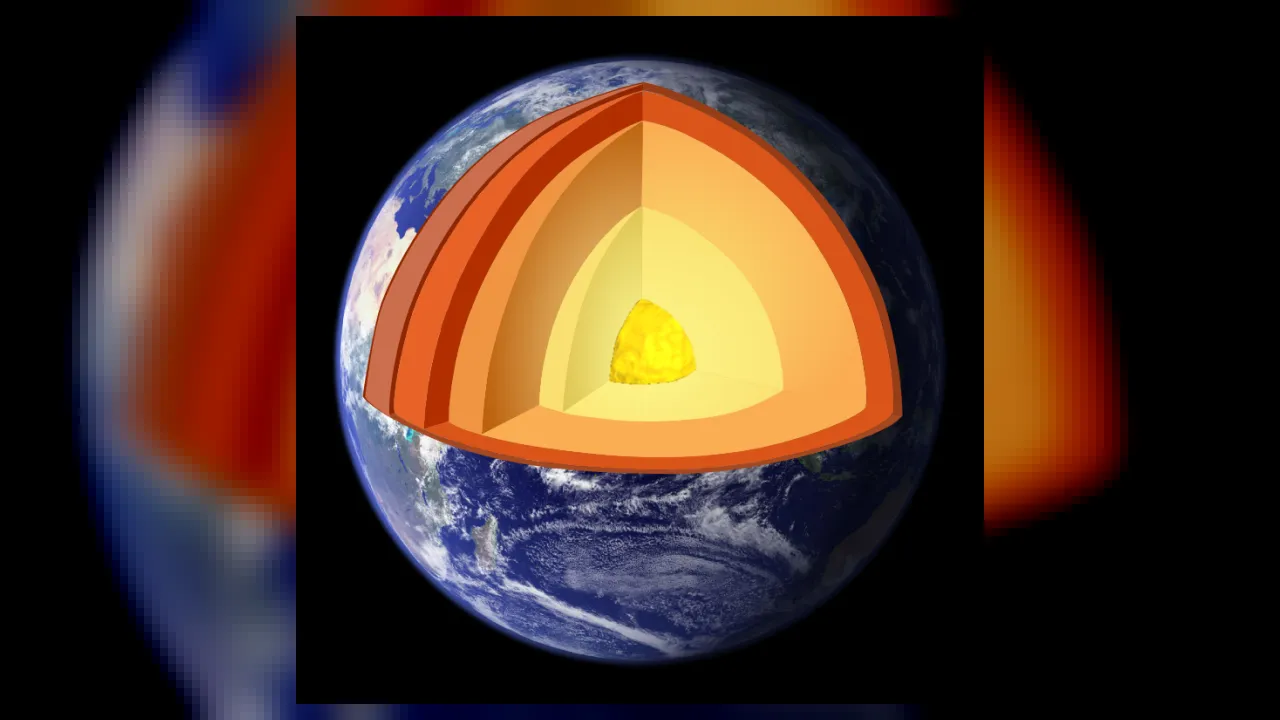
1. Which layer takes up most of the space inside planet Earth?
2. How fast does warm rock in the mantle creep along underground?
🤯 Mind-Blowing Fact • Grade 2
August's bright lime-green birthstone—peridot—is actually a gem crystal of olivine brought straight up from Earth's upper mantle by volcanoes!
✨ Word Sparks (Grade 2 Glossary)
Tap 🔊 to hear
Olivine
Green magnesium-iron mineral common in upper mantle
Magma
Pockets of melted rock formed underground
Volume
The amount of 3D space something fills
🪝
Is Earth's mantle a giant ocean of red liquid lava—or something way more surprising?
1
Busting the Lava Myth!
Picture books often paint Earth's mantle bright red, tricking people into thinking the whole mantle is liquid ! In real life, heavy pressure keeps almost 99 percent of the 1,800-mile-thick mantle completely solid rock—mostly rich olive-green crystals called .
2
Bendy Like Silly Putty
How can solid rock move? Under thousands of degrees of heat and immense pressure, solid mantle rock behaves like warm candle wax or stiff putty over millions of years—slowly rising when hot and sinking when cooler!
3
Diamonds From the Deep
Way down in the mantle, carbon squeezes into sparkling diamonds that ancient volcanic 'pipes' blasted upward toward the surface!
1. What is almost all of Earth's mantle actually like?
2. Which sparkling gemstone forms deep inside Earth's high-pressure mantle?
🤯 Mind-Blowing Fact • Grade 3
Rare tectonic crashes occasionally shove slices of green upper-mantle rock right onto dry land—so hikers at Gros Morne National Park in Canada can literally walk on exposed Earth mantle!
✨ Word Sparks (Grade 3 Glossary)
Tap 🔊 to hear
Lithosphere
Rigid outer shell of crust and top mantle
Asthenosphere
Soft, bendable upper-mantle zone beneath tectonic plates
Mantle Plume
Rising column of extra-hot solid mantle rock
🪝
How does slow-motion heat churning inside the mantle move giant continents across the globe?
1
Eighty-Four Percent of Our World
Stretch a tape measure from the bottom of Earth's crust down to the liquid outer core, and the mantle spans a colossal 2,900 kilometers (1,800 miles)! Accounting for 84 percent of Earth's volume and two-thirds of its mass, the mantle is packed with dense magnesium- and iron-rich silicate minerals.
2
Lithosphere Rides on Asthenosphere
Geologists split the top of the mantle into two teamwork zones! The cool, rigid uppermost mantle locks onto the crust above it to form stiff puzzle pieces called the . Right underneath sits the hotter, softer —a ductile solid zone slippery enough for tectonic plates to glide across!
3
Giant Convection Loops
Just like warm soup rising from the bottom of a pot on a stove, mantle rock heated near the core slowly rises over millions of years, spreads sideways under the plates, cools off, and sinks back down in giant convection currents.
4
Hotspot Volcano Chains
Sometimes extra-hot rise like narrow blowtorches from deep underground—melting spots through moving ocean plates to build island chains like Hawaii!
1. Which soft, bendable layer of the upper mantle lets stiff tectonic plates slide slowly on top of it?
2. What drives the giant slow-motion convection currents inside Earth's mantle?
🤯 Mind-Blowing Fact • Grade 4
Although you will never pick up a chunk of 'bridgmanite' on a normal hike, that high-pressure lower-mantle crystal is actually the #1 most common mineral on planet Earth—outnumbering feldspar nearly two-to-one across the whole globe!
✨ Word Sparks (Grade 4 Glossary)
Tap 🔊 to hear
Moho
Boundary separating Earth's crust from denser mantle
Bridgmanite
Earth's most abundant mineral, filling lower mantle
Decompression Melting
Hot solid rock melting as pressure drops upward
🪝
How did geologists discover the most abundant mineral on Earth—hidden 400 miles underground—by studying a crashed meteorite?
1
Crossing the 'Moho' Into Peridotite
In 1909, Croatian seismologist Andrija Mohorovičić noticed that earthquake waves suddenly accelerated from about 6.5 km/s to over 8 km/s right beneath Earth's crust! Today called the '' (Mohorovičić Discontinuity), this boundary marks where lighter crustal granite and basalt end and dense olive-green mantle peridotite begins—rich in olivine, pyroxene, and red garnet.
2
Mineral Makeovers Under Crushing Depth
As you descend deeper into the mantle's 'Transition Zone' (410 to 660 kilometers down), crushing pressure forces olivine's atoms to repack into tighter, denser crystal structures without changing chemistry—first into emerald-green wadsleyite, then cobalt-blue ringwoodite! Below 660 kilometers in the lower mantle, crystals transform again into ultra-dense '' (magnesium silicate perovskite). Named in 2014 after scientists finally found natural microscopic specks inside a shocked meteorite, bridgmanite actually makes up ~38 percent of our entire planet—Earth's single most abundant mineral!
3
Decompression Melting Feeds Volcanoes
If the mantle is solid rock, where does liquid lava come from? Beneath mid-ocean ridges and hotspots, hot solid mantle peridotite rises toward lower pressure near the surface; dropping pressure lowers its melting point (''), causing 5 to 20 percent of the rock to melt into basaltic magma!
4
Hidden Oceans Locked in Crystal
Tiny diamonds brought up from the 500-kilometer-deep Transition Zone revealed real ringwoodite crystals holding 1.5 percent water molecules locked inside their atomic lattices—meaning Earth's deep mantle holds more water locked in dry crystal structure than all surface oceans combined!
1. How does solid mantle rock melt to feed mid-ocean ridge volcanoes without suddenly getting hotter?
2. In what form does the mantle Transition Zone (410–660 km deep) store vast amounts of water?
🤯 Mind-Blowing Fact • Grade 5
In 2023, scientists aboard the ocean drilling ship JOIDES Resolution drilled a record 4,160 feet (1,268 meters) straight into exposed upper-mantle rock near the Mid-Atlantic Ridge's 'Lost City' hydrothermal vents!
✨ Word Sparks (Grade 5 Glossary)
Tap 🔊 to hear
Viscosity
Measure of how strongly a fluid resists flowing
Xenolith
Deep mantle rock fragment carried up by magma
Tomography
3D imaging of Earth's interior using seismic waves
🪝
What are the two continent-sized 'mystery blobs' sitting at the very bottom of Earth's mantle beneath Africa and the Pacific Ocean?
1
Rheology of Solid-State Dislocation Creep
How can a crystalline silicate solid transmit high-speed seismic shear waves (4.5 to 7.3 km/s) like rigid steel on a one-second timescale, yet flow like a convecting fluid over tens of millions of years? Mantle geodynamics hinges on solid-state 'dislocation and diffusion creep' at temperatures spanning ~1,000°C below the Moho to ~3,700°C above the core-mantle boundary! With an astronomical of 10^21 pascal-seconds—roughly a sextillion times thicker than kitchen honey—individual crystal vacancies hop atom-by-atom under tectonic stress, allowing solid peridotite and bridgmanite to convect at centimeters per year while generating internal radiogenic heat from decaying uranium-238, thorium-232, and potassium-40.
2
Seismic Discontinuities at 410 km, 660 km, and D''
Global seismic maps sharp global speed jumps inside the mantle where pressure triggers solid-state phase transitions in (Mg,Fe)2SiO4! At 410 km (~14 GPa), orthorhombic olivine collapses into spinel-structured wadsleyite; at 520 km, into ringwoodite; and at 660 km (~24 GPa), ringwoodite disproportionates into octahedral bridgmanite ((Mg,Fe)SiO3) plus ferropericlase ((Mg,Fe)O). Just 200 km above the liquid core—inside the enigmatic D'' ('D-double-prime') thermal boundary layer (~125 GPa)—bridgmanite flattens one final time into 'post-perovskite.'
3
LLSVPs: Continent-Sized Blobs at the Mantle Base
3D seismic CT scans of the deep lower mantle revealed two colossal structures nicknamed 'Tuzo' (beneath Africa) and 'Jason' (beneath the central Pacific)—Large Low-Shear-Velocity Provinces (LLSVPs) towering up to 1,000 kilometers above the core! Denser and chemically distinct from surrounding bridgmanite—possibly ancient subducted oceanic crust piles or remnants of the 4.5-billion-year-old Moon-forming Theia impact—the edges of these deep blobs launch most of Earth's major hotspot plumes and diamond-bearing kimberlites.
4
Xenoliths and Ophiolites: Direct Mantle Samples
Although deep-sea drilling vessels like JOIDES Resolution and Chikyu probe thin oceanic crust toward the Moho (recovering a record 1,268-meter continuous serpentinized mantle peridotite core along the Mid-Atlantic Ridge in 2023!), geologists also inspect ''—fist-sized green peridotite nodules ripped from 50–200 km depths and rocketed upward at supersonic speeds in volcanic kimberlite pipes.
5
Planetary Recycling Over Billions of Years
Tomographic images track cold blue slabs of subducted ocean seafloor sinking all the way past 660 km toward the core graveyard—proving whole-mantle convection links surface oceans, atmosphere volatiles, and deep-Earth chemistry in one grand planetary engine.