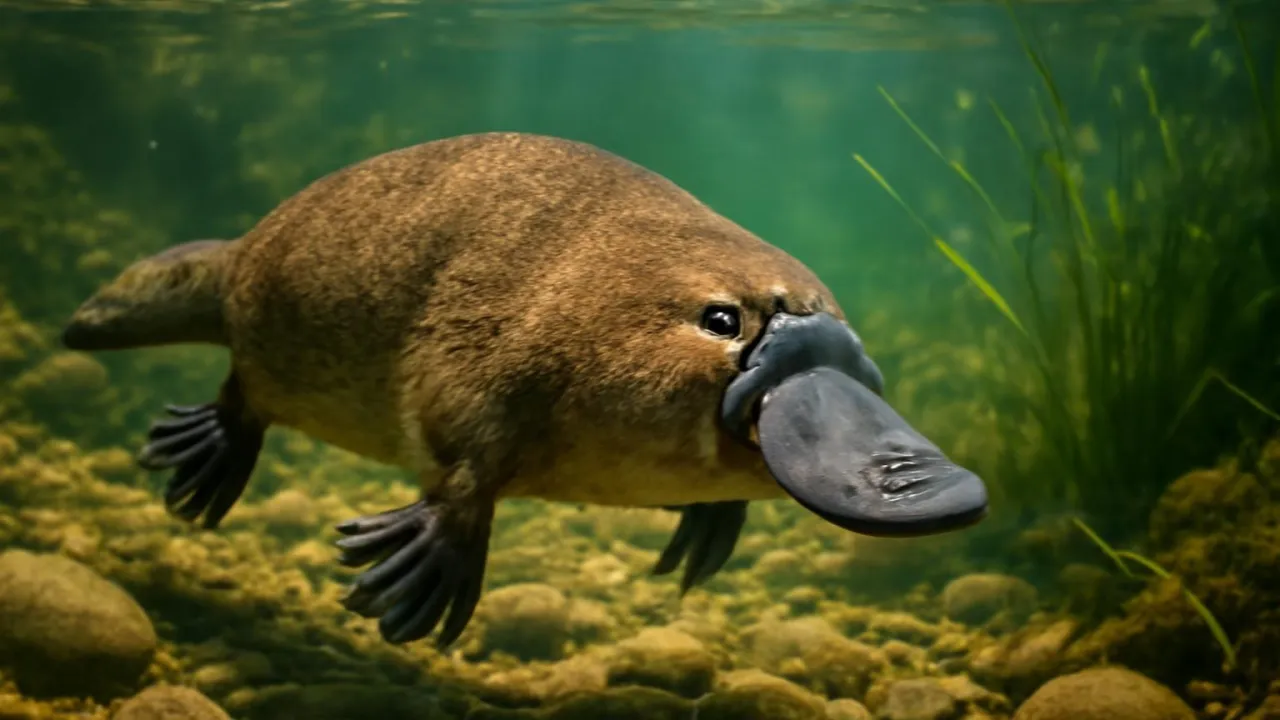
Even though it lays eggs, the platypus feeds its babies with milk like other mammals!
✨ Word Sparks (Grade 2 Glossary)
Tap 🔊 to hear
burrow
A home dug in the ground
larvae
Baby insects that live in water
electric signals
Tiny energy that animals can sense
🪝
Have you ever seen an animal with a duck’s bill and webbed feet?
1
Appearance and Features
The duck-billed platypus has a flat bill and soft brown fur covering its body. It has webbed feet that help it swim quickly in water. Its tail is broad and flat, which helps with balance and storing fat.
2
Habitat and Home
This animal lives in freshwater rivers and lakes in eastern Australia and Tasmania. It builds along riverbanks to hide and rest during the day. The platypus is mostly active at night when it searches for food.
3
Diet and Special Skill
The platypus eats insects, , and small water animals it finds underwater. It uses its bill to detect from prey hiding in mud or sand. This special sense helps it find food even when it cannot see well.
The platypus can detect electric signals from prey even when its eyes and ears are closed underwater!
✨ Word Sparks (Grade 3 Glossary)
Tap 🔊 to hear
electroreception
Sensing electric signals from animals
nocturnal
Active at night and sleeps in day
monotreme
A mammal that lays eggs
🪝
Did you know the platypus is one of the few mammals that lay eggs?
1
Unique Body Features
The duck-billed platypus has a wide, flat bill covered with sensitive skin to detect prey. Its webbed feet act like paddles, allowing it to swim fast underwater. The thick fur keeps it warm in cold water. These adaptations help it survive in its watery habitat.
2
Habitat and Behavior
Platypuses live in freshwater rivers and lakes in eastern Australia and Tasmania. They create burrows along riverbanks for shelter and protection. Mostly , they hunt for food at night to avoid predators. Their camouflage helps them blend into muddy waters.
3
Feeding and Senses
This mammal uses to sense electric fields made by small animals. It hunts underwater, closing its eyes and ears to focus on its bill’s signals. Platypuses eat insects, larvae, and small crustaceans found in riverbeds. This unique hunting method helps them find hidden prey.
4
Life Cycle and Reproduction
Unlike most mammals, the platypus lays eggs instead of giving birth to live young. The female lays one to three eggs and keeps them warm in a burrow. After hatching, the babies feed on the mother’s milk, which she secretes without nipples. This unusual reproduction is a key trait of .
1. Why does the platypus close its eyes underwater?
2. What makes the platypus different from most mammals?
🤯 Mind-Blowing Fact • Grade 4
Platypuses help keep freshwater ecosystems healthy by controlling insect populations and aerating soils.
✨ Word Sparks (Grade 4 Glossary)
Tap 🔊 to hear
electroreceptors
Body parts that sense electric signals
ecosystem
A community of living things and places
incubate
To keep eggs warm until they hatch
🪝
How does the duck-billed platypus survive in rivers with many predators?
1
Physical Adaptations and Survival
The platypus has a unique bill covered with that detect tiny electric signals from prey hidden in murky water. Its webbed feet and flat tail allow it to swim swiftly and steer precisely, helping it escape predators. Thick fur insulates its body, keeping it warm in cold freshwater environments.
2
Role in the Ecosystem
As a predator, the platypus controls insect and crustacean populations in freshwater food webs. It also serves as prey for larger animals like eagles and snakes, balancing the . Its burrowing habits aerate riverbanks, improving soil health and water quality. Humans impact platypus habitats through pollution and waterway changes.
3
Geographic Distribution
Platypuses are native to eastern Australia and Tasmania, living mainly in freshwater rivers and lakes. They prefer slow-moving streams with soft riverbeds for easy burrowing. Seasonal changes affect their activity, with more feeding during warmer months. Conservation efforts focus on protecting these habitats from human disturbance.
4
Reproduction and Development
Female platypuses lay one to three leathery eggs in burrows dug along riverbanks, where they them for about ten days. After hatching, the young feed on their mother’s milk, which is secreted through skin pores since platypuses lack nipples. This reproductive strategy is rare among mammals and helps maintain species survival.
1. What helps the platypus find prey in muddy water?
2. How do platypus babies get milk from their mother?
🤯 Mind-Blowing Fact • Grade 5
The platypus’s electroreception allows it to find prey hidden in murky water without using its eyes or ears!
✨ Word Sparks (Grade 5 Glossary)
Tap 🔊 to hear
monotreme
A mammal that lays eggs instead of live babies
electroreception
Sensing electric fields from other animals
riparian
Relating to riverbanks and nearby land
🪝
What makes the duck-billed platypus one of the most unusual mammals on Earth?
1
Taxonomy and Scientific Classification
The duck-billed platypus, scientifically named Ornithorhynchus anatinus, belongs to the order, which includes egg-laying mammals. It is the only living species in its genus and family, representing a unique evolutionary lineage dating back over 100 million years. This classification highlights its blend of reptilian and mammalian traits.
2
Physiological Adaptations and Mechanics
The platypus uses through thousands of receptors in its bill to detect electric fields generated by muscle contractions of prey. Its dense fur provides excellent insulation, maintaining body temperature in water as cold as 5 degrees Celsius. Webbed feet retract on land, allowing efficient walking, while the broad tail stores fat reserves for energy.
3
Conservation Status and Human Impact
Currently classified as Near Threatened, the platypus faces habitat loss due to water pollution, dam construction, and climate change. Conservation programs focus on protecting river habitats and monitoring populations to prevent decline. Public education raises awareness about the platypus’s ecological importance and the need for freshwater ecosystem preservation.
4
Ecological Role and Behavior
As a semi-aquatic predator, the platypus regulates populations of aquatic invertebrates, contributing to balanced freshwater food webs. Its nocturnal foraging reduces competition with other species. Burrowing activities enhance soil aeration and nutrient cycling, supporting healthy zones. Seasonal breeding cycles align with water temperature changes.
5
Quantitative Comparisons and Unique Traits
Adult platypuses measure about 20 inches (50 centimeters) long and weigh between 2 to 5 pounds (1 to 2.3 kilograms). They can swim at speeds up to 1.2 miles per hour (2 kilometers per hour) using webbed feet. Remarkably, females lay 1 to 3 leathery eggs and incubate them for 10 days, a rare trait among mammals.