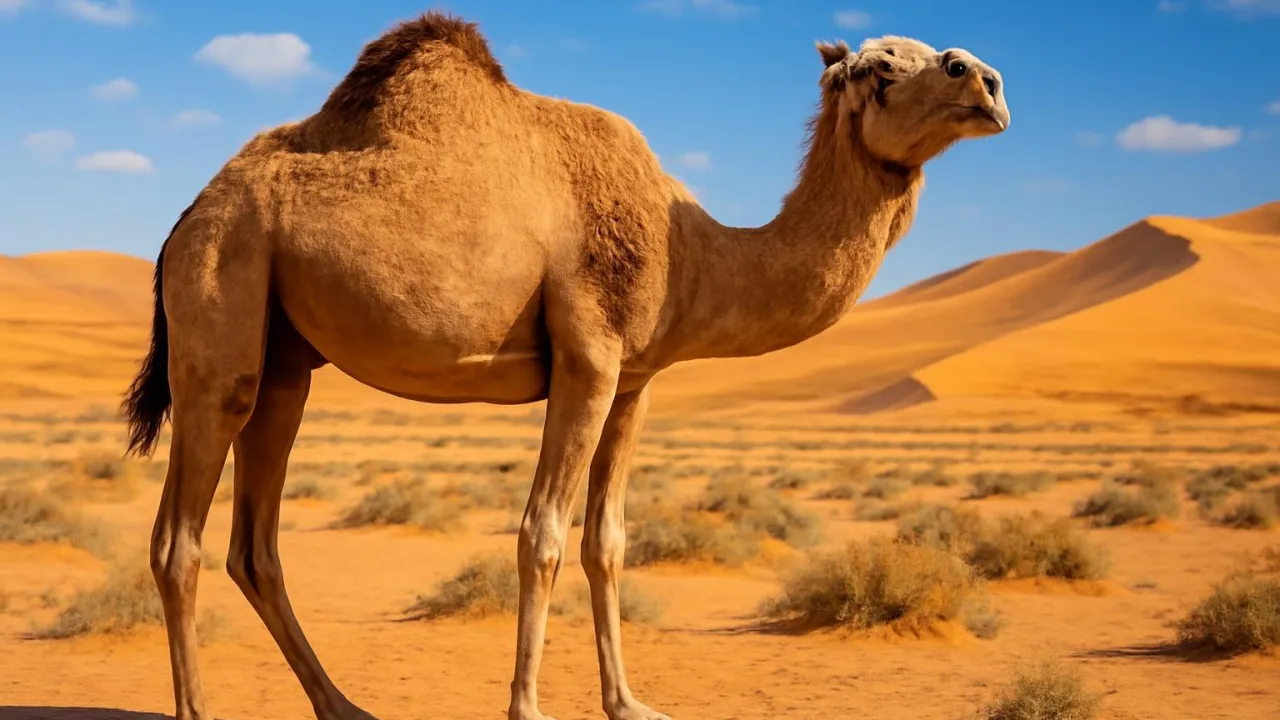
Dromedary camels can drink up to 30 gallons of water in just 13 minutes!
✨ Word Sparks (Grade 2 Glossary)
Tap 🔊 to hear
hump
A fat bump on a camel’s back
desert
A very hot and dry place
fur
Soft hair that covers animals
🪝
Have you ever wondered how camels survive in the hot desert sun?
1
Camels’ Unique Hump
The dromedary camel has one large on its back. This hump stores fat for energy. It helps camels survive without food for days. The hump also keeps their body cool.
2
Desert Home
Dromedary camels live in hot where water is very rare. They travel long distances on sand dunes. The desert sun is strong and dry. Camels have thick that protects them from heat.
3
What Camels Eat and Drink
Camels eat dry plants and thorny bushes that other animals avoid. They can drink large amounts of water quickly. Sometimes, camels go weeks without drinking water at all.
2. How do camels protect themselves from the hot sun?
🤯 Mind-Blowing Fact • Grade 3
A dromedary camel’s hump can weigh up to 80 pounds of fat!
✨ Word Sparks (Grade 3 Glossary)
Tap 🔊 to hear
adaptation
A body change that helps survival
insulate
To keep heat in or out
conserve
To save or use carefully
🪝
Did you know dromedary camels have special adaptations to live in deserts?
1
Amazing Hump Adaptation
The dromedary camel’s single hump stores fat, which provides energy during food scarcity. This helps camels survive long desert journeys without eating. The hump also reduces heat absorption, aiding temperature regulation. It is a key survival feature in harsh environments.
2
Living in Hot Deserts
Dromedary camels inhabit arid deserts where water and food are scarce. Their thick fur them from extreme heat during the day and cold at night. Camels’ wide feet prevent sinking into soft sand, helping them walk easily. These protect camels from predators and harsh climates.
3
Diet and Water Conservation
Camels feed on tough, dry plants that many animals avoid, gaining necessary nutrients. They can drink large amounts of water quickly to rehydrate after long thirst periods. Camels’ bodies water by producing dry feces and concentrated urine. This efficient water use is crucial for desert survival.
4
Cool Body Features
Camels have long eyelashes and ear hairs that protect against sand and dust. Their nostrils can close tightly to keep out blowing sand. Camels’ thick lips allow them to eat thorny plants without injury. These features help camels thrive in their sandy habitat.
Dromedary camels can lose up to 25% of their body weight from water and still survive.
✨ Word Sparks (Grade 4 Glossary)
Tap 🔊 to hear
ecosystem
All living things in one place
herbivore
An animal that eats plants
disperse
To spread seeds or animals far
🪝
How do dromedary camels survive and help desert ecosystems thrive?
1
Hump and Energy Storage
The dromedary camel’s single hump stores fat, which the body converts into energy and water during scarce times, allowing survival in deserts. This adaptation reduces heat gain by limiting fat distribution across the body, helping camels regulate temperature efficiently. Because of this, camels can travel long distances without food or water. Their humps are a vital cause of their desert endurance.
2
Role in Desert Ecosystems
Dromedary camels play important roles in desert food webs as , feeding on tough plants and shrubs that other animals avoid. They help seeds through their droppings, supporting plant growth and biodiversity. Humans domesticate camels for transport, milk, and meat, impacting positively and negatively. Camels’ grazing can affect vegetation patterns, showing cause and effect in deserts.
3
Geographic Range and Habitat
These camels inhabit deserts across North Africa, the Middle East, and parts of South Asia, thriving in arid climates with extreme temperatures. Their thick fur protects them from sunburn during the day and cold nights, showing adaptation to harsh environments. Camels’ wide feet prevent sinking in sand, enabling efficient movement across dunes. Their habitat range demonstrates their ecological flexibility.
4
Physical Features for Survival
Camels have long eyelashes and ear hairs that block blowing sand and dust, protecting sensitive areas. Their nostrils close tightly to keep out desert sandstorms, preventing respiratory problems. Thick, leathery lips allow them to eat thorny desert plants without injury, ensuring nutrient intake. These physical traits are critical adaptations to desert life.
Dromedary camels can survive losing 25% of their body water, far beyond most mammals’ limits.
✨ Word Sparks (Grade 5 Glossary)
Tap 🔊 to hear
physiology
How a body works inside
metabolize
To change food into energy
herding
Caring for groups of animals
🪝
What makes the dromedary camel a master of desert survival and human history?
1
Scientific Classification and Evolution
The dromedary camel, scientifically named Camelus dromedarius, belongs to the family Camelidae. It evolved about 4 million years ago adapting to arid environments. Unlike the Bactrian camel with two humps, the dromedary has a single hump specialized for fat storage. This evolutionary trait supports survival in extreme desert climates by providing energy and water.
2
Physiological Mechanisms for Desert Life
Dromedary camels possess unique physiological adaptations including the ability to tolerate body temperature fluctuations from 93°F to 106°F without sweating. Their hump stores up to 80 pounds of fat, which into water and energy. Camels conserve water by producing dry feces and highly concentrated urine. Their red blood cells are oval-shaped, allowing better blood flow during dehydration.
3
Conservation and Human Impact
While wild dromedary camels are extinct, domesticated populations exceed 14 million worldwide, primarily in Africa and Asia. Humans rely on camels for transportation, milk, meat, and wool, integrating them into agricultural economies. However, overgrazing by camels can degrade desert vegetation, leading to soil erosion. Conservation efforts focus on sustainable to balance ecological health.
4
Quantitative Comparisons and Physical Features
Adult dromedary camels stand about 7 feet tall at the shoulder and weigh up to 1,320 pounds. They can drink 30 gallons of water in 13 minutes and survive without water for up to two weeks. Their broad, padded feet measure about 8 inches wide, preventing sinking in sand. Camels’ eyelashes contain three layers to protect eyes from harsh desert winds.
5
Historical and Cultural Significance
Dromedary camels have been domesticated for over 3,000 years, playing a crucial role in trade across the Silk Road and Arabian Peninsula. They enabled long-distance travel and cultural exchange in some of the world’s harshest environments. Today, camels remain symbols of endurance and survival in desert cultures, celebrated in festivals and folklore.