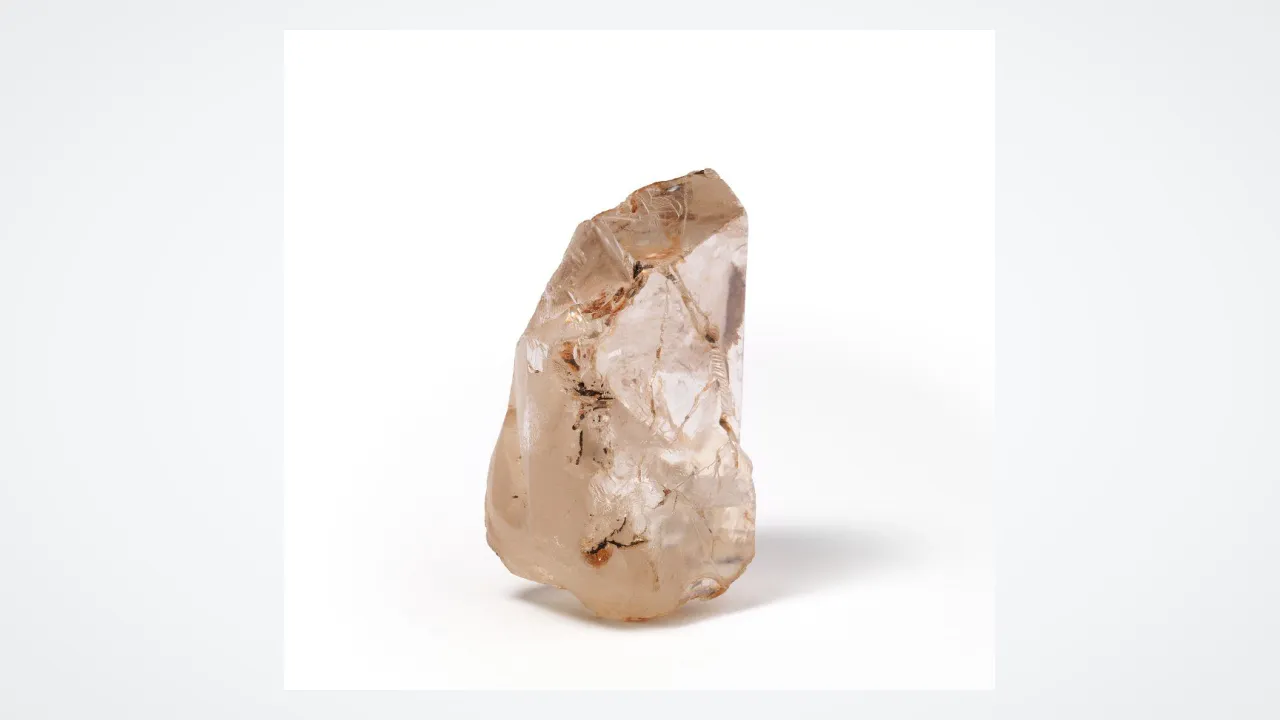
2. Why do builders put tiny diamonds on saw blades?
🤯 Mind-Blowing Fact • Grade 2
Most natural diamonds formed more than one billion years ago—long before dinosaurs walked on Earth!
✨ Word Sparks (Grade 2 Glossary)
Tap 🔊 to hear
pressure
Strong pushing force pressing on something
volcano
An opening in Earth where hot rock erupts
mineral
A natural solid crystal formed in Earth
🪝
How can dark pencil lead and a sparkling diamond be made of the exact same stuff?
1
Same Element, Big Surprise
Look closely at the dark tip of your pencil, and then picture a sparkling gem. Believe it or not, both are made of pure carbon! Inside a pencil, flat carbon sheets slide apart easily.
2
Squeezed in Earth's Oven
Deep beneath your feet, about one hundred miles down, Earth is super hot and heavy. Crushing weight locks carbon atoms together on every side, building a crystal that never bends.
3
Riding Volcano Elevators
Ancient pushed fast tubes of melted rock up toward the ground. These rocky elevators carried hidden diamonds close to the surface, where miners and scientists find them today.
1. What shares the exact same carbon element as a diamond?
2. How did deep mantle diamonds reach Earth's surface?
🤯 Mind-Blowing Fact • Grade 3
About four out of every five diamonds mined on Earth are used for heavy-duty tools and science equipment rather than jewelry!
✨ Word Sparks (Grade 3 Glossary)
Tap 🔊 to hear
Mohs scale
A one-to-ten chart ranking mineral scratch hardness
mantle
The thick hot rock layer below Earth's crust
facet
A flat polished side cut onto a gem
🪝
Why does a diamond score a perfect 10 on the mineral hardness scale?
1
Top of the Mohs Scale
Imagine rubbing two rocks together to see which one leaves a mark. Geologists use the Mohs Hardness Scale, numbered from one to ten, to test minerals. Soft talc sits at number one, while diamond rules at number ten as Earth's hardest natural mineral.
2
A Locked Pyramid Grid
Why is diamond so tough? Every single carbon atom bonds tightly to four neighbor atoms in a neat three-dimensional pyramid pattern. Because there are no weak gaps in this crystal grid, nothing softer can push the atoms apart.
3
Kimberlite Pipes from the Mantle
Natural diamonds grow in the upper under blistering heat and crushing pressure. Deep volcanic eruptions create carrot-shaped rock tubes called kimberlite pipes that blast diamonds upward before they can melt into graphite.
4
More Than Sparkly Jewelry
Jewelers cut flat windows called onto clear gems so white light bounces out in colorful flashes. Meanwhile, industrial diamonds drill oil wells, polish telescope mirrors, and slice silicon computer chips.
1. What number does diamond hold on the Mohs Hardness Scale?
2. What are the carrot-shaped volcanic rock tubes that carry diamonds upward called?
🤯 Mind-Blowing Fact • Grade 4
Diamond conducts heat so rapidly that touching a room-temperature diamond feels icy cold because it pulls warmth straight out of your fingertip!
✨ Word Sparks (Grade 4 Glossary)
Tap 🔊 to hear
refraction
The bending of light passing into dense material
cleavage
The tendency of crystals to split along flat planes
synthetic
Made by humans in a laboratory using science
🪝
What happens to light when it enters a crystal that slows sunbeams down by more than half?
1
Trapping and Bending Sunbeams
Hold a cut gemstone under a lamp and watch flashes of red, blue, and violet dance across the room. Light travels blazingly fast through air, yet the dense carbon lattice inside a diamond slows that light down by nearly sixty percent! This sharp slowdown bends light at steep angles—a property scientists call —splitting white beams into fiery rainbow colors.
2
Forged Beneath Ancient Cratons
Earth scientists studying rocks and minerals—a core Virginia Earth science topic—know that environment shapes crystal structure. Natural diamonds crystallize 90 to 120 miles underground beneath thick, ancient continental roots called cratons, where temperatures top 2,000 degrees Fahrenheit and pressures exceed 700,000 pounds per square inch.
3
Hardness Versus Toughness
Although diamond cannot be scratched by steel or quartz, geologists distinguish scratch hardness from impact toughness. Strike a diamond at just the right angle with a steel hammer and it can split cleanly along flat atomic planes known as directions.
4
Diamonds in Labs and Space
Today engineers grow real diamonds in weeks using high-pressure presses or superheated carbon gas. Because diamond conducts heat five times better than copper, tiny diamond plates cool high-power electronics and laser instruments aboard spacecraft.
1. Why does a cut diamond split white light into colorful flashes?
2. What happens if a diamond is struck hard along its atomic cleavage plane?
🤯 Mind-Blowing Fact • Grade 5
In 2014, geologists discovered a microscopic water-rich mineral called ringwoodite sealed inside a Brazilian diamond, proving that vast reservoirs of water are locked deep within Earth's mantle transition zone!
✨ Word Sparks (Grade 5 Glossary)
Tap 🔊 to hear
polymorph
Minerals with identical chemistry but different crystal shapes
inclusion
Material trapped inside a mineral while it grows
tetrahedral
Shaped like a four-sided pyramid atomic bond
🪝
How can tiny flaws trapped inside a diamond reveal what Earth's interior looked like three billion years ago?
1
Time Capsules from the Deep Mantle
To a mantle geologist, the most priceless diamond is rarely a flawless jewel—it is one containing tiny mineral specks trapped inside. Humans have never drilled deeper than about 7.6 miles into Earth's crust, leaving the underlying mantle completely out of reach. Because a diamond's rigid carbon cage shields microscopic for up to 3.5 billion years, rising crystals deliver untouched samples of deep-Earth chemistry straight to laboratory microscopes.
2
Polymorphs and Tetrahedral Bonding
Diamond and graphite are classic : minerals sharing an identical chemical formula (pure carbon, C) arranged into contrasting crystal architectures. In graphite, carbon atoms link into hexagonal sheets held together by weak forces that rub off onto paper. Under pressures above 45 to 60 kilobars and temperatures near 1,000 to 1,300 degrees Celsius, each carbon atom forms four equal covalent bonds in a rigid cubic lattice.
3
Supersonic Kimberlite Eruptions
If diamonds rose slowly with drifting mantle rock, dropping pressure while temperatures stayed high would rearrange their atoms back into ordinary graphite. Instead, volatile-rich magmas burst upward through cratonic fractures at speeds reaching hundreds of miles per hour, quenching diamonds inside cone-shaped kimberlite and lamproite pipes.
4
The Secrets Behind Colored Diamonds
Pure diamond is completely colorless, yet trace atomic substitutions transform its hue. One nitrogen atom replacing carbon per million atoms tints a crystal canary yellow, while trace boron atoms absorb red light to produce rare blue diamonds. Intense natural plastic deformation deep underground even creates rare pink diamonds.
5
High-Pressure Windows and Planetary Diamonds
In modern physics labs, scientists press two opposing gem tips together inside a Diamond Anvil Cell to recreate core-level pressures exceeding millions of atmospheres. Astronomers even calculate that crushing pressures inside ice giants Uranus and Neptune split methane molecules into literal diamond rain sinking toward planetary cores.