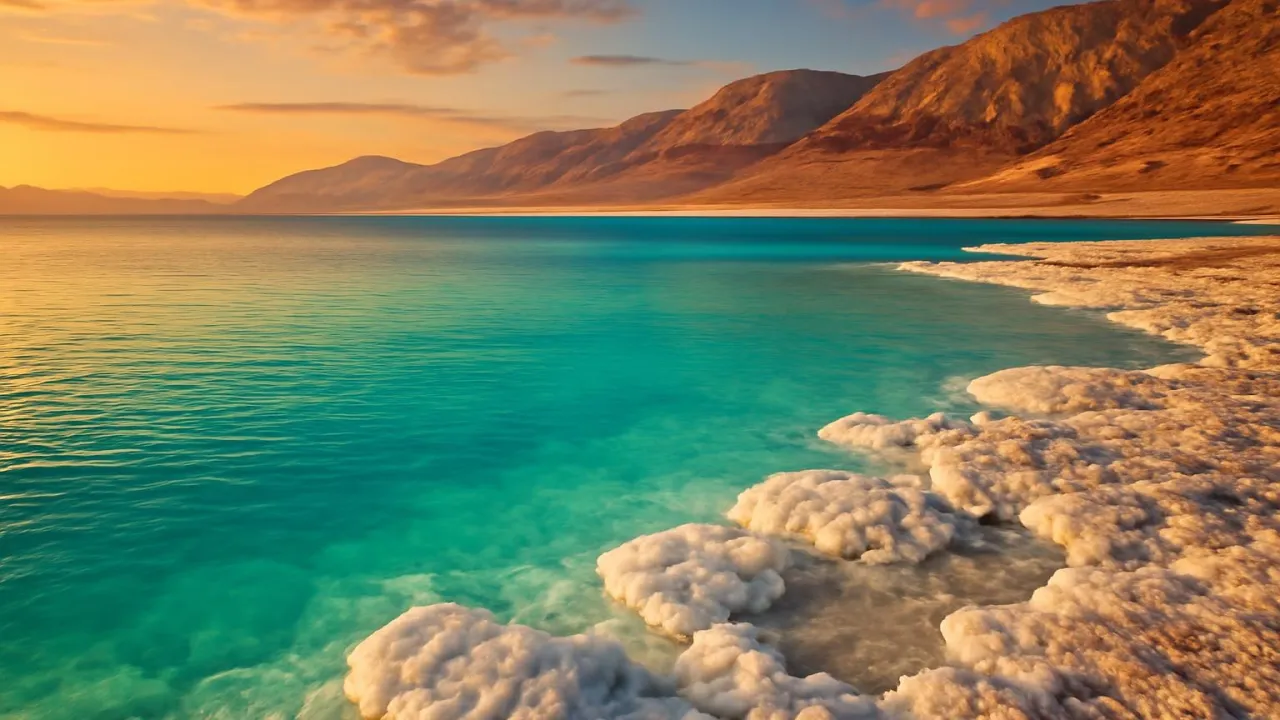
The Dead Sea is about ten times saltier than the ocean!
✨ Word Sparks (Grade 2 Glossary)
Tap 🔊 to hear
crystal
A shiny, hard piece of salt
lowest
The very bottom or lowest place
heavy
Something that weighs a lot
🪝
Have you ever floated without swimming at all?
1
A Lake Full of Salt
The Dead Sea has so much salt, it forms white on the shore. The water is much saltier than the ocean, making it feel thick and slippery. People visit to see the sparkling salt and bright blue water.
2
Floating Like Magic
If you step into the Dead Sea, you float without trying! The salt makes the water very , so your body stays on top. Many people come just to float and relax in the warm sun.
3
A Place Like No Other
The Dead Sea is the place on Earth's land. It lies in a hot, dry desert between steep mountains. People from all over the world come to see its strange beauty and try floating for themselves.
The Dead Sea’s water is so dense you can read a book while floating!
✨ Word Sparks (Grade 3 Glossary)
Tap 🔊 to hear
density
How tightly packed something is
evaporation
When water turns into air
mineral
A natural substance from the earth
🪝
What happens if you try to sink in the Dead Sea?
1
A Lake of Surprising Salt
The Dead Sea is famous for its super salty water, which is almost ten times saltier than the ocean. This salt forms shiny crystals along the rocky shore, making the landscape sparkle in the sun. The lake sits between tall, dry mountains in the Middle East. Its water feels slippery and thick because of all the dissolved .
2
Why You Float So Easily
When you step into the Dead Sea, your body floats right up! The reason is : all the salt makes the water much denser than regular lakes or oceans. This density creates strong buoyancy, so you barely have to move to stay on top. Even if you try to sink, the water keeps you up.
3
Earth’s Lowest Land Spot
The Dead Sea is the lowest place on land, lying over 1,300 feet below sea level. It is surrounded by desert and rocky cliffs, making the area very dry and hot. Rivers once fed the lake, but now very little water flows in. The hot sun causes fast , leaving even more salt behind.
4
A Place for Science and Fun
People visit the Dead Sea to float, relax, and see its sparkling shores. Scientists study its and how the salty water affects the land. The salty mud is used in special skin treatments around the world. This lake is a natural wonder that amazes everyone who visits.
The Dead Sea’s salty mud is used in spa treatments all over the world.
✨ Word Sparks (Grade 4 Glossary)
Tap 🔊 to hear
buoyancy
The force that makes things float
hypersaline
Very, very salty water
tectonic
Related to Earth’s moving plates
🪝
Imagine dipping your hand into water so salty you can barely sink—what’s happening beneath the surface?
1
A Hypersaline Wonder
The Dead Sea, located in the Jordan Rift Valley, is a lake with a salt concentration nearly ten times that of the ocean. Its dazzling white salt crystals cover the rocky shoreline, and the water feels slick due to dissolved minerals like magnesium and potassium. The lake’s unique chemistry means almost no plants or fish can survive in its waters. Surrounded by arid desert and steep cliffs, the Dead Sea creates a truly otherworldly landscape.
2
The Science of Floating
Floating in the Dead Sea is not magic—it’s science! The water’s high salt content increases its density, which means molecules are packed tightly together. This density creates strong , a force that pushes objects upward, allowing people to float effortlessly. Even those who cannot swim can safely bob on the surface, making it a favorite spot for curious travelers.
3
Earth’s Deepest Dry Land
The Dead Sea sits over 1,300 feet (400 meters) below sea level, making it the lowest exposed place on Earth’s land. Over millions of years, shifts formed the valley, and rivers once filled the lake. Today, little water flows in, and the hot desert sun causes rapid evaporation, leaving behind thick layers of salt and minerals.
4
Cultural and Scientific Importance
For thousands of years, people have visited the Dead Sea for its healing mud and mineral-rich water. Ancient civilizations used its resources for medicine and trade, while modern scientists study its geology and chemistry. The shrinking shoreline reminds us how climate and human use can change even the world’s most unique landmarks.
The Dead Sea’s surface is over 1,400 feet (430 meters) below sea level—lower than any other place on land!
✨ Word Sparks (Grade 5 Glossary)
Tap 🔊 to hear
Archimedes’ principle
A science rule explaining why things float
evaporation
When water turns into vapor and leaves
mineral deposit
Natural build-up of minerals from water
🪝
What if you could float so easily that reading a newspaper on water felt effortless—what secrets does the Dead Sea hold?
1
A Valley of Salt and Science
Nestled between Israel and Jordan, the Dead Sea is a hypersaline lake formed in the Jordan Rift Valley by tectonic plate movement millions of years ago. Its water contains about 34% salt—nearly ten times saltier than the ocean—resulting in dramatic white salt crystals along its shores. The lake’s surface sits approximately 1,410 feet (430 meters) below sea level, making it the lowest exposed point on Earth’s land. This unique environment supports almost no aquatic life, giving the Dead Sea its mysterious name.
2
Why Floating Feels Like Magic
The Dead Sea’s extraordinary buoyancy is a direct result of its high salt concentration, which increases the water’s density to about 1.24 kg/L. When you enter, the dense water pushes your body upward with greater force than regular lakes or oceans. This phenomenon, explained by , means even non-swimmers can lie back and float effortlessly. The sensation is so unusual that visitors often read books or newspapers while bobbing on the surface.
3
Geology and Changing Shorelines
The Dead Sea’s basin was created by tectonic shifts along the Dead Sea Transform fault, gradually sinking over millions of years. Historically, rivers like the Jordan fed the lake, but today much less water enters due to damming and irrigation. Combined with intense desert heat, this causes rapid —about 55 inches (140 cm) per year—leaving behind thick and causing the shoreline to recede dramatically.
4
Cultural, Economic, and Scientific Impact
For thousands of years, the Dead Sea has been a destination for healing, trade, and scientific discovery. Ancient Egyptians used its minerals for mummification, while Greeks and Romans praised its medicinal mud. Today, industries extract valuable minerals like potash and bromine, and scientists study its unique ecosystem to understand extreme environments. The shrinking lake highlights urgent environmental challenges faced by the region.
5
A Global Natural Wonder
The Dead Sea’s remarkable properties draw visitors, researchers, and conservationists from around the world. Its mineral-rich mud is exported to spas globally, and its geologic history provides clues about Earth’s changing climate. Ongoing restoration projects aim to slow the shrinking shoreline and preserve this natural wonder for future generations. The Dead Sea stands as a living laboratory, revealing the power of nature, science, and human impact.