2. How do scientists know dark matter is hiding in space?
🤯 Mind-Blowing Fact • Grade 2
Billions of tiny dark matter particles may be zipping harmlessly right through your bedroom every single second!
✨ Word Sparks (Grade 2 Glossary)
Tap 🔊 to hear
astronomer
scientist who studies stars and space
spiral
pinwheel shape with curving star arms
halo
giant round cloud surrounding a galaxy
🪝
Why don't spinning galaxies fling their outer stars out into deep space?
1
Spinning Like a Merry-Go-Round
Imagine riding a super-fast merry-go-round at the park! Without rails to hold you in, you would slide right off. galaxies spin super fast too, yet their outer stars stay put instead of flying away.
2
Invisible Matter Everywhere
realized something unseen must be adding extra weight and pull. They named this mysterious substance dark matter. It never shines, reflects light, or casts a dark shadow.
3
Holding the Universe Together
Even telescopes cannot snap a direct photo of dark matter itself. Instead, scientists spot its strong gravity bending starlight and wrapping every galaxy in a giant protective !
1. What would happen to fast-spinning galaxies without dark matter's extra gravity?
2. Why is it called 'dark' matter?
🤯 Mind-Blowing Fact • Grade 3
Everything you have ever seen—people, planets, trees, and twinkling stars—makes up less than five percent of the entire universe!
✨ Word Sparks (Grade 3 Glossary)
Tap 🔊 to hear
mass
amount of matter inside an object
orbit
curved path around a heavy object
cosmic web
vast network of matter across space
🪝
How did a scientist measuring star speeds uncover 85 percent of the universe's matter?
1
A Cosmic Speed Surprise
Picture swirling water in a kitchen bowl, or planets orbiting our Sun. Close to the Sun, Mercury zips around fast, while distant Neptune creeps along slowly. Astronomers expected stars at the edges of spiral galaxies to move slowly too.
2
Vera Rubin's Big Discovery
In the 1970s, astronomer Vera Rubin measured star speeds across dozens of spiral galaxies. To everyone's shock, outer stars raced just as fast as inner stars! Visible stars and gas clouds had nowhere near enough to hold those speedy stars in .
3
Bending Light Like a Lens
This hidden is called dark matter, and it makes up about 85 percent of all matter in the cosmos. Although it ignores light and radio waves, its enormous gravity bends passing starlight like a giant glass magnifying lens.
4
The Cosmic Web
Across deep space, dark matter stretches out in vast tangled threads called the . Glowing galaxies gather along these invisible strands like morning dewdrops sparkling on a spiderweb!
1. What surprising clue did astronomer Vera Rubin discover about spiral galaxies?
2. About what share of all matter in the universe is dark matter?
🤯 Mind-Blowing Fact • Grade 4
Deep inside abandoned gold mines a mile underground, scientists guard ultra-pure liquid xenon tanks hoping to catch a single dark matter particle bumping an atom!
✨ Word Sparks (Grade 4 Glossary)
Tap 🔊 to hear
gravitational lensing
bending of starlight by heavy gravity
electromagnetic
relating to light, radio, and X-rays
galaxy cluster
hundreds of galaxies bound by gravity
🪝
How can astronomers map invisible clouds millions of light-years wide without ever seeing them?
1
Clues from Runaway Galaxies
Imagine weighing a closed gift box and discovering it feels ten times heavier than the toy inside! In 1933, astronomer Fritz Zwicky noticed a similar puzzle in the Coma Cluster, where whole galaxies zipped around far too fast for visible starlight to explain. Decades later, Vera Rubin and Kent Ford proved that individual spiral galaxies also spin rapidly from core to edge, tucked inside massive invisible halos.
2
Why Ordinary Atoms Cannot Explain It
Everything on Earth—from ocean water to mountain rock—is built from ordinary atoms made of protons, neutrons, and electrons. Dark matter behaves completely differently because it ignores forces altogether. X-rays, infrared heat, and visible light pass straight through it without bouncing off or warming it up.
3
Gravitational Lensing Maps
To map something completely transparent, astronomers rely on . Heavy concentrations of dark matter warp surrounding space, bending light from even more distant background galaxies into stretched arcs and glowing rings. By measuring how strongly that starlight curves, space telescopes like Hubble and James Webb reconstruct detailed 3D maps of unseen dark matter.
4
Architect of Cosmic Structure
Without dark matter, our Milky Way might never have formed! Soon after the Big Bang, dark matter clumped together first, creating deep gravitational wells that drew ordinary hydrogen gas inward to ignite the earliest stars and galaxies.
1. How does gravitational lensing help astronomers locate dark matter?
2. Why do physicists build dark matter detectors deep underground inside mines?
🤯 Mind-Blowing Fact • Grade 5
Our Milky Way Galaxy is embedded inside a spherical dark matter halo stretching nearly two million light-years across and weighing over one trillion Suns!
✨ Word Sparks (Grade 5 Glossary)
Tap 🔊 to hear
non-baryonic
matter not built from protons or neutrons
rotation curve
graph comparing star speed to distance
WIMPs
predicted heavy particles that rarely collide
🪝
What happened when two giant galaxy clusters smashed together and separated normal matter from dark matter?
1
A Cosmic Collision in the Bullet Cluster
Nearly four billion light-years from Earth, two titanic galaxy clusters plowed directly through each other at millions of miles per hour, forming a spectacle called the Bullet Cluster. During the crash, vast clouds of hot X-ray-emitting hydrogen gas slammed together and slowed down through friction. Yet gravitational lensing maps revealed that most of the cluster's mass glided straight through the collision untouched—stunning proof that dark matter truly exists.
2
From Fritz Zwicky to Galactic Rotation Curves
The dark matter mystery began in 1933 when Swiss astrophysicist Fritz Zwicky calculated the velocities of galaxies inside the Coma Cluster and coined the term dunkle Materie. In the 1970s, Vera Rubin and Kent Ford used precision spectrographs to plot galactic . According to Newtonian gravity, orbital velocity should drop with distance, yet stars tens of thousands of light-years out orbited at flat, blistering speeds, requiring massive spherical dark matter halos.
3
Non-Baryonic Suspects
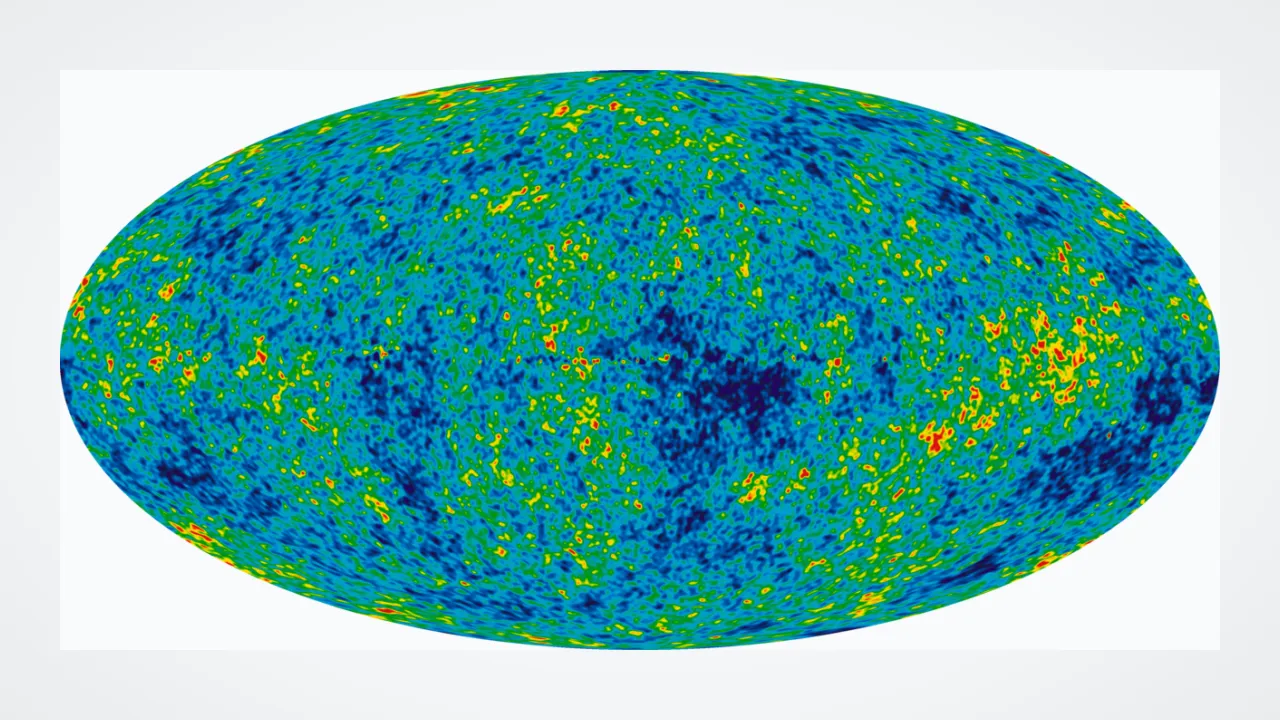
Modern observations of the cosmic microwave background show that dark matter comprises roughly 26.8 percent of the universe's total mass-energy budget, compared to just 4.9 percent for ordinary baryonic atoms. Physicists hunt several theoretical particle suspects, including —Weakly Interacting Massive Particles—and featherweight quantum particles called axions.
4
Scaffolding the Infant Universe
In the Lambda-CDM cosmological model, 'cold' slow-moving dark matter served as the gravitational scaffolding of cosmic history. Because dark matter was unaffected by the intense radiation pressure of the early universe, it clumped into filamentary webs hundreds of millions of years before normal gas could cool, pulling hydrogen into nascent galaxies.
5
Next-Generation Observatories
Today, subterranean laboratories like LUX-ZEPLIN operate alongside space missions such as ESA's Euclid telescope and NASA's Nancy Grace Roman Space Telescope. By surveying billions of galaxies across ten billion years of cosmic history, scientists aim to unmask the subatomic identity of this invisible cosmic architect.