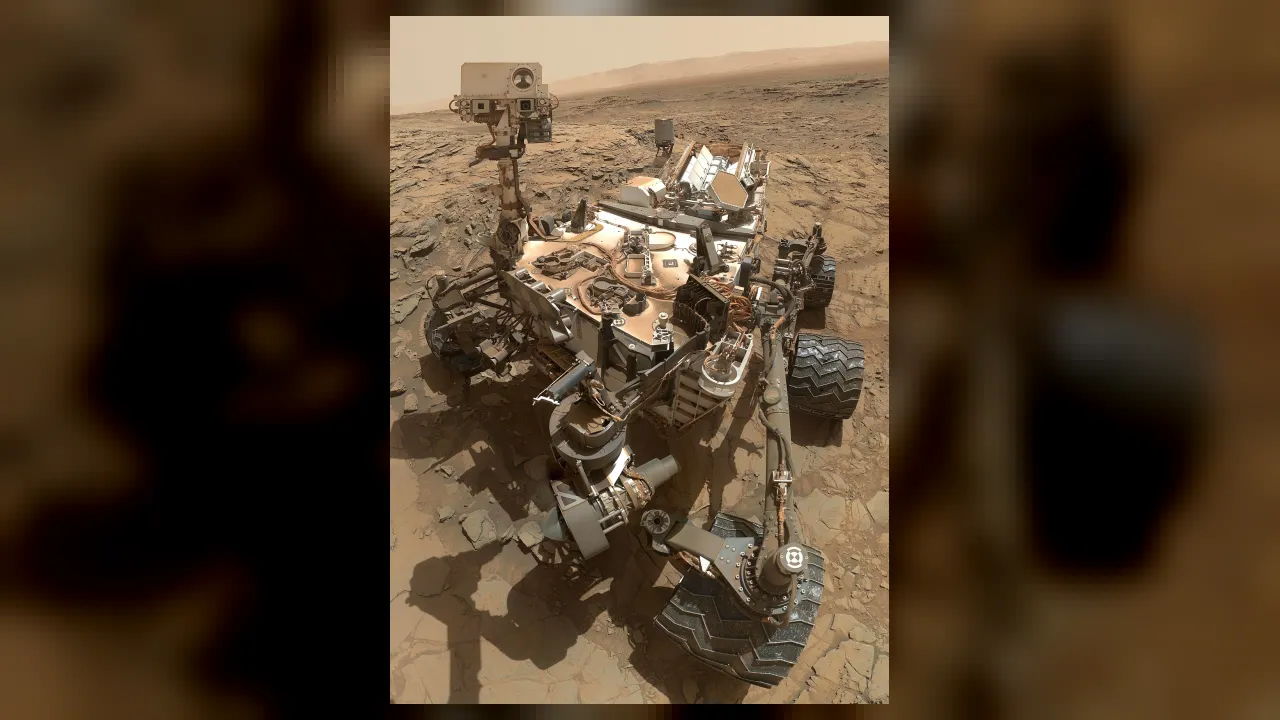
2. What exciting secret did the rover discover about ancient Mars?
🤯 Mind-Blowing Fact • Grade 2
Tiny holes in Curiosity's aluminum wheels spell out the letters J-P-L in Morse code across the Martian sand!
✨ Word Sparks (Grade 2 Glossary)
Tap 🔊 to hear
panorama
A wide picture showing the whole view around
sky crane
A hovering rocket stage that lowers a rover
geology
The science of rocks, soil, and planet surfaces
🪝
Why did engineers invent a flying rocket crane just to park one robot on Mars?
1
Seven Minutes of Suspense
Picture a heavy robot plunging into the thin pink sky of Mars! Airbags were too weak for this one-ton machine, so a hovering rocket platform called the lowered it softly onto Gale Crater in 2012.
2
A Rolling Geology Lab
Rising from its deck, a tall mast holds cameras that snap crisp . Its ChemCam eye zaps rocks from twenty feet away, while a strong robotic arm drills deep inside stones to scoop up gray powder.
3
Climbing Mount Sharp
Year after year, the rover treks up Mount Sharp, reading each rock layer like pages in a giant history book of ancient water.
1. How did Curiosity safely touch down on the Martian surface?
2. What mountain inside Gale Crater is the rover climbing?
🤯 Mind-Blowing Fact • Grade 3
Curiosity's ChemCam laser fires pulses carrying the brief power of a million lightbulbs onto a spot as small as a pinhead!
✨ Word Sparks (Grade 3 Glossary)
Tap 🔊 to hear
mudstone
Rock formed when ancient mud hardens over time
retrorocket
A rocket engine fired forward to slow down
microbe
A tiny living thing seen with a microscope
🪝
How can dusty gray mudstone prove that tiny microbes could have once lived on Mars?
1
Daring Landing in Gale Crater
Hold your breath as a heat shield blazes orange above the Red Planet! On August 5, 2012, NASA's Mars Science Laboratory survived a nail-biting descent, firing eight so its Sky Crane could set Curiosity gently onto the floor of Gale Crater.
2
Nuclear Power Through Dust Storms
Unlike earlier rovers that needed sunny skies for solar panels, this explorer carries a special battery powered by heat from radioactive plutonium. That steady energy keeps heaters warm during freezing nights and lets the rover work straight through planet-wide dust storms.
3
Baking Powdered Rock
When its drill collects rock powder, the rover drops pinches of dust into tiny ovens inside its belly. Sensitive sniffers found sulfur, nitrogen, oxygen, phosphorus, and carbon—the exact chemical building blocks living things need!
4
Reading a Three-Mile Mountain
Smooth pebbles and clay layers along Mount Sharp revealed that billions of years ago, gentle streams fed a lake mild enough to drink.
1. Why doesn't a giant Martian dust storm shut down Curiosity's power?
2. What did smooth rounded pebbles in Gale Crater tell scientists?
🤯 Mind-Blowing Fact • Grade 4
Even after its percussion drill motor jammed in 2016, JPL engineers invented a brand-new 'feed-extended' drilling technique from 100 million miles away to save its rock-sampling superpower!
✨ Word Sparks (Grade 4 Glossary)
Tap 🔊 to hear
strata
Stacked layers of sedimentary rock formed over ages
spectrum
Separated wavelengths of light revealing chemical elements
organic
Carbon-based molecules often linked to life's chemistry
🪝
What turned Mars from a world of sparkling lakes into the freezing desert we see today?
1
Engineering the Rocker-Bogie Climb
Rolling across jagged Martian bedrock without getting stuck demands clever suspension. Curiosity rides on six independently driven titanium-hubbed wheels attached to a rocker-bogie mechanism. When one side rolls over a boulder twice a wheel's height, linkages tilt smoothly so all six wheels stay planted on the ground while keeping the main chassis balanced.
2
Spectroscopy From Afar and Within
Before driving up to an outcrop, geologists fire the ChemCam infrared laser up to twenty-three feet away, vaporizing a tiny speck of stone into glowing plasma. A telescope splits that flash into a rainbow to identify minerals instantly. Promising targets then meet the seven-foot robotic arm, which delivers drilled samples to the SAM chemistry suite and CheMin X-ray analyzer.
3
Tracing Mars's Great Drying
As the rover ascended three-mile-high Mount Sharp—officially named Aeolis Mons—a dramatic climate shift emerged in the . Lower clay-rich mudstones formed in long-lasting lakes over three billion years ago, whereas higher layers contain salty sulfates left behind as water evaporated.
4
Organic Molecules and Methane Whiffs
Curiosity also uncovered ancient carbon molecules preserved in three-billion-year-old rocks and detected mysterious seasonal spikes of methane gas in Gale Crater's thin air.
1. What did the transition from clay layers to salty sulfate layers up Mount Sharp reveal?
2. How does ChemCam identify what a distant rock is made of?
🤯 Mind-Blowing Fact • Grade 5
Curiosity takes full rover 'selfies' with no visible camera stick by stitching together dozens of overlapping snapshots from the MAHLI hand-lens camera on its moving robotic wrist!
✨ Word Sparks (Grade 5 Glossary)
Tap 🔊 to hear
habitable
Having conditions suitable to support living organisms
salinity
The amount of dissolved salt inside water
spectrometer
An instrument measuring chemicals by light or mass
🪝
How did an 899-kilogram robotic chemist prove that early Mars offered a habitable home at the very time life began on Earth?
1
Taming Entry, Descent, and Landing
When NASA's Mars Science Laboratory slammed into the Martian atmosphere at 13,200 miles per hour in August 2012, radio signals took fourteen minutes to cross space to California. Guided solely by onboard computers, the capsule shed 99 percent of its kinetic energy behind a heat shield and supersonic parachute before igniting its eight-engine Sky Crane descent stage. Lowering the 899-kilogram Curiosity rover on nylon bridles prevented rocket exhaust from blasting a dangerous crater beneath its wheels.
2
Nuclear Endurance and Analytical Power
Powered by a Multi-Mission Radioisotope Thermoelectric Generator converting heat from decaying plutonium-238 dioxide into 110 watts of continuous electricity, Curiosity carries the most sophisticated geochemistry suite ever landed on Mars until Perseverance. Inside its chassis, the CheMin instrument fires X-rays through powdered samples to reveal crystal structures, while the Sample Analysis at Mars (SAM) lab heats dust to 1,800 degrees Fahrenheit inside mass and gas chromatographs.
3
Yellowknife Bay and Habitable Waters
Just months after landing, drilling at a basin called Yellowknife Bay answered the mission's central question. Clay-rich mudstones showed neutral pH, low , chemical energy sources for chemolithoautotrophic microbes, and all six essential biogenic elements—hydrogen, carbon, oxygen, nitrogen, sulfur, and phosphorus.
4
Ascent Through Martian Epochs
Over more than a decade of roving across over twenty miles of rugged terrain, Curiosity climbed thousands of vertical feet up Aeolis Mons. Cross-bedded sandstones, ancient streambeds, rippling wave textures, and sulfate-bearing ridges chronicle how Mars lost much of its protective atmosphere and liquid surface water.
5
Preparing for Human Boots
Meanwhile, Curiosity's RAD radiation detector continuously measures cosmic rays and solar energetic particles reaching the surface, giving mission planners vital data to shield future astronauts exploring the Red Planet.