🌌 COSMOS
🔭 IAU Southern Circumpolar Constellation (Cru) • Smallest Official Constellation
VA Science SOL 1.6, 4.5, 4.6 (Solar System, Stars & Space Exploration)
Crux (Southern Cross)
Tiny Compass of the Southern Skies
Grade 1 • Early Reader • 72 words
🌌 Cosmic Location & DistanceDeep Southern Celestial Sky • Circumpolar South of 34°S Latitude
⚡ Cosmic SparkGuides Southern Hemisphere travelers true south despite being the smallest constellation in the sky
🤯 Mind-Blowing Fact • Grade 1
Right beside the bright stars of the Southern Cross sits a dark patch of space dust nicknamed the Coalsack!
✨ Word Sparks (Grade 1 Glossary)
Tap 🔊 to hear
south
compass direction toward Earth's bottom pole
kite
diamond shape flying high on wind
flag
colorful cloth symbol of a country
🪝
How can the tiniest constellation in the whole sky also be one of the brightest and most famous?
1
Four Bright Kite Stars
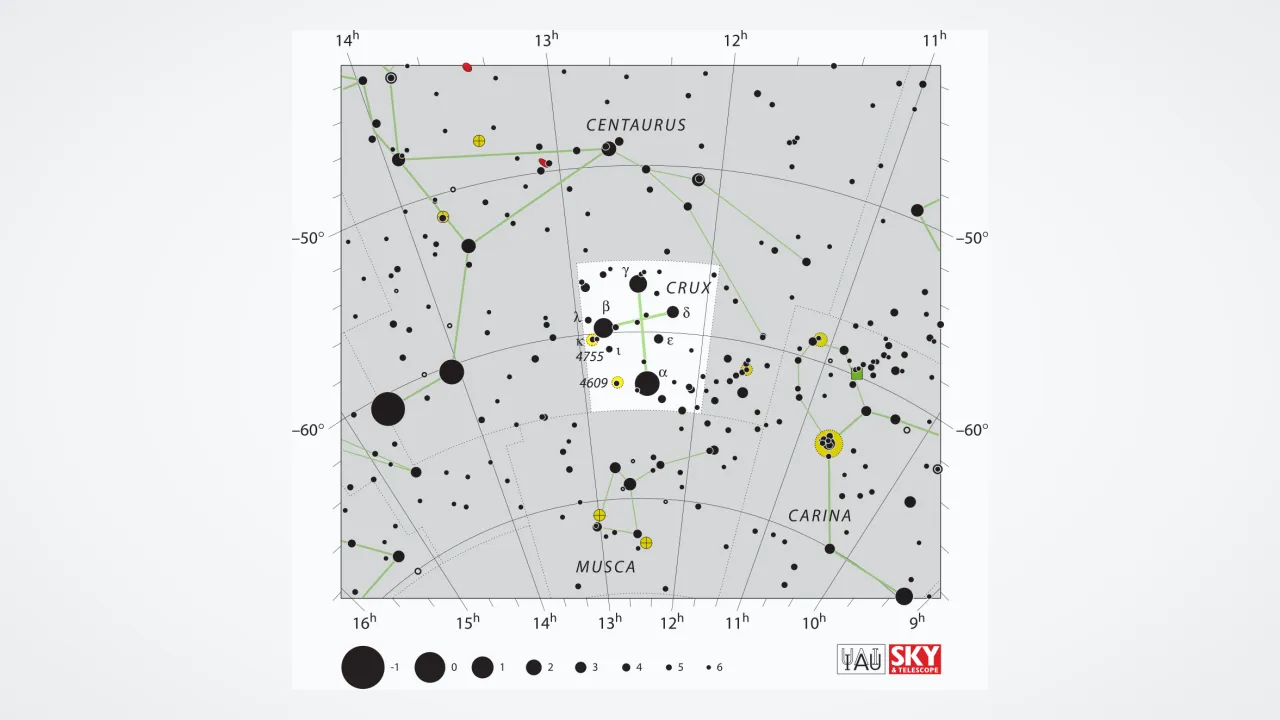
Fly down to Australia, Brazil, or New Zealand and look up at night! Four super-bright stars sparkle like a glowing or cross. A fifth smaller star twinkles right inside!
2
Pointing True South
The southern sky has no bright Star. Instead, travelers follow the long line of the Southern Cross to find true south!
3
Shining on Flags
People love the Southern Cross so much that five different countries proudly paint its stars right on their national !
1. How does Crux compare in area to all 87 other official constellations?
2. How do stargazers in the Southern Hemisphere use the Southern Cross?
🤯 Mind-Blowing Fact • Grade 2
In Indigenous Australian star stories, the dark Coalsack Nebula right beside the Southern Cross forms the head of a giant 'Emu in the Sky'!
✨ Word Sparks (Grade 2 Glossary)
Tap 🔊 to hear
hemisphere
one half of Earth or the sky
Jewel Box
colorful star cluster inside Southern Cross
dark nebula
thick dust cloud blocking background starlight
🪝
Since there is no bright 'South Star' like Polaris, how do sailors in southern oceans find true south?
1
Small Patch, Huge Sparkle
Gaze into the milky ribbon of the southern night sky and four brilliant stars jump right out at you! Known as Crux, or the Southern Cross, this tiny constellation covers less sky than any other—yet packs more bright stars per inch than almost anywhere else.
2
Drawing the Sky Compass
Look closely at the top star, Gacrux—it glows warm orange-red while the other three main stars shine icy blue-white! Draw an imaginary line from top star Gacrux down through bottom star Acrux about four and a half cross-lengths, then drop straight down to the horizon to find due south.
3
Jewels and Dark Dust
Tucked beside the Cross sparkles the colorful star cluster right next to the pitch-dark Coalsack dust cloud!
1. Which main star at the top of the Southern Cross glows warm orange-red instead of blue-white?
2. What famous animal do many Indigenous Australian peoples trace starting from the dark Coalsack cloud beside Crux?
🤯 Mind-Blowing Fact • Grade 3
Wait five thousand years and you wouldn't recognize Greece's ancient sky—because Earth's axis wobbles like a spinning top, ancient Athenians could actually see the Southern Cross before it drifted south!
✨ Word Sparks (Grade 3 Glossary)
Tap 🔊 to hear
Southern Pointers
Alpha and Beta Centauri pointing at Crux
precession
slow 26,000-year wobble of Earth's spin axis
multiple star
three or more stars orbiting together
🪝
Why don't hikers slip up and follow the look-alike 'False Cross' instead of the real Southern Cross?
1
Spotting the Real Cross
Sail south across the equator and a thrilling new sky unfolds overhead! Because nearby Vela and Carina form a slightly larger diamond nicknamed the 'False Cross,' experienced southern navigators use two foolproof clues to confirm real Crux: its fifth off-center star named Ginan, and two dazzling neighbor stars in Centaurus called 'The '—Alpha and Beta Centauri—aiming right at the Cross!
2
Acrux: Six Stars in One
Acrux, the brightest star at the foot of the Cross, sits 320 light-years away. Though it looks like one blazing blue-white diamond to your eyes, telescopes split Acrux into multiple hot massive stars orbiting together!
3
Inside the Jewel Box
Aim a small telescope beside left-hand star Mimosa and you strike cosmic treasure: NGC 4755, nicknamed the 'Kappa Crucis Jewel Box.' Around a hundred young blue-white supergiants sparkle around one vivid ruby-red supergiant in the center!
4
Emblem of Southern Nations
Never setting south of 34 degrees latitude, Crux shines on the national flags of Australia, New Zealand, Brazil, Papua New Guinea, and Samoa.
1. How do Alpha and Beta Centauri ('The Southern Pointers') help navigators avoid following the False Cross?
2. Why did astronomer John Herschel nickname star cluster NGC 4755 'the Jewel Box'?
🤯 Mind-Blowing Fact • Grade 4
In 2018, the International Astronomical Union officially adopted the traditional Wardaman Aboriginal Australian name 'Ginan'—meaning a dilly-bag of songs and knowledge—for Epsilon Crucis, the fifth star of the Southern Cross!
✨ Word Sparks (Grade 4 Glossary)
Tap 🔊 to hear
axial precession
slow circular wobble of Earth's tilted axis
silicate dust
tiny rock-mineral grains floating between stars
celestial pole
sky point directly above Earth's geographic pole
🪝
How did Earth's slow 26,000-year wobble hide the Southern Cross from northern skies where ancient Greeks once watched it shine?
1
Wobbling Out of Northern Sight
Spin a toy top on a table and watch its handle trace a slow lazy circle! Planet Earth wobbles the exact same way once every 25,772 years—a motion astronomers call . Around 1000 BCE, stargazers in Greece and Egypt easily saw the bright stars of Crux as the hind legs of Centaurus. Over centuries, Earth's slow wobble shifted those stars steadily southward until they vanished below Mediterranean horizons, waiting until 16th-century European ocean voyages to be mapped as an independent constellation!
2
Precision South Pole Triangulation
Spanning a mere 68 square degrees—just 0.165 percent of the sky—Crux acts as the Southern Hemisphere's master compass. Navigators extend a line 4.5 times down the upright beam from red giant Gacrux (88 light-years away, the closest Cross star) through blue multiple-star Acrux, or intersect that line with a perpendicular bisector between Alpha and Beta Centauri, pinpointing the dark South within a single degree!
3
Anatomy of the Coalsack
Silhouetted against the dazzling Carina-Sagittarius spiral arm sits the Coalsack Nebula, just 600 light-years from Earth. Spanning over 30 light-years across, its sub-microscopic silicate and carbon dust grains block 90 percent of visible background starlight while glowing faintly at infrared and ALMA millimeter wavelengths.
4
Many Cultures, One Iconic Sky
Known as Te Punga (the Anchor of Tama-rereti's canoe) to Māori navigators, Chakana (the Andean Cross) to the Inca, and Mulapin's Southern Plough, Crux unites navigation, myth, and astrophysics.
1. Why could ancient Greek astronomers see the stars of the Southern Cross thousands of years ago even though Athens cannot see them today?
2. What actually makes the Coalsack Nebula look like a dark 'hole' in the Milky Way?
🤯 Mind-Blowing Fact • Grade 5
Brazil's national flag portrays the Southern Cross and 22 other stars in the exact sky positions seen over Rio de Janeiro at 8:30 a.m. on November 15, 1889—drawn as if viewed from outside the celestial sphere!
✨ Word Sparks (Grade 5 Glossary)
Tap 🔊 to hear
bolometric
total star brightness across all wavelengths combined
Beta Cephei star
massive hot blue star pulsing every few hours
extinction
dimming and reddening of starlight by space dust
🪝
Why does a constellation covering less than one-sixth of one percent of the sky boast three of the twenty-five brightest stars visible from Earth?
1
Extreme Stellar Density Along the Carina-Sagittarius Arm
Encompassing just 68 square degrees—nineteen times smaller than Hydra—Crux owes its astonishing brilliance to galactic geometry. Looking toward Crux at zero degrees galactic latitude means peering tangentially down the star-packed Carina-Sagittarius Spiral Arm of our Milky Way! Within this compact diamond blaze three first-magnitude luminaries: Alpha Crucis (Acrux, combined magnitude 0.76, 13th brightest in the night sky), Beta Crucis (Mimosa, magnitude 1.25, 20th brightest), and M3.5III red giant Gamma Crucis (Gacrux, magnitude 1.64, just 88.6 light-years away).
2
Massive OB Siblings and Beta Cephei Pulsations
Whereas foreground red giant Gacrux is a cool, evolved solar-neighborhood neighbor, blue-white powerhouses Acrux (320 light-years), Mimosa (280 light-years), and Delta Crucis (Imai, 345 light-years) belong to the Lower Centaurus-Crux subgroup of the Scorpius-Centaurus OB Association. Both Mimosa and Imai are textbook Beta Cephei variable stars—10-to-16-solar-mass B-type giants whose iron-opacity pulsations rhythmically expand and contract their outer envelopes over periods of four to six hours, each radiating more than 10,000 to 30,000 times our Sun's output.
3
Chronometer in the Kappa Crucis Jewel Box
Nestled just southeast of Mimosa at roughly 6,400 light-years distance glitters open cluster NGC 4755—John Herschel's famed 'Jewel Box.' Containing over a hundred young high-mass stars born simultaneously just 14 million years ago, NGC 4755 serves astrophysicists as a textbook laboratory for massive stellar evolution: nearly all bright members shine as hot B-type supergiants except DU Crucis, one slightly heavier sibling that has already raced ahead into its cool M2Iab red supergiant phase.
4
Dark Extinction in the Coalsack
Adjacent lies the prominent Coalsack dark nebula (~590 light-years away), documented by Vicente Yáñez Pinzón in 1499 and deeply woven into Indigenous Australian Dark-Sky constellations where dust lanes—rather than bright star dots—form sacred celestial figures.
5
From Ptolemy's Centaur to Modern Flags
Formally separated from Centaurus onto European celestial globes by Petrus Plancius and Augustin Royer in the late 16th and 17th centuries, Crux remains humanity's unmistakable beacon of the southern skies.