☄️ Composition & OrbitPowered by City-Sized Crab Pulsar • 30 Spins per Second
⚡ Cosmic SparkBlasted out by a star explosion so bright people watched it in broad daylight in 1054
🤯 Mind-Blowing Fact • Grade 1
Just one teaspoon of material from the tiny star core inside the Crab Nebula would weigh as much as Mount Everest!
✨ Word Sparks (Grade 1 Glossary)
Tap 🔊 to hear
explode
Burst outward with huge energy
daylight
Bright sunshine during the daytime
remnant
Glowing cloud left after a blast
🪝
What if a brand-new star popped out so bright you could see it at lunchtime?
1
Boom in the Daytime Sky
Nearly one thousand years ago, people looked up at the blue daytime sky and gasped! A giant star had exploded far away. For three weeks, it shone even in bright sunshine!
2
Tangled Web of Gas
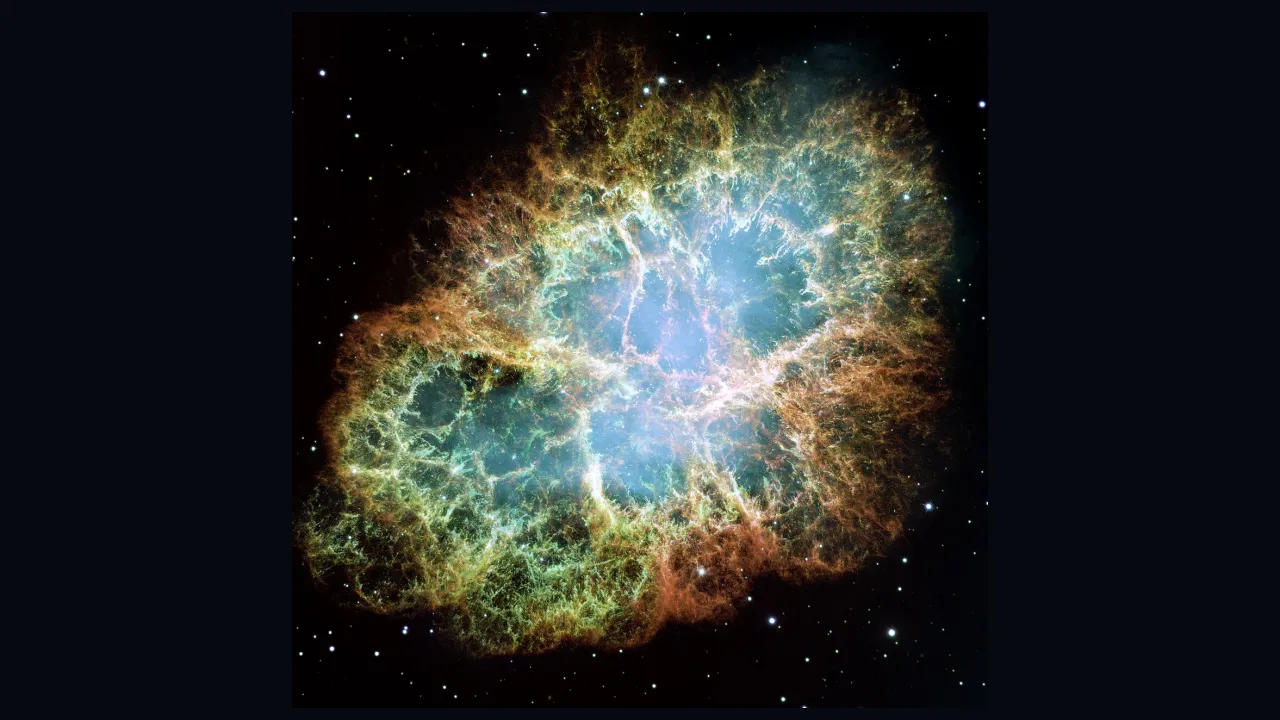
Today, telescopes see the colorful cloud left by that big boom. Tangled orange ribbons gave it the name Crab Nebula!
3
A Tiny Whirling Engine
Right in the middle spins a tiny crushed star core no bigger than a city. It whirls around thirty times every single second!
1. How bright was the star explosion that made the Crab Nebula?
2. How fast does the tiny star core at the center of the Crab Nebula spin?
🤯 Mind-Blowing Fact • Grade 2
The Crab Nebula grows wider by about 80 million miles every single day—almost the distance from Earth to our Sun!
✨ Word Sparks (Grade 2 Glossary)
Tap 🔊 to hear
guest star
Ancient name for sudden exploding stars
filament
Thin glowing ribbon of space gas
catalog
Organized numbered list of sky objects
🪝
How did skywatchers in the year 1054 solve a mystery for modern astronomers?
1
The Guest Star of 1054
On July 4 in the year 1054, astronomers in China, Japan, and the Middle East wrote down amazing news. A dazzling new '' blazed in Taurus the Bull! It shone in daytime skies for 23 days and stayed visible at night for nearly two years.
2
Number One on Messier's List
Seven hundred years later, comet hunter Charles Messier spotted a glowing cloud in that exact spot and made it item number one on his famous sky list: Messier 1! Another astronomer sketched its tentacle-like and named it the Crab Nebula.
3
Still Racing Outward
Even today, the Crab Nebula's colorful gas shell blasts outward at nearly one thousand miles every second!
2. In what year did ancient astronomers watch the Crab Nebula's supernova explode in Earth's sky?
🤯 Mind-Blowing Fact • Grade 3
NASA's Chandra X-ray Observatory revealed glowing X-ray rings and twin jets shooting straight out from the tiny spinning Crab Pulsar!
✨ Word Sparks (Grade 3 Glossary)
Tap 🔊 to hear
pulsar
Fast-spinning neutron star beaming lighthouse pulses
neutron star
Ultra-dense crushed core of massive star
magnetic field
Invisible force loops around spinning magnets
🪝
What keeps the Crab Nebula glowing with eerie blue light nearly a thousand years after it exploded?
1
Shattered Star in Taurus
Roughly 6,500 light-years away in Taurus, a massive star ran out of fuel and exploded as a supernova. Its flash reached Earth in July 1054. Today, the shattered wreckage spans 11 light-years across and hurtles outward at 930 miles per second!
2
Meet the Crab Pulsar
Crushed at the center of the blast sits a called the Crab . Packing more mass than our entire Sun into a sphere only fifteen miles wide, it spins thirty times per second—sweeping twin lighthouse beams of radio waves and X-rays past Earth!
3
Ghostly Blue Dynamo
The acts like a giant electric generator. Its twisting fling electrons near the speed of light, making the center of the Crab Nebula glow an eerie, ghostly blue.
4
Spreading Stardust Elements
Tangled outer filaments glow orange, green, and red with sulfur, oxygen, and carbon forged inside the star before it blew apart.
1. About how wide is the ultra-dense Crab Pulsar spinning at the heart of the Crab Nebula?
2. What powers the ghostly blue glow inside the middle of the Crab Nebula?
🤯 Mind-Blowing Fact • Grade 4
Just by slowing its spin by tiny billionths of a second per day, the Crab Pulsar pumps 100,000 times more total power into the nebula than our Sun radiates!
✨ Word Sparks (Grade 4 Glossary)
Tap 🔊 to hear
synchrotron light
Glow from fast electrons spiraling magnets
millisecond
One thousandth of a single second
supernova remnant
Expanding shockwave cloud from exploded star
🪝
How did matching ancient 11th-century star charts with modern radio dishes prove that supernovae create neutron stars?
1
Rewinding Cosmic Film to 1054
When early-twentieth-century astronomers photographed Messier 1 decade after decade, they noticed its lacy filaments visibly expanding! Measuring backward from its 930-mile-per-second expansion speed pointed straight to an explosion seen on Earth nine centuries earlier—matching Song Dynasty Chinese records of the brilliant daytime 'guest star' of July 1054.
2
Clinching the Neutron Star Theory
In the 1930s, theorists Walter Baade and Fritz Zwicky boldly predicted that core-collapse supernovae crush stellar cores into city-sized neutron stars. Proof arrived in 1968 when radio astronomers discovered PSR B0531+21—the Crab Pulsar—flashing once every 33 right inside the 1054 blast center!
3
Synchrotron Radiation Engine
Why hasn't the Crab Nebula faded into cold darkness more than nine hundred years after its blast? As the whirling Crab Pulsar slows by 38 billionths of a second each day, its lost rotational energy drives a furious wind of electrons spiraling near light speed around magnetic field lines—beaming polarized blue, infrared, and X-ray brighter than 75,000 Suns!
4
JWST Maps Dust and Iron
In 2023, NASA's James Webb Space Telescope mapped warm silicate-carbon dust filaments alongside singly ionized nickel and iron cages inside the remnant, helping astrophysicists test whether a relatively modest eight-to-ten-solar-mass star triggered this historic explosion and seeded Taurus with freshly forged elements.
1. How did astronomers prove the Crab Nebula came from the historic 1054 guest star?
2. Where does the Crab Nebula get the huge energy needed to outshine 75,000 Suns today?
🤯 Mind-Blowing Fact • Grade 5
Astronomers use the Crab Nebula so frequently to calibrate X-ray and gamma-ray space telescopes that high-energy brightness is literally measured in units called 'Crabs' and 'millicrabs'!
✨ Word Sparks (Grade 5 Glossary)
Tap 🔊 to hear
gauss
Unit measuring magnetic field strength
relativistic
Moving close to the speed of light
ejecta
Material blasted outward by an explosion
🪝
Why is Messier 1 the only cosmic object studied simultaneously by eleventh-century court astronomers and modern gamma-ray telescopes?
1
Crossroads of History and High-Energy Physics
Positioned roughly 2,000 parsecs (6,500 light-years) away in Taurus, Messier 1—dubbed the Crab Nebula after Anglo-Irish astronomer William Parsons, 3rd Earl of Rosse, sketched its crustacean-like filaments through his Leviathan telescope in 1844—anchors modern high-energy astrophysics. Although the star actually detonated around 5450 BCE, its light wavefront reached Earth on July 4, 1054 CE, blazing near apparent magnitude -6 in daytime skies before inspiring centuries of astronomical breakthroughs.
2
Rotational Spin-Down and Pulsar Wind
At the remnant's dynamic center whirls PSR B0531+21, a 1.4-solar-mass neutron star crushed into a sphere roughly 20–25 kilometers across with a surface magnetic field exceeding a trillion —billions of times stronger than Earth's! Spinning 30.2 times per second (a 33-millisecond period), magnetic dipole braking gradually lengthens its period by 36.5 nanoseconds daily, converting rotational kinetic energy into a magnetohydrodynamic wind equivalent to 100,000 solar luminosities.
3
X-Ray Tori and Gamma-Ray Flares
Time-lapse movies combining NASA's Chandra X-ray Observatory and Hubble show luminous wisps rippling outward at half the speed of light through an equatorial X-ray torus while polar jets lance across light-years. Astonishingly, Fermi and AGILE gamma-ray space telescopes even catch sudden magnetic-reconnection flares inside the nebula accelerating electrons to petavolt energies—far surpassing the highest particle energies achieved inside CERN's Large Hadron Collider!
4
JWST Probes an Electron-Capture Origin
Because the Crab's outer filaments carry unexpectedly low kinetic energy—only a tenth of a canonical supernova—astronomers long debated whether its progenitor was an eight-to-ten-solar-mass super-asymptotic giant branch star undergoing electron-capture collapse rather than a heavier iron-core collapse.
5
Nickel-to-Iron Clue Resolved
In 2023–2024, JWST's MIRI and NIRCam instruments mapped milky-white synchrotron smoke alongside crisp infrared emission from singly ionized sulfur, iron, and nickel, measuring nickel-to-iron abundance ratios that point to either a low-mass iron-core collapse or a borderline electron-capture supernova.