🌌 COSMOS
🔭 Magnetized Coronal Plasma Cloud • Heliospheric Eruption
VA Science SOL 1.6, 4.5, 4.6 (Solar System, Stars & Space Exploration)
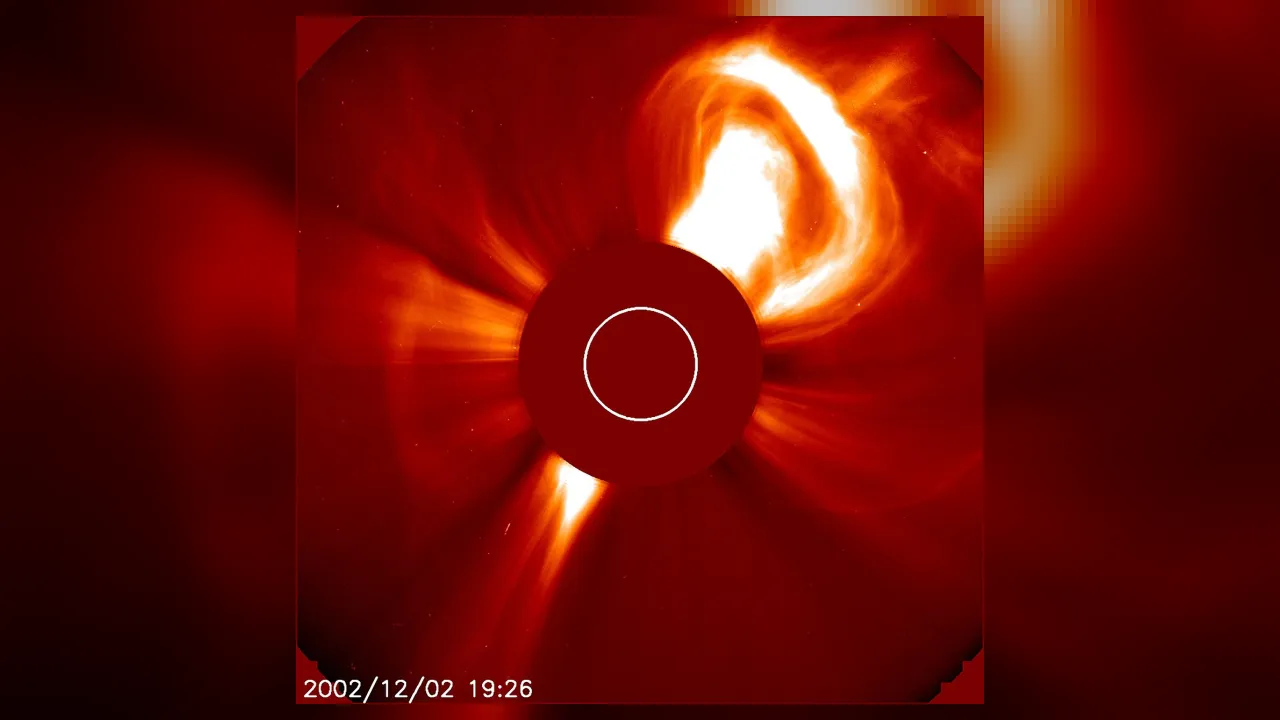
Coronal Mass Ejection
Billion-Ton Solar Storm Clouds Painting Earth's Auroras
Grade 2 • Developing • 114 words
🌌 Cosmic Location & DistanceSolar Corona to Interplanetary Space • Erupts outward past planets
🪐 Scale / DiameterExpands wider than 30 million miles (50 million km) • Billions of tons
☄️ Composition & OrbitMagnetized protons & electrons • Travels 15 hours to 3 days to Earth
⚡ Cosmic SparkHurls a billion-ton magnetic bubble across space to ignite glowing global auroras
🤯 Mind-Blowing Fact • Grade 1
A single coronal mass ejection can hurl as much weight into space as 10,000 Empire State Buildings!
✨ Word Sparks (Grade 1 Glossary)
Tap 🔊 to hear
corona
The super-hot outer crown around the Sun
shield
A barrier that keeps something safe from harm
aurora
Colorful ribbons of light in polar night skies
🪝
Did you know the Sun can burp out a giant cloud heavier than a mountain?
1
A Giant Sun Burp!
WHOOSH! Sometimes the Sun blasts a huge bubble of hot gas out into space. Scientists call this big storm cloud a coronal mass ejection, or CME for short.
2
A Multi-Day Trip
This giant cloud zooms past planets at super speed. Even so, space is huge! It takes one to three days to reach Earth.
3
Painting the Night Sky
Earth wears an invisible magnetic that pushes most of the storm away. Near the poles, the sky lights up with green and pink !
1. About how long does a coronal mass ejection take to travel from the Sun to Earth?
2. What pretty sight lights up Earth's sky when a CME brushes our magnetic shield?
🤯 Mind-Blowing Fact • Grade 2
Space telescopes use a tiny metal disk like an artificial thumb to block the Sun's glare so scientists can spot faint CME clouds erupting!
✨ Word Sparks (Grade 2 Glossary)
Tap 🔊 to hear
ejection
Something thrown or blasted forcefully outward
deflect
To bounce or turn something onto another path
magnetic field
Invisible magnetic lines looping around Earth or stars
🪝
How does a billion-ton bubble from the Sun make the sky dance with neon colors?
1
Cannonballs of Plasma
Picture the Sun's outer atmosphere—called the corona—stretching like a giant bubble until it pops outward! A coronal mass launches billions of tons of electrified gas and tangled magnets into space. As the cloud races away, it swells wider than the Sun itself.
2
Earth's Magnetic Armor
If the Sun aims that storm straight toward our planet, it arrives between fifteen hours and three days later. Thankfully, Earth's acts like sturdy armor and most of the fast particles safely around us.
3
Northern and Southern Lights
Some particles slide down magnetic lines near the North and South Poles. When they bump oxygen and nitrogen high in the air, shimmering curtains of green, red, and violet light dance overhead!
1. Where does a coronal mass ejection blast outward from?
2. Why do astronomers block the bright middle of the Sun inside special telescopes?
🤯 Mind-Blowing Fact • Grade 3
During the 1859 Carrington Event CME, auroras glowed all the way down to Cuba and Hawaii, and telegraph operators sent messages even after unplugging their batteries!
✨ Word Sparks (Grade 3 Glossary)
Tap 🔊 to hear
geomagnetic storm
Shaking of Earth's magnetic shield by solar clouds
transformer
Machine that adjusts electricity flowing in power grids
coronagraph
Telescope tool that makes an artificial solar eclipse
🪝
Why did telegraph wires spark on their own during the greatest solar storm in recorded history?
1
Launching a Magnetic Giant
High in the Sun's outer corona, giant loops of electrified plasma strain against twisted magnetic fields. When those magnetic ropes snap free, a coronal mass ejection blasts billions of tons of protons and electrons into the Solar System at speeds topping one million miles per hour!
2
Geomagnetic Storms
Because a CME carries its own built-in magnetic field, its orientation matters when it reaches Earth. If its magnet points opposite to Earth's magnetic shield, the two link up and trigger a . Shimmering auroras can stretch far south toward places that rarely see northern lights!
3
Power Grids on Guard
Shaking Earth's magnetic field also creates electric currents inside long metal power lines and pipelines underground. Engineers monitor space weather forecasts so they can protect before a storm hits.
4
Sentinel Satellites
Parked a million miles sunward of Earth, spacecraft like SOHO and DSCOVR give power operators early warning before a CME arrives.
1. What happened to telegraph machines during the famous 1859 Carrington solar storm?
2. Why do spacecraft like DSCOVR wait a million miles closer to the Sun than Earth?
🤯 Mind-Blowing Fact • Grade 4
In May 2024, a rapid-fire train of several CMEs merged together on their way to Earth, painting vivid pink and green auroras across all 50 U.S. states and Mexico!
✨ Word Sparks (Grade 4 Glossary)
Tap 🔊 to hear
magnetosphere
Protective magnetic bubble surrounding planet Earth
flux rope
Twisted bundle of magnetic lines holding plasma
halo CME
Storm cloud heading straight toward or away
🪝
Why can two identical billion-ton solar clouds strike Earth, yet only one triggers a worldwide aurora show?
1
Anatomy of a Flux Rope
When twisted magnetic arches in the Sun's corona lose stability, they hurl a colossal magnetic '' filled with up to ten billion tons of ionized hydrogen and helium plasma into interplanetary space. Velocities range from gentle 250-kilometer-per-second puffs to ferocious 3,000-kilometer-per-second shockwaves capable of crossing Earth's orbit in just fifteen hours.
2
The North-South Magnetic Key
Surprisingly, speed alone doesn't determine how strongly a CME shakes Earth's . Earth's daytime magnetic field points northward. If an incoming CME's magnetic field also points north, it mostly glances off our shield. Yet if the CME points southward, opposite poles snap together through dayside magnetic reconnection, funneling vast solar energy into our magnetotail.
3
Auroral Chemistry and Grid Currents
Charged particles accelerate down polar field lines: oxygen atoms excited near 100 kilometers altitude emit brilliant emerald-green light, higher oxygen glows crimson red, and nitrogen adds violet fringes. Meanwhile, rapid magnetic fluctuations induce ground currents (GICs) in high-voltage power grids—like the March 1989 CME that knocked out electricity across Quebec inside ninety seconds.
4
Halo CMEs in Coronagraphs
Using occulting disks on the SOHO spacecraft, astronomers spot Earth-directed storms as expanding '' ringing the entire Sun.
1. Which magnetic direction in a CME causes the strongest geomagnetic storm at Earth?
2. What creates the bright green color most often seen in auroras?
🤯 Mind-Blowing Fact • Grade 5
Without a protective magnetic field like Earth's, billions of years of CMEs and solar wind stripped away most of ancient Mars's thick atmosphere!
✨ Word Sparks (Grade 5 Glossary)
Tap 🔊 to hear
Lagrange Point L1
Gravity balance spot between Earth and Sun
electromagnetic induction
Changing magnetic fields creating electric currents
solar maximum
Peak active phase of the 11-year solar cycle
🪝
What happened in July 2012 when a record-shattering solar superstorm missed modern civilization by just nine days?
1
Discovering Mass Eruptions From Space
Although scientists suspected solar particles drove geomagnetic storms since the 1859 Carrington Event, coronal mass ejections remained unseen until December 1971, when the Orbiting Solar Observatory 7 (OSO-7) captured an expanding bright loop using a spaceborne coronagraph. Today we recognize CMEs as large-scale magnetohydrodynamic instabilities that expel 10^12 to 10^13 kilograms of coronal plasma per eruption.
2
Interplanetary Shockwaves and Cannibal CMEs
When a fast CME plows through slower ambient solar wind faster than the local magnetosonic wave speed, it drives a compressed bow shock ahead of itself that accelerates lethal solar energetic protons. During , back-to-back eruptions from one active region can overtake earlier clouds—forming 'cannibal CMEs' with amplified magnetic fields, compressed plasma sheaths, and extreme geoeffectiveness.
3
Faraday's Law and Modern Infrastructure
When a southward-directed interplanetary magnetic field ($B_z < 0$) triggers magnetospheric substorms, rapidly shifting ionospheric electrojets obey Faraday's law of : changing magnetic fields generate electric fields inside Earth's crust. Long high-voltage transmission lines channel geomagnetically induced currents into massive grid transformers, threatening overheating while GPS signals suffer ionospheric scintillation.
4
The Near-Miss of July 2012
On July 23, 2012, NASA's twin-view STEREO-A spacecraft rode squarely through a colossal double CME traveling near 3,000 km/s—an earlier plasma cloud had swept interplanetary space clear, allowing the main magnetic flux rope to retain immense speed and southward field intensity. Had that active region erupted just nine days earlier when aimed at Earth, economic studies estimate global transformer damage and satellite disruptions could have taken years to repair.
5
L1 Early Warning Sentinels
Stationed 1.5 million kilometers sunward at the gravitational balance of Sun-Earth , sentinel spacecraft including DSCOVR, ACE, and NOAA's Space Weather Follow-On mission sample incoming solar plasma and measure magnetic polarity ($B_z$) in situ 15 to 60 minutes before terrestrial impact. Combined with heliospheric imagers tracking storm propagation from the Sun's limb, these warnings let power-grid operators balance reactive loads and place vulnerable satellites into safe mode.