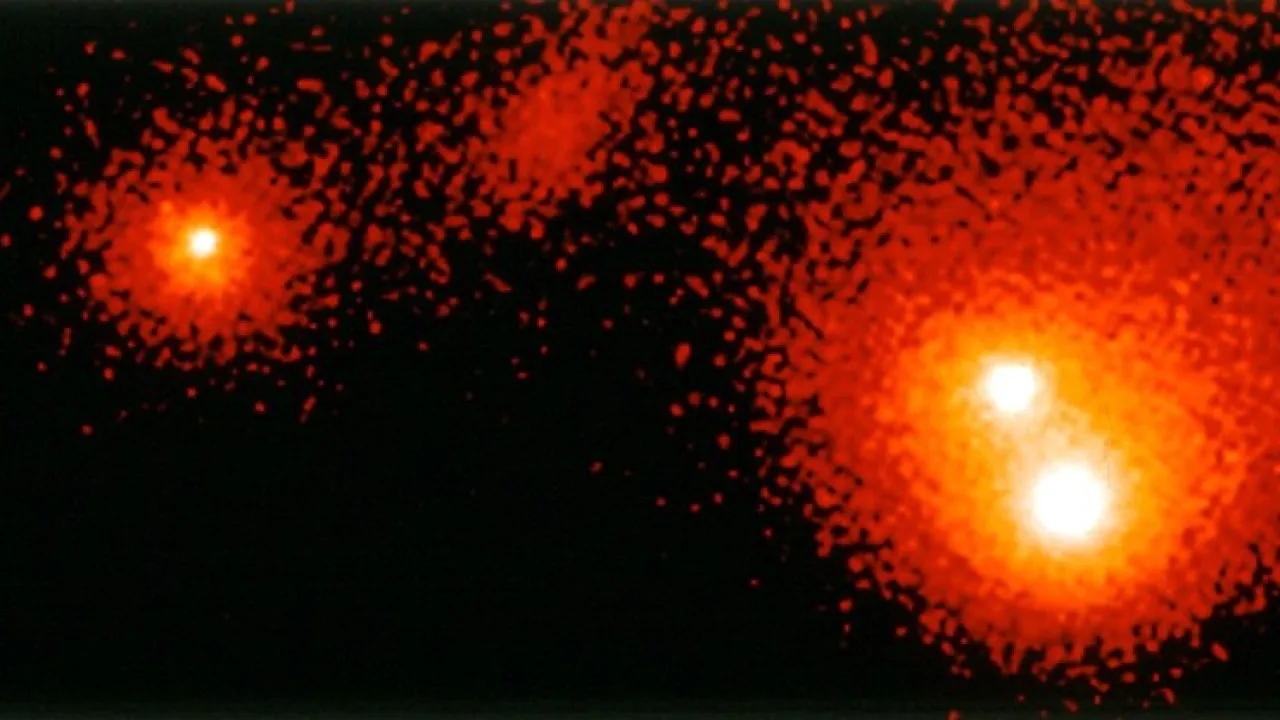
1. Why did people call Comet Shoemaker-Levy 9 a 'string of pearls'?
2. Which giant planet did Comet Shoemaker-Levy 9 crash into in 1994?
🤯 Mind-Blowing Fact • Grade 2
The dark smoky bruises in Jupiter's clouds stood out so clearly for months that kids could spot them with small backyard telescopes!
✨ Word Sparks (Grade 2 Glossary)
Tap 🔊 to hear
capture
Trap a passing space object with gravity
plume
Tall rising cloud of gas and dust
observatory
Building with big telescopes for studying space
🪝
How did a stormy night at a mountain observatory uncover a comet about to hit Jupiter?
1
Found on Damaged Film
On a cloudy night in March 1993, Carolyn Shoemaker, Eugene Shoemaker, and David Levy almost skipped taking photos at California's Palomar . Using slightly spoiled film to save good sheets, Carolyn spotted a weird squashed streak near Jupiter—their ninth shared comet discovery!
2
Torn Into Letters A to W
Instead of orbiting the Sun, this comet had been captured by Jupiter! Eight months earlier, passing too close to Jupiter ripped its fragile body into twenty-one pieces labeled with letters from A to W.
3
Six Days of Cosmic Fireworks
In July 1994, telescopes everywhere watched all twenty-one chunks slam into Jupiter at 134,000 miles per hour, tossing thousands of miles high!
1. Why did Comet Shoemaker-Levy 9 have the number '9' in its name?
2. How fast were the comet fragments traveling when they plunged into Jupiter's atmosphere?
🤯 Mind-Blowing Fact • Grade 3
In the comet's official label 'D/1993 F2,' the letter D stands for 'Disappeared'—used only for comets that break up or crash completely!
✨ Word Sparks (Grade 3 Glossary)
Tap 🔊 to hear
Roche limit
Close zone where planet tides tear moons apart
tidal force
Stretching pull caused by uneven strong gravity
atmosphere
Thick blanket of gases surrounding a planet
🪝
How can giant Jupiter rip a solid icy comet apart without even touching it?
1
Crossing the Danger Zone
Imagine Jupiter's gravity pulling harder on the front side of a loose snowball than on its back side! In July 1992, an unseen 3-mile comet skimmed just 15,000 miles above Jupiter's cloud tops—well inside Jupiter's , the invisible tidal zone where gravity stretches fragile objects apart. Eight months later, Carolyn and Eugene Shoemaker and David Levy photographed the resulting train of twenty-one glowing fragments.
2
Humanity's First Predicted Crash
When orbital math showed D/1993 F2 would strike Jupiter in July 1994, astronomers around the globe pointed every major telescope—including Hubble—at the gas giant. Never before had scientists watched two Solar System bodies collide live!
3
Galileo's Secret Side View
Each fragment struck just out of Earth's sight on Jupiter's night side, rotating into view minutes later. Fortunately, NASA's Galileo probe—still cruising toward Jupiter—had a direct view of the impact flashes!
4
Fragment G's Giant Scar
Largest Fragment G unleashed giant fireballs 1,900 miles tall and painted an Earth-sized dark smudge across Jupiter's southern clouds.
1. What tore Comet Shoemaker-Levy 9 into twenty-one pieces in July 1992?
2. How did scientists directly observe the exact moments the fragments hit Jupiter's hidden side?
🤯 Mind-Blowing Fact • Grade 4
Over twenty-five years after the 1994 impacts, the Herschel Space Observatory proved that 95 percent of the water vapor floating in Jupiter's upper stratosphere came straight from Comet Shoemaker-Levy 9!
✨ Word Sparks (Grade 4 Glossary)
Tap 🔊 to hear
bolide
An extra-bright fireball exploding in an atmosphere
stratosphere
Calm upper layer of a planet's atmosphere
rubble pile
Space body loosely held together by gravity
🪝
What hidden chemicals deep inside Jupiter were blasted into view by Comet Shoemaker-Levy 9?
1
Captured from the Sun's Grip
Tracing Comet Shoemaker-Levy 9's path backward revealed a remarkable biography: giant Jupiter had quietly captured this short-period comet from a solar orbit around 1929, turning it into a temporary satellite on a wild two-year loop! On July 7, 1992, the comet grazed within 25,000 kilometers of Jupiter's upper clouds—inside the Roche limit—shredding its rubble-pile nucleus into twenty-one fragments spanning 700,000 miles by the time the Shoemakers and David Levy discovered it.
2
Sixty Kilometers Per Second
From July 16 to July 22, 1994, Jupiter's spinning atmosphere marched into fragment after fragment like targets on a cosmic conveyor belt. Entering at 37 miles per second (60 km/s), superheated exploded tens of miles down, lofting 2,000-mile-high plumes that splashed back onto the and baked dark organic aerosols wider than Earth.
3
Probing Jupiter's Deep Chemistry
Spectrographs examining the glowing plumes detected sulfur, ammonia, carbon monoxide, and water. Surprisingly, water still lingers in Jupiter's upper decades later—delivered directly by the icy comet itself!
4
Wake-Up Call for Planetary Defense
Watching Fragment G release energy hundreds of times greater than all human fireworks or engines ever built inspired governments worldwide to fund modern Near-Earth Object sky surveys—leading eventually to NASA's DART asteroid-deflection test.
1. What did Comet Shoemaker-Levy 9's easy breakup inside Jupiter's Roche limit prove about its internal structure?
2. How did watching the 1994 Jupiter impacts directly benefit safety here on Earth?
🤯 Mind-Blowing Fact • Grade 5
Ripples triggered in Jupiter's delicate inner dusty ring by Comet Shoemaker-Levy 9's dusty coma in 1994 were still visible as spiral waves when New Horizons flew past Jupiter thirteen years later!
✨ Word Sparks (Grade 5 Glossary)
Tap 🔊 to hear
perijove
Point in an orbit closest to giant Jupiter
tensile strength
How strongly a material resists being pulled apart
aerosol
Fine mist of tiny solid particles in gas
🪝
How did Eugene Shoemaker—the geologist who proved Meteor Crater came from space—witness the ultimate validation of impact science on Jupiter?
1
From Arizona Craters to Palomar's String of Pearls
Decades before 1993, astrogeologist Eugene Shoemaker revolutionized planetary science by proving Arizona's Barringer Crater was gouged by an asteroid rather than a volcano, training Apollo astronauts to read lunar impact basins. On the stormy night of March 24, 1993, using water-damaged edge film on Palomar's 18-inch Schmidt camera, Carolyn Shoemaker, Eugene Shoemaker, and David Levy spotted a bar-like smear near Jupiter. High-resolution Hubble imagery resolved twenty-one distinct cometary nuclei—labeled A through W—strung along a million-kilometer orbital train.
2
Tidal Disruption of a Jovian Quasi-Satellite
Backward orbital integration showed Jupiter had captured the roughly 4-kilometer parent comet decades earlier into an unstable eccentric Jovicentric orbit. On July 7, 1992, dipped just 0.35 Jupiter radii above the cloud deck—well inside the fluid Roche limit. Differential gravitational pull overcame the nucleus's negligible (~1,000 pascals), confirming comets assemble as porous, strengthless rubble piles.
Between July 16 and July 22, 1994, each fragment plunged at 60 kilometers per second into Jupiter's southern latitudes near 44 degrees south, just behind the morning limb. En route 1.6 AU away, NASA's Galileo spacecraft directly recorded initial 24,000-kelvin bolide flashes, while Hubble and terrestrial infrared arrays watched ballistic plumes soar 3,000 kilometers high before collapsing back to heat vast patches of the Jovian stratosphere and paint dark carbon-sulfur rings wider than Earth's diameter.
4
Stratospheric Tracers and Jupiter's Dual Cosmic Role
Submillimeter wind mapping using ALMA and infrared spectra from Herschel later tracked hydrogen cyanide and water vapor deposited by SL9 circulating across Jupiter's stratosphere for decades! Simultaneously, the crash illuminated Jupiter's dual role: absorbing Oort-cloud comets like a giant cosmic shield while occasionally flinging main-belt asteroids sunward.
5
Birth of Modern Planetary Defense
Fragment G's six-teraton release—equivalent to six million megatons of TNT—galvanized Congressional mandates for NASA's Spaceguard Survey, cataloging over 95 percent of kilometer-scale near-Earth asteroids long before any can surprise our world.