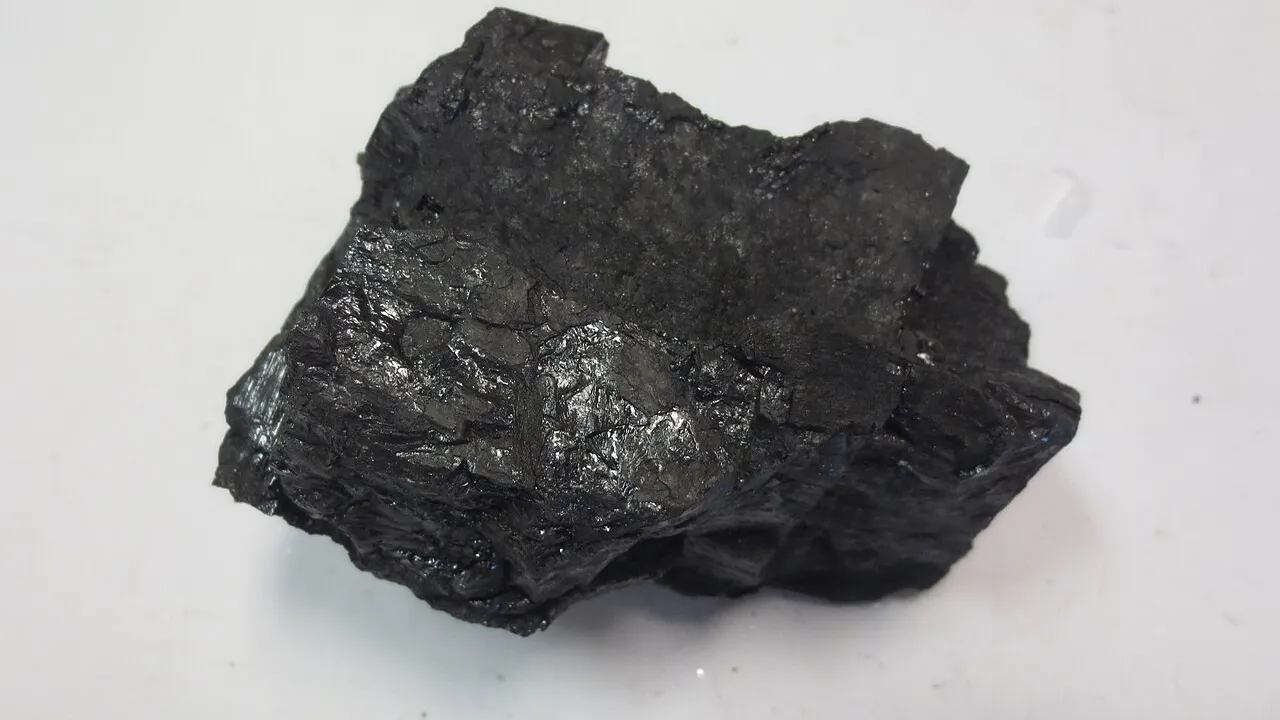
1. What living things formed coal millions of years ago?
2. Why does a piece of coal feel much lighter than most rocks of the same size?
🤯 Mind-Blowing Fact • Grade 2
Miners sometimes split open a seam of coal and find an entire 300-million-year-old fern leaf or dragonfly wing stamped right into the rock!
✨ Word Sparks (Grade 2 Glossary)
Tap 🔊 to hear
peat
Spongy brown mat of partly decayed swamp plants
oxygen
Gas in air and water needed for decay
carbon
Main chemical element inside all living plants
🪝
Why do scientists sometimes call a lump of black coal 'buried sunshine'?
1
Sunlight Stored in Leaves
Three hundred million years ago, lush tropical swamps covered much of North America. Tree-sized club mosses and giant ferns used sunlight to grow thick trunks and leaves. When they toppled into stagnant water, there was too little for bugs and bacteria to rot them away.
2
First Step: Spongy Peat
Instead of rotting, soggy plants piled up into a thick brown mat called . Later, rivers washed heavy blankets of mud and sand right over the swamp.
3
Heat and Pressure Take Over
Deep underground, rising heat and heavy rock layers squeezed water out of the , packing the dark tighter and tighter until it became solid coal.
1. What is the spongy brown layer that forms first before plants turn into coal?
2. Why didn't the fallen swamp plants completely rot away before being buried?
🤯 Mind-Blowing Fact • Grade 3
America's very first commercial coal mines opened in the 1700s near Richmond, Virginia, inside a buried 220-million-year-old basin!
✨ Word Sparks (Grade 3 Glossary)
Tap 🔊 to hear
organic
Made from once-living plants or animals
lignite
Soft brownish coal formed under shallow burial
anthracite
Hardest, shiniest coal shaped by high pressure
🪝
How does one soggy swamp mat climb four different rungs on the coal ladder?
1
An Organic Sedimentary Rock
Most rocks are built of inorganic mineral crystals, yet coal breaks the rule! Geologists classify coal as an sedimentary rock because it consists of compressed plant remains rather than sand grains or seashells. Much of Earth's coal dates to the Carboniferous Period—whose very name means 'coal-bearing.'
2
Four Ranks of Coalification
Geologists call the step-by-step baking and squeezing process coalification. Shallow burial presses brown peat into soft, crumbly brown coal called . Deeper burial and warmth turn lignite into dull-to-shiny black bituminous coal. Finally, intense mountain-building pressure transforms bituminous coal into hard, mirror-bright —a metamorphic grade of coal!
3
Coal Seams in Virginia
In Virginia's Appalachian Plateau across Wise, Buchanan, and Dickenson counties, horizontal coal seams stripe mountainsides between sandstone and shale beds.
4
Why Scientists Call It a Fossil Fuel
Because coal takes hundreds of millions of years to form, geologists classify it as a nonrenewable fossil energy resource.
1. Which sequence puts the stages of coal formation in the right order from softest to hardest?
2. In which geologic province of Virginia are flat-lying coal seams most abundant today?
🤯 Mind-Blowing Fact • Grade 4
Giant dragonfly-like insects called Meganeura grew wingspans as wide as a hawk's during the coal-swamp era thanks to extra-high oxygen in the air!
✨ Word Sparks (Grade 4 Glossary)
Tap 🔊 to hear
Carboniferous
Geologic era when vast coal-forming swamps flourished
bituminous
Common black layered coal used in industry
nonrenewable
Resource taking millions of years for Earth to replace
🪝
Why did Earth make giant coal beds 300 million years ago at a scale never repeated in the same way?
1
Scale Trees and Oxygen-Rich Skies
Step back 310 million years into the Pennsylvanian Subperiod along the equator, where eastern North America once sat. Towering 100-foot scale trees called Lepidodendron, jointed giant horsetails named Calamites, and dragonflies with two-foot wingspans thrived in vast coastal delta swamps. As plants buried billions of tons of carbon without decaying, atmospheric oxygen climbed above thirty percent—much higher than today's twenty-one percent!
2
Squeezing Out Water and Volatiles
Fresh peat holds nearly ninety percent water and only about fifty-five percent carbon in its dry matter. As subsiding river deltas buried peat under thousands of feet of sand and mud, temperatures of 100 to 200 degrees Celsius drove off water, methane, and oxygen. Lignite rises to roughly 65 percent carbon, Appalachian coal reaches 75 to 85 percent carbon, and folded Pennsylvania anthracite exceeds 92 percent pure carbon.
3
Virginia's Three Historic Coal Ages
Remarkably, Virginia preserves coal from three separate geologic eras: Mississippian coal in the Valley and Ridge near Montgomery County, vast Pennsylvanian coal in the Appalachian Plateau, and Triassic rift-basin coal near Midlothian west of Richmond!
4
Earth's Carbon Balance
When ancient swamps locked carbon underground as coal, atmospheric carbon dioxide dropped and cooled the planet; burning coal rapidly releases that stored Paleozoic carbon back into today's atmosphere.
1. What happened to the chemical makeup of buried plant matter as heat and pressure increased during coalification?
2. How did burying billions of tons of unrotted swamp plants change Earth's ancient atmosphere?
🤯 Mind-Blowing Fact • Grade 5
Under a microscope, shiny bands in coal still reveal ancient wildfire charcoal, waxy spore coats, and crushed bark cells from trees that lived 310 million years ago!
✨ Word Sparks (Grade 5 Glossary)
Tap 🔊 to hear
cyclothem
Repeating stack of marine and coal-swamp rock layers
maceral
Microscopic preserved plant part building up coal
lignin
Tough woody plant compound resistant to decay
🪝
How did coastal sea-level swings and lignin chemistry team up to stack dozens of coal seams inside a single mountain?
1
Cyclothems: Sea-Level Heartbeats in Stone
Count the rock ledges up an Appalachian Plateau mountainside, and you will notice a repeating vertical rhythm called a : sandstone, underclay with fossilized tree roots (Stigmaria), a black coal seam, and marine shale or limestone—repeated dozens of times! During the Late Paleozoic Ice Age, Southern Hemisphere glaciers waxed and waned on Gondwana, raising and lowering global seas every hundred thousand years and alternately flooding and uncovering equatorial coastal peat mires.
2
Lignin Evolution and Anoxic Mire Preservation
Two factors converged during the Carboniferous: vascular arborescent lycopsids evolved tough woody bark rich in decay-resistant polymers, while rapidly subsiding foreland basins beside the rising Appalachian-Variscan mountains kept waterlogged mires acidic and anoxic. Before wood-rot fungi and shifting Pangean aridification slowed global peat accumulation, vast carbon blankets escaped microbial oxidation.
3
Macerals: Plant Tissues Under Reflected Light
Whereas ordinary rocks consist of inorganic minerals, coal petrologists identify microscopic organic components called ! Woody stems become shiny vitrinite bands; waxy spores, pollen, and leaf cuticles become hydrogen-rich liptinite; and ancient wildfire charcoal becomes silky, soot-like inertinite.
4
Thermal Maturity and Anthracite Metamorphism
Where intense Alleghanian tectonic folding heated seams above 200 to 250 degrees Celsius—as in eastern Pennsylvania's Lackawanna and Lehigh valleys and Virginia's Valley coal fields—volatile hydrocarbons were expelled while aromatic carbon rings aligned into dense, conchoidal-fracturing anthracite exceeding 92 percent fixed carbon and burning with a clean, nearly smokeless blue flame.
5
Metallurgical Coke and Paleoclimate Lessons
Low-sulfur Appalachian bituminous coal baked at 1,000 degrees Celsius inside airless ovens fuses into strong, porous carbon coke that reduces iron ore inside blast furnaces. At the same time, comparing ancient Carboniferous carbon drawdown with modern emissions helps climate scientists model Earth's long-term carbon cycle as industries develop renewable electricity and green-hydrogen steelmaking.