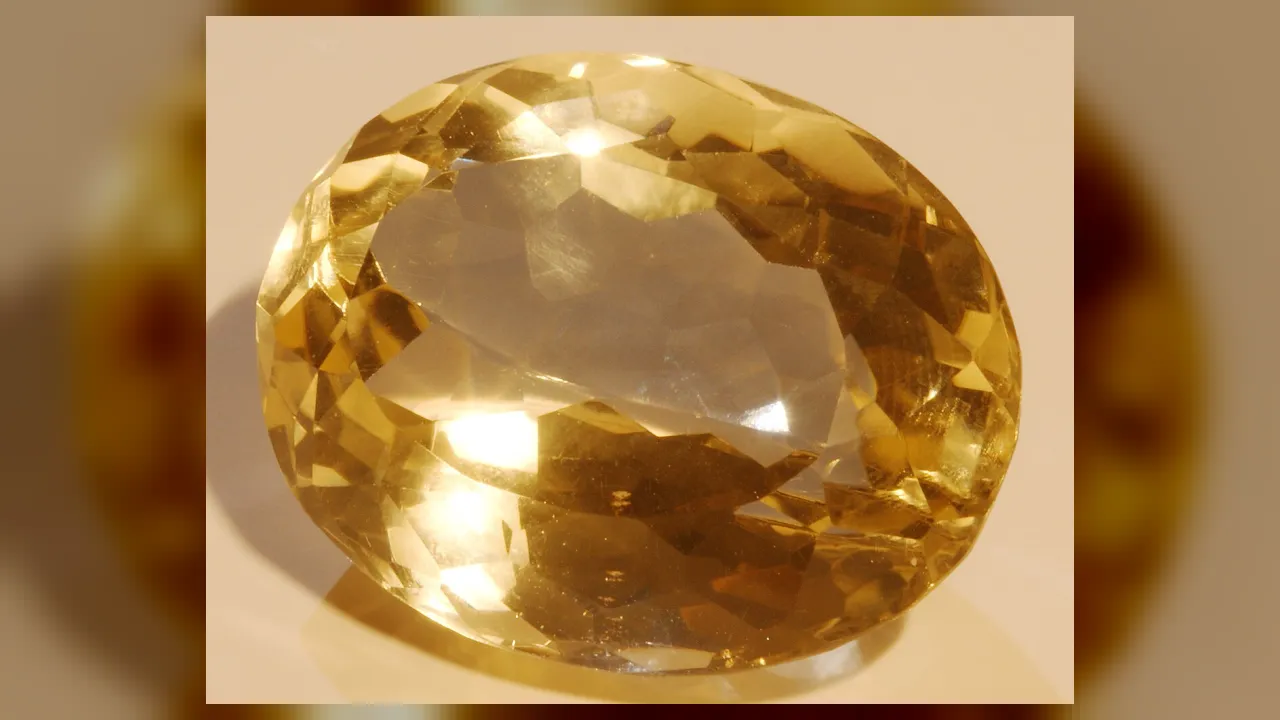
1. Which yellow fruit inspired the name 'citrine'?
2. Which month celebrates sunny citrine as a traditional birthstone?
🤯 Mind-Blowing Fact • Grade 2
Most bright orange-gold citrine sold in rock shops actually started out as purple amethyst geode clusters before being heated!
✨ Word Sparks (Grade 2 Glossary)
Tap 🔊 to hear
magma
Melted hot rock deep beneath Earth's surface
kiln
A super-hot oven used for baking stones
transform
To change completely in look or form
🪝
How can underground heat turn a purple crystal into a golden yellow one?
1
Nature's Color Makeover
Picture a pocket of purple amethyst crystals resting quietly inside a mountain. Suddenly, hot rises nearby and warms the surrounding rock like a giant underground oven!
2
From Grape to Honey
As the temperature climbs, tiny iron particles inside the purple quartz rearrange themselves. Slowly, deep grape purple into warm lemon yellow and golden honey—creating citrine!
3
Natural Versus Heated Gems
Unheated pale-yellow citrine grown naturally inside granite pockets is quite rare. Because people love its sunny glow, gem makers often warm Brazilian amethyst in special ovens to copy Earth's recipe.
1. What happens when Earth's underground heat warms purple amethyst crystals?
2. Which metal inside quartz creates citrine's yellow and honey tones?
🤯 Mind-Blowing Fact • Grade 3
For hundreds of years before modern mineral testing, people nicknamed golden citrine 'Spanish topaz' or 'Madeira topaz' even though it is pure quartz!
✨ Word Sparks (Grade 3 Glossary)
Tap 🔊 to hear
topaz
A harder yellow gem often confused with citrine
champagne
A pale sparkling golden-yellow color shade
brooch
A decorative jeweled pin worn on clothing
🪝
How could rock detectives tell a pale natural citrine crystal apart from heat-treated amethyst?
1
Spotting Clues Like a Geologist
Place two yellow crystals side by side on a science table. One is a tall, single six-sided prism glowing soft yellow all the way from base to tip. The other sits on a white rocky crust with short, dark orange-red tips. A sharp-eyed geologist knows right away: the pale single point is rare natural citrine, while the orange cluster is heat-treated amethyst!
2
Mistaken for Topaz in History
For centuries, merchants confused golden citrine with another yellow mineral called imperial . Modern geologists test hardness to tell them apart: citrine sits at Mohs hardness seven, whereas topaz scratches citrine at hardness eight.
3
Scottish Cairngorm Treasures
In Scotland's Cairngorm Mountains, smoky-yellow and honey-amber citrine crystals weathered out of ancient granite peaks, decorating traditional Highland for hundreds of years.
4
Tough Enough for Everyday Wear
Because citrine shares quartz's strong silicon-dioxide framework without fragile cleavage planes, its sunny facets stay bright and scratch-resistant for generations.
1. How can a geologist distinguish golden citrine from yellow topaz using a scratch test?
2. What visual clue often reveals that a citrine cluster is actually heat-treated amethyst?
🤯 Mind-Blowing Fact • Grade 4
Gemologists use polarized light filters to spot genuine unheated citrine because natural citrine shifts subtly between two yellow shades as you turn it, while baked amethyst does not!
✨ Word Sparks (Grade 4 Glossary)
Tap 🔊 to hear
nanoparticle
An ultra-tiny particle smaller than light waves
dichroism
Showing two slightly different colors when rotated
geothermal
Heated naturally by warmth inside Earth's crust
🪝
Why do some natural citrine crystals turn smoky yellow without ever having been purple first?
1
Two Natural Pathways to Gold
Mineralogists studying quartz coloration have uncovered two separate natural ways Earth makes citrine! In the first pathway, ferric iron (Fe3+) collects as ultra-tiny iron-oxide between crystal layers—either during warm hydrothermal growth or when heat bakes preexisting amethyst or smoky quartz. Those microscopic iron clusters absorb blue and violet wavelengths, leaving warm amber and honey hues.
2
Aluminum-Driven Lemon Quartz
In the second natural pathway, found inside granite pegmatites in Brazil, Madagascar, and Russia's Ural Mountains, trace aluminum and lithium ions replace silicon inside the SiO2 framework without much iron at all. Natural low-dose radiation combines smoky and pale-yellow color centers to produce delicate smoky-lemon crystals.
3
Dichroism Under Polarized Filters
Earth science labs use polarized light to tell genuine natural citrine apart from baked amethyst! Unheated natural citrine displays faint —shifting slightly between two shades of pale yellow as you rotate the crystal—whereas heat-treated amethyst loses that directional color shift.
4
Bolivia's Famous Ametrine Veins
Where underground temperatures hovered right around the transition threshold inside limestone fractures in eastern Bolivia, single quartz crystals preserved both states at once as bicolor purple-and-gold ametrine. Like all crystalline quartz varieties studied in Virginia Earth science labs, citrine registers hardness seven on the Mohs scale, leaves a colorless white streak, displays glassy luster, and chips along curved conchoidal fractures without flat cleavage planes.
1. Why does ferric iron inside citrine make the crystal look yellow or orange to our eyes?
2. Which optical property helps gemologists identify unheated natural citrine in a lab?
🤯 Mind-Blowing Fact • Grade 5
Slice a Bolivian ametrine crystal horizontally like a loaf of bread and you will see an alternating six-slice pinwheel of three purple amethyst triangles and three golden citrine triangles!
✨ Word Sparks (Grade 5 Glossary)
Tap 🔊 to hear
refractive index
Number measuring how strongly a mineral bends light
sector zoning
Different crystal faces trapping impurities at different rates
lapidary
The craft of cutting and polishing gemstones
🪝
What exact atomic changes occur between 350 and 500 degrees Celsius when violet quartz transforms into golden citrine?
1
Solid-State Iron Precipitation
Trace the journey of iron atoms inside macrocrystalline quartz (SiO2) as crustal temperatures rise. Below 300 degrees Celsius, irradiation-induced [FeO4]0 hole centers generate amethyst's royal violet absorption band near 545 nanometers. Once geothermal fluids or laboratory furnaces heat the crystal between 350 and 500 degrees Celsius, thermal energy releases trapped electrons, reducing tetravalent iron back to Fe3+ and mobilizing iron ions to cluster into submicroscopic ferric oxide (Fe2O3-like) nanoparticles measuring fewer than ten nanometers across. Because those nanoparticles are far smaller than visible wavelengths, the gem remains completely transparent while strong ultraviolet-to-blue charge-transfer absorption imparts rich Madeira-orange to golden hues.
2
True Natural Aluminum-Hole Citrine
Spectroscopists reserve the strictest definition of primary natural citrine for unheated crystals grown directly inside granitic pegmatites and alpine clefts—such as specimens from Congo, Zambia, Madagascar, and Russia. In these stones, trace Al3+ ions balanced by Li+ or H+ interstitials form aluminum-related defect centers alongside trace Fe3+, producing cool champagne, straw-yellow, or smoky-citrine shades that display pleochroism under a dichroscope.
3
Thermal Gradients and Sector Zoning
Why do bilingual purple-and-yellow ametrine crystals split into crisp geometric triangles when sliced crosswise? Quartz grows via alternating positive (r) and negative (z) rhombohedral faces whose surface atomic steps trap iron at different rates! Differential iron uptake combined with gentle hydrothermal heating near 200 to 300 degrees Celsius converts one set of sectors into ferric-oxide citrine while preserving amethyst color centers in adjacent sectors.
4
Distinguishing Quartz from Topaz by Refractometry
Before 19th-century optical mineralogy, gem traders routinely grouped yellow sapphire, imperial topaz, and citrine under the catch-all label 'topaz.' Modern gemologists measure without scratching a stone: citrine registers 1.544 to 1.553 with specific gravity 2.65, whereas topaz registers 1.619 to 1.627 with specific gravity 3.53.
5
Durability in Decorative Lapidary Arts
Free of topaz's basal cleavage hazard and available in flawless giant pegmatite crystals weighing tens of kilograms, natural and heated citrines became signature gems of 1920s Art Deco geometric jewelry and museum-scale faceted sculptures.