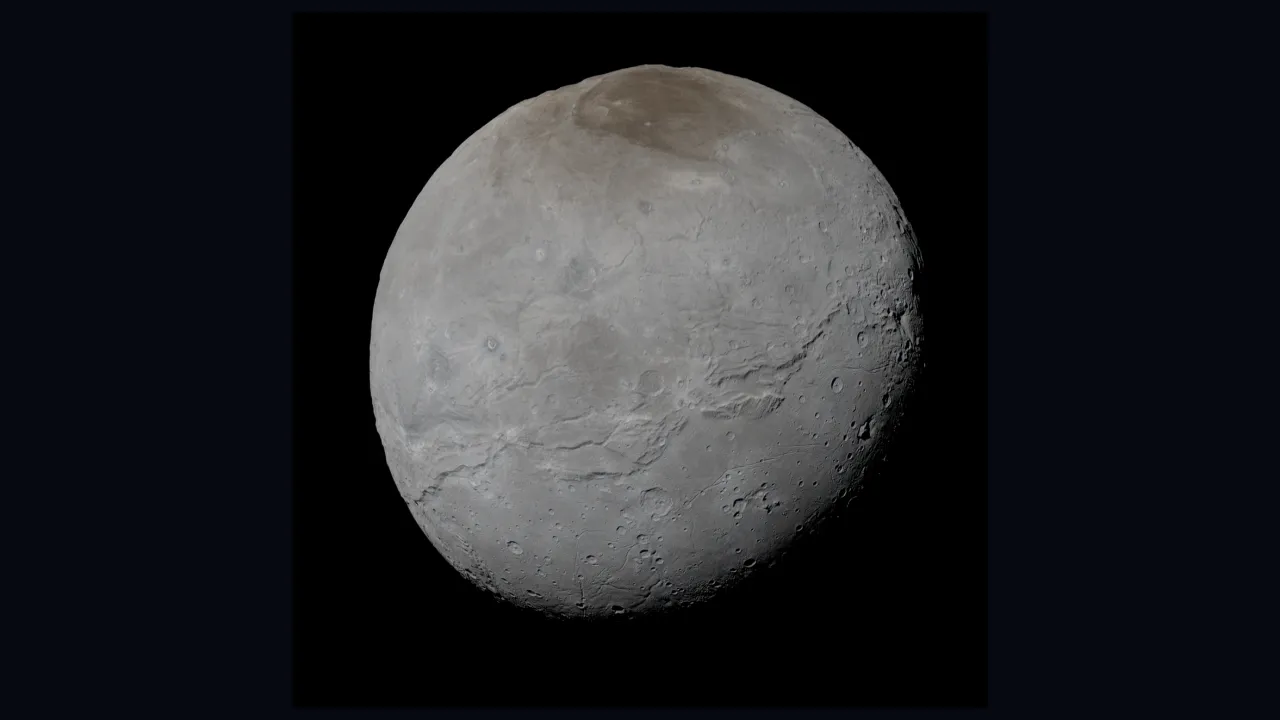
2. What unusual feature sits right on top of Charon's north pole?
🤯 Mind-Blowing Fact • Grade 2
Astronomer James Christy named Charon after the mythical boatman of the underworld—and picked the 'Ch' spelling to sound like 'Shar-on' after his wife Charlene!
✨ Word Sparks (Grade 2 Glossary)
Tap 🔊 to hear
Bulge
A rounded bump sticking out from an edge.
Balance point
Center spot where two weights balance evenly.
Gorge
A deep canyon with steep rocky or icy walls.
🪝
How did a tiny blurry 'bump' on a photograph reveal a giant moon in 1978?
1
The Mystery Bump
In 1978, astronomer James Christy studied telescope photos of Pluto and noticed a weird sticking out of one side. Older photos showed that bump moving around Pluto every six days—he had discovered giant Charon!
2
A True Double World
Most moons circle a deep inside their heavy planet. Charon is so hefty compared to Pluto that both worlds circle an invisible balance point floating in empty space between them!
3
Grand Canyons of Ice
When New Horizons zoomed past in 2015, it photographed a thousand-mile belt of giant canyons four times deeper than Earth's Grand Canyon!
1. Where is the gravitational balance point that Pluto and Charon orbit around?
2. How did James Christy first spot Charon in 1978?
🤯 Mind-Blowing Fact • Grade 3
On Charon's smooth plains stands Kubrick Mons—a mysterious two-mile-tall 'mountain in a moat' surrounded by a deep circular ditch!
✨ Word Sparks (Grade 3 Glossary)
Tap 🔊 to hear
Tidal lock
Gravity keeping two worlds facing each other permanently.
Ultraviolet
Invisible high-energy light rays shining from the Sun.
Moat
A deep wide trench surrounding a central peak.
🪝
How did Pluto paint a giant red cap onto its neighbor moon across 12,000 miles of space?
1
Sharing Air Across Space
Charon has almost zero air of its own, while neighbor Pluto leaks thin methane gas into space. As Charon orbits just 12,160 miles away, its freezing minus-430-degree winter pole traps escaping Pluto gas like cold flypaper! When sunlight returns, rays bake that frozen methane into dark red organic soot called Mordor Macula.
2
Bursting Like a Soda Can
Across Charon's equator stretches Serenity Chasma, part of a global canyon chain over a thousand miles long. Billions of years ago, an underground water ocean inside Charon froze solid, expanded outward, and cracked its icy shell wide open!
3
Mountains in a Moat
South of those canyons lies smooth Vulcan Planitia, where weird mountains like Kubrick Mons sit inside deep sunken —likely formed when thick icy lava oozed across the plains.
4
Locked in Mutual Gaze
Every 6.39 days, Pluto and Charon spin and orbit in exact lockstep—the Solar System's ultimate double dwarf planet!
1. How did Charon's dark red north polar cap (Mordor Macula) form?
2. What split open Charon's 1,000-mile equatorial canyon belt long ago?
🤯 Mind-Blowing Fact • Grade 4
In 2024, the James Webb Space Telescope discovered hydrogen peroxide—the same bubbly chemical in first-aid kits—forming naturally on Charon's irradiated water ice!
✨ Word Sparks (Grade 4 Glossary)
Tap 🔊 to hear
Barycenter
Shared center of gravity two worlds orbit around.
Volatile
Chemical that evaporates easily even at cold temperatures.
Ammonia hydrate
Water ice crystal mixed with antifreeze ammonia molecules.
🪝
Why did Pluto stay covered in churning nitrogen glaciers while neighboring Charon lost all its surface gases?
1
Gravity Escape Threshold
Even though Pluto and Charon forged side by side from the same giant Kuiper Belt collision four billion years ago, New Horizons revealed strikingly different surfaces! Pluto gleams with nitrogen, methane, and carbon monoxide frosts, whereas Charon's surface is bare, rock-hard water ice tinted gray. Because Charon has only twelve percent of Pluto's mass, its weaker surface gravity let lightweight nitrogen and methane molecules escape into space eons ago!
2
Barycentric Binary Mechanics
Holding the highest moon-to-primary mass ratio (roughly 1 to 8.2) of any large pair in the Solar System, Charon pulls their shared center of mass—the —about 1,200 kilometers above Pluto's surface. Both bodies achieved complete mutual synchronous rotation, zeroing out ongoing tidal flexing.
3
JWST Spots Carbon Dioxide and Peroxide
In 2024, the James Webb Space Telescope observed Charon at longer infrared wavelengths than New Horizons could reach, detecting pristine carbon dioxide ice excavated by craters alongside hydrogen peroxide ($H_2O_2$) forged as radiation zaps water molecules!
4
Ammonia Hydrate Clues
Spectrometers also spotted crystalline water ice mixed with inside bright craters like Organa—natural antifreeze leftovers from Charon's ancient cryovolcanic floods across Vulcan Planitia.
1. Why is Charon covered in bare water ice while nearby Pluto holds thick sheets of nitrogen and methane ice?
2. What two chemicals did the James Webb Space Telescope newly identify on Charon in 2024?
🤯 Mind-Blowing Fact • Grade 5
New 2025 supercomputer models suggest Pluto and Charon formed via 'kiss-and-capture'—briefly sticking together like a spinning cosmic snowman for a single day before separating into lifelong orbit partners!
✨ Word Sparks (Grade 5 Glossary)
Tap 🔊 to hear
Kiss-and-capture
Grazing collision where two icy worlds briefly merge, then orbit.
Cryomagma
Pressurized icy slush rising toward a moon's surface.
Mutual eclipse
Orbiting partners taking turns passing across each other.
🪝
Did Pluto and Charon lock together through a 'kiss-and-capture' collision between two icy protoplanets?
1
Mutual Eclipses Unlock Bulk Densities
Between 1985 and 1990—just seven years after James Christy's discovery—Earth crossed the orbital plane of Charon, triggering a once-per-124-year series of mutual Pluto-Charon eclipses! Tracking those brightness dips allowed astronomers to calculate precise radii and individual masses long before spacecraft arrival. New Horizons refined Charon's diameter to 1,212 kilometers and its bulk density to 1.702 grams per cubic centimeter (slightly less dense than Pluto's 1.854, indicating roughly 55 percent rock and 45 percent ice).
2
The 'Kiss-and-Capture' Origin Breakthrough
For years, moon-formation simulations treated colliding icy worlds like fluid droplets—which underpredicted rock fractions or smeared Charon into a debris disk. In 2025, planetary scientists incorporating the true structural strength of cold rock and ice discovered a '' mechanism: two differentiated Kuiper Belt progenitors grazed each other, briefly merged for ten to thirty hours like a spinning snowman, and then separated intact into a tidally bound binary while preserving both bodies' rocky cores!
3
Extensional Tectonism of Argo and Serenity Chasmata
Spanning over 1,800 kilometers with scarps plunging seven to nine kilometers deep, Charon's equatorial tectonic belt records roughly one percent radial expansion. As Charon's early subsurface ammonia-water ocean froze completely solid, tensile stresses fractured the thickening ice I shell and squeezed viscous upward to resurface Vulcan Planitia around sunken-moat constructs like Kubrick and Clarke Montes.
4
Seasonal Cold-Trapping at Mordor Macula
During each century-long polar winter, surface temperatures inside Mordor Macula plunge to 25 kelvins (-248°C)—cold enough to condense hydrodynamic methane escaping Pluto before Lyman-alpha ultraviolet photons polymerize nonvolatile reddish macromolecular tholins.
5
Small-Crater Deficit in the Kuiper Belt
Counting craters across four-billion-year-old Vulcan Planitia revealed a sharp deficit of craters smaller than thirteen kilometers, proving most primordial Kuiper Belt objects accreted straight into 10-to-100-kilometer bodies rather than swarming with tiny kilometer-sized pebbles!