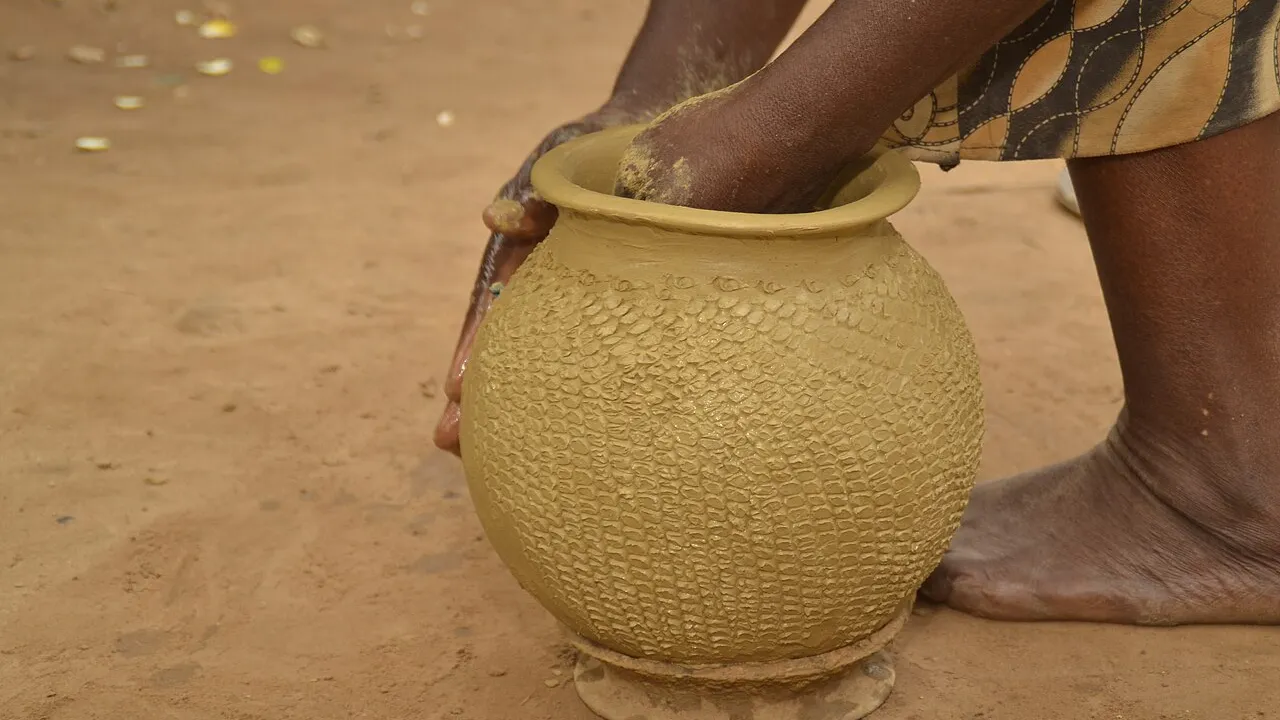
1. What machine spins clay in a circle while the potter shapes it?
2. What does a kiln use to turn soft clay hard?
🤯 Mind-Blowing Fact • Grade 2
A tiny air bubble left inside wet clay can expand in the hot kiln and pop a pot apart!
✨ Word Sparks (Grade 2 Glossary)
Tap 🔊 to hear
Wedging
Kneading clay to push out air bubbles
Centering
Pressing spinning clay steady in the middle
Waterproof
Able to hold water without leaking
🪝
Why do potters slap and knead clay like bread dough before spinning it?
1
Wedging Out Air Bubbles
Thump, press, and roll! Before spinning a bowl, a ceramic potter kneads damp clay on a sturdy table. This step is called , and it pushes out tiny trapped air bubbles so the pot will not crack.
2
Centering on the Wheel
Once the clay is smooth, the potter tosses it onto the middle of a spinning wheel. Wet hands steady the lump until it spins without wobbling, and gentle fingers pull tall, even walls upward.
3
Kiln Fire and Glassy Glaze
After drying for days, the pale clay pot bakes inside a fiery kiln. Then the potter dips it in liquid glaze and fires it again, melting tiny minerals into a smooth, coat.
1. Why does a potter wedge clay before shaping a bowl?
2. What happens to liquid glaze during the second kiln firing?
🤯 Mind-Blowing Fact • Grade 3
A glaze that looks chalky gray when brushed on can turn dazzling cobalt blue or emerald green after firing in the kiln!
✨ Word Sparks (Grade 3 Glossary)
Tap 🔊 to hear
Throwing
Shaping wet clay on a spinning wheel
Leather-hard
Firm damp clay ready for neat trimming
Bisque
Clay baked once before glaze is added
🪝
How can powdery minerals turn into a glassy, colorful coat inside an oven?
1
Earth, Water, and Balance
Step inside a busy pottery studio, where shelves hold rows of damp bowls and the air smells like fresh rain on soil. Ceramic potters combine art and chemistry to turn natural clay from riverbeds into sturdy tableware, tiles, and sculptures.
2
Throwing and Trimming
Shaping clay on a spinning wheel is called . The potter uses steady hands, wooden ribs, and damp sponges to guide the spinning form. When the clay dries to a firm stage called , metal loop tools trim a neat ring on the bottom.
3
Bisque Firing Transformation
Bone-dry pots are fragile, so they undergo a first bake called a firing. Inside the kiln, temperatures climb past one thousand seven hundred degrees Fahrenheit, permanently changing crumbly dirt into hard, porous ceramic.
4
The Chemistry of Glaze
Next, potters brush or dip pots into liquid glazes mixed from ground quartz, feldspar, and metal oxides. A second, hotter firing melts those minerals into colorful glass that seals every tiny pore.
1. At what stage of dryness does a potter trim a neat foot ring onto the bottom of a bowl?
2. Why do bisque-fired mugs still need a coat of glaze before holding juice or soup?
🤯 Mind-Blowing Fact • Grade 4
Because clay shrinks up to fifteen percent during drying and firing, potters use special oversize 'shrink rulers' when making lids that must fit teapots!
✨ Word Sparks (Grade 4 Glossary)
Tap 🔊 to hear
Stoneware
Dense, strong clay fired at high temperatures
Slip
Liquid clay mixture used like glue
Vitrification
Heat fusing clay particles into dense stone
🪝
Why does a handmade clay mug shrink noticeably smaller between the potter's wheel and your kitchen table?
1
From Riverbank Sediment to Studio Craft
Across thousands of years, broken shards of pottery have helped archaeologists trace how ancient communities cooked, traded, and stored grain. Today, ceramic potters carry that timeless craft forward, blending sculptural design with materials science to create functional dinnerware, architectural tiles, and gallery art. In Virginia and throughout the Appalachian region, potters have long prized local clays dug near river valleys.
2
Centrifugal Force and Clay Memory
When a wheel spins at two hundred revolutions per minute, centrifugal force tries to fling wet clay outward while the potter's palms press inward. Balancing these opposing forces requires practiced muscle memory. Potters also build pieces by hand using rolled coils or flat slabs, carefully scoring and joining edges with liquid clay called .
3
Shrinkage and Vitrification
As water evaporates from damp clay, microscopic mineral platelets pull closer together, causing the vessel to shrink. Later, inside an electric or gas kiln reaching over two thousand two hundred degrees Fahrenheit, a process called fuses clay particles together. By the end, a mug may shrink by twelve percent, so potters must calculate oversize measurements before they begin.
4
Color From Earth's Elements
Glaze formulation works like a science lab. Copper carbonate can yield turquoise or deep red depending on how much oxygen enters the kiln, while iron oxide creates warm amber and rust tones. Every opening of a cooled kiln reveals how heat and chemistry transformed earthy paste into gleaming stone.
1. Why must a potter throw a teapot lid slightly larger than the finished size needed?
2. How can the exact same copper glaze turn green in one firing and red in another?
🤯 Mind-Blowing Fact • Grade 5
Potters still place small pyramid-shaped 'pyrometric cones' inside kilns because these calibrated mineral cones bend at exact heat-work thresholds, showing true ceramic maturity better than air temperature alone!
✨ Word Sparks (Grade 5 Glossary)
Tap 🔊 to hear
Plasticity
Ability of wet clay to hold shaped forms
Kaolinite
Pure white clay mineral formed from feldspar
Flux
Mineral that helps silica melt lower
🪝
What connects a handcrafted stoneware pitcher in an artist's studio to the heat-shield tiles on a spacecraft?
1
Ancient Silicates and Modern Artisans
Run your fingertips along the fluted sides of a wheel-thrown porcelain vase, and you are touching transformed weathered granite. Over millions of years, rain and carbonic acid break down feldspar rock into microscopic hexagonal platelets of clay. When mixed with water, thin films of moisture let these flat crystals slide smoothly past one another—a property called that allows a ceramic potter to coax spinning earth into paper-thin walls.
2
Precision Mechanics at the Wheel
Mastering the wheel demands precise control of friction, rotational speed, and wall thickness. After wedging clay to align platelets and expel air pockets, a potter centers up to twenty pounds of stoneware over the wheel head. Raising a tall cylinder requires synchronized pressure between inside and outside fingertips; press too thin near the base and the wet vessel collapses, leave it too thick and uneven drying stresses can split the piece.
3
Thermal Physics Inside the Kiln
Firing is an irreversible sequence of chemical and physical changes monitored with pyrometric cones and digital thermocouples. Around one thousand sixty-three degrees Fahrenheit, quartz crystals inside the clay body suddenly rearrange their atomic lattice during 'quartz inversion,' expanding slightly. Potters must ramp temperatures slowly through this zone so thermal shock does not shatter the work, before climbing past two thousand three hundred degrees Fahrenheit to achieve full vitrification.
4
Silica Glass and Oxide Chemistry
Formulating food-safe glazes requires balancing three chemical components: silica to form glass, alumina to keep molten glaze from dripping off vertical walls, and such as calcium or sodium to lower silica's extreme melting point. Trace transition metals—cobalt, manganese, iron, and rutile—interact with kiln oxygen levels to produce luminous crystalline surfaces.
5
Studio Entrepreneurship and Shared Heritage
Contemporary ceramic potters work across custom tableware studios, historic preservation workshops, industrial dinnerware design labs, and community classrooms. The very thermal resilience they harness in kilns also inspires aerospace ceramics, proving that humanity's oldest craft remains vital to modern life.