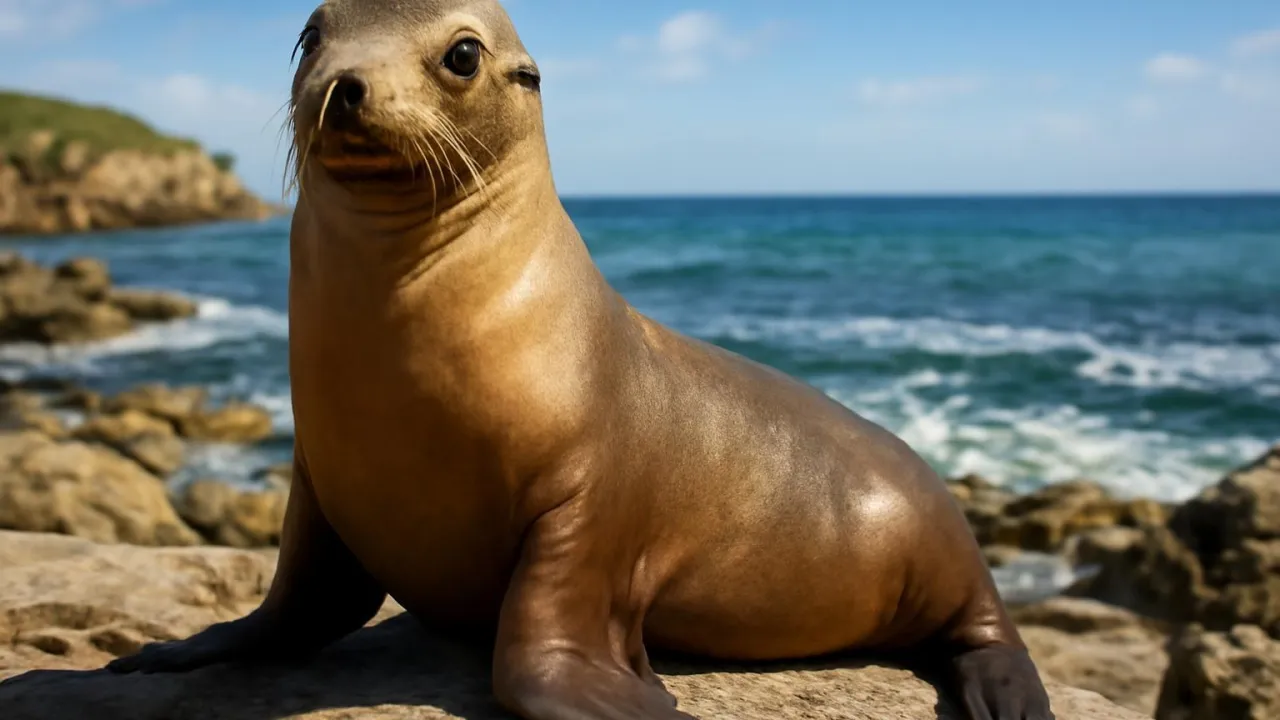
California sea lions can dive over 900 feet deep to find food underwater!
✨ Word Sparks (Grade 3 Glossary)
Tap 🔊 to hear
camouflage
Colors that help animals hide from others.
nutrients
Food parts that help animals grow strong.
predator
An animal that hunts other animals.
🪝
Did you know California sea lions can 'walk' on land using their flippers?
1
Flippers Help Them Move
California sea lions have strong, flexible flippers that help them swim fast and walk on land. Their front flippers act like powerful paddles in the water. On land, they rotate their flippers to support their body weight and move quickly.
2
Living by the Ocean
These sea lions live along the Pacific Coast, where rocky shores and sandy beaches provide safe resting spots. Their brown fur helps them blend in with rocks, which is a kind of to hide from .
3
Eating to Survive
Sea lions hunt fish, squid, and small marine animals by diving deep underwater. They use their sharp teeth to catch slippery prey. Eating enough food gives them the needed to stay warm and active.
4
Talking with Flippers
Sea lions communicate by barking loudly and clapping their flippers. This helps them warn others about danger or attract mates. Their social sounds are important for living in groups called colonies.
California sea lions can swim up to 25 miles per hour when chasing prey in the ocean!
✨ Word Sparks (Grade 4 Glossary)
Tap 🔊 to hear
ecosystem
A community of living things and their home.
migration
Moving to a new place during seasons.
predator
An animal that hunts other animals.
🪝
How do California sea lions use their flippers to survive on land and in water?
1
Flipper Adaptations for Survival
California sea lions have evolved strong, flexible flippers that allow them to swim swiftly through water and walk on rocky shores. Their front flippers serve as powerful paddles for fast swimming, while on land they rotate these flippers under their bodies to support movement and balance. This dual use helps them escape and hunt efficiently.
2
Role in the Coastal Ecosystem
These sea lions play an important role in the coastal food web by controlling fish and squid populations. They also serve as prey for larger like orcas and sharks, which helps maintain balance. Human activities such as fishing and pollution impact their habitats and food sources, sometimes causing population changes.
3
Geographic Range and Habitats
California sea lions are found along the Pacific Coast from Alaska to central Mexico. They prefer sandy beaches and rocky islands for breeding and resting. Seasonal occur as they follow food sources and warmer waters during colder months, showing their ability to adapt to changing environments.
4
Communication and Social Behavior
Sea lions use a variety of vocalizations, including barks and growls, along with flipper claps to communicate within colonies. These social behaviors help establish territory, attract mates, and warn of danger. Group living provides protection and helps with raising pups, increasing survival rates.
California sea lions can dive deeper than 900 feet and swim faster than 25 miles per hour!
✨ Word Sparks (Grade 5 Glossary)
Tap 🔊 to hear
locomotion
The way animals move from place to place.
entanglement
When animals get caught in fishing nets or lines.
quadrupedal
Walking on all four limbs.
🪝
What makes the California sea lion a remarkable marine mammal along the Pacific Coast?
1
Scientific Classification and Physical Traits
The California sea lion, Zalophus californianus, belongs to the Otariidae family, known as eared seals. Adult males can reach lengths of up to 8 feet and weigh around 600 pounds, while females are smaller. Their external ear flaps and large front flippers distinguish them from true seals. These features help them hear and swim efficiently in their marine environment.
2
Physiological Adaptations for Aquatic Life
These sea lions possess a streamlined body and powerful flippers that enable swimming speeds up to 25 miles per hour. Their lungs and blood store oxygen efficiently, allowing dives exceeding 900 feet and lasting several minutes. On land, they rotate flippers under their bodies for , which helps them move quickly on rocky shores.
3
Conservation and Human Impact
California sea lions are currently listed as least concern but face threats from habitat pollution, in fishing gear, and climate change affecting prey availability. Conservation efforts include protected marine areas and rescue programs to reduce human-caused injuries. Public education also helps reduce harmful interactions with humans.
4
Behavior, Communication, and Social Structure
These sea lions form large colonies during breeding season, where males establish territories by vocalizing and clapping flippers. Their complex social behaviors include cooperative hunting and pup rearing. Vocalizations vary from barks to growls, essential for maintaining social bonds and coordinating group activities.
5
Quantitative Comparisons and Habitat Range
California sea lions inhabit coastal waters from Alaska to central Mexico, adapting to temperatures ranging from near freezing to warm subtropical zones. Adult males weigh about 600 pounds, roughly ten times heavier than a large dog, and can swim at speeds rivaling many fish species. Their ability to dive deep and move fast supports their survival in diverse marine habitats.