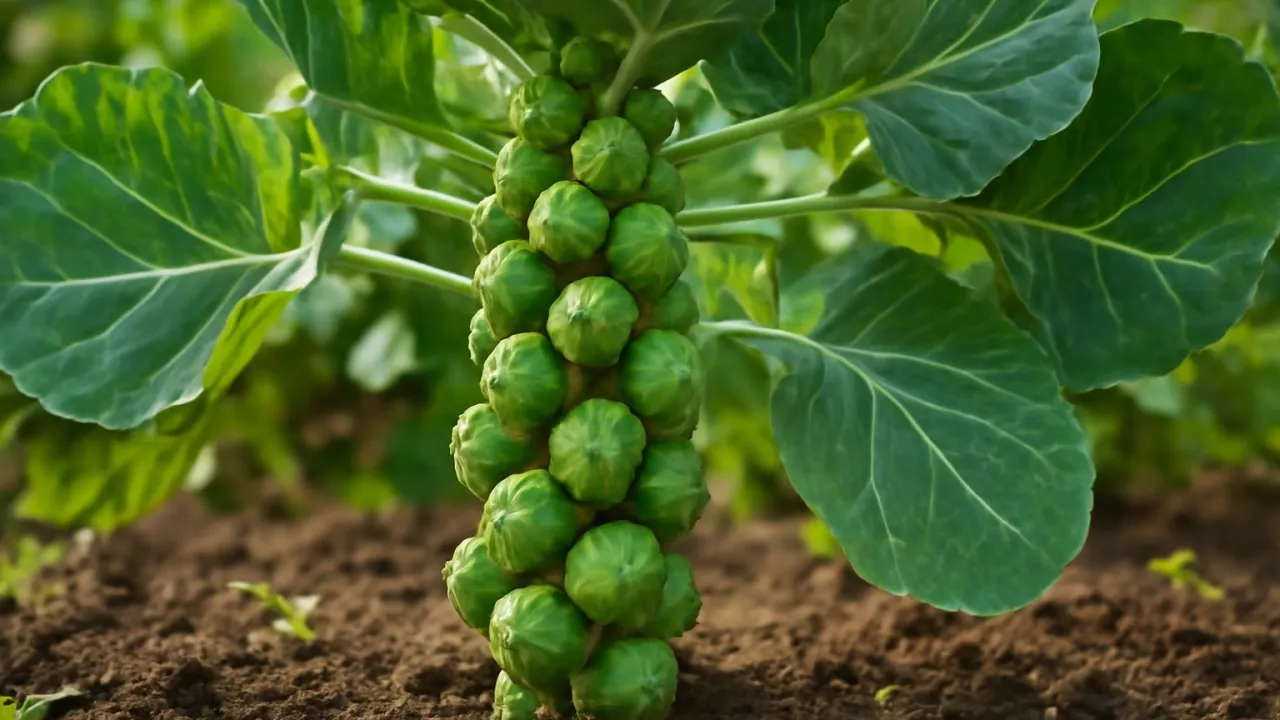
Brussels sprouts grow best in cool weather and can grow up to three feet tall!
✨ Word Sparks (Grade 2 Glossary)
Tap 🔊 to hear
stalk
The tall stem that holds the sprouts
vitamin
A healthy part of food that helps your body
moist
A little wet, like damp soil
🪝
Have you ever seen tiny green vegetables growing on a tall plant?
1
Tiny Vegetables on a Stalk
Brussels sprouts grow on tall in gardens. They look like small cabbages. Each sprout is a tiny vegetable. They grow close together on the plant.
2
Where They Live and Grow
These vegetables grow best in cool weather. They need full sun and soil to grow well. Farmers plant them in temperate places like Europe. The plants can grow two to three feet tall.
3
A Special Green Treat
Brussels sprouts have many that help your body grow. People cook them by steaming or roasting. They taste a little sweet and nutty. Eating them helps keep you healthy every day.
Brussels sprouts use their tight leaves as camouflage to hide from insects and predators!
✨ Word Sparks (Grade 3 Glossary)
Tap 🔊 to hear
camouflage
How plants hide by blending in with surroundings
nutrients
Good things in food that help your body grow
predator
An animal or insect that tries to eat plants
🪝
Did you know Brussels sprouts are tiny cabbages that grow on tall stalks?
1
What Are Brussels Sprouts?
Brussels sprouts are small, round vegetables that look like mini cabbages. They grow tightly packed along a tall, thick stalk. This plant belongs to the cabbage family, called Brassica. Their green leaves protect the sprouts as they grow.
2
How They Grow and Adapt
These vegetables grow best in cool climates where they get full sun and moist soil. The stalk helps the sprouts stay off the ground and away from some . Their tight leaves act like to hide from insects. This adaptation helps them survive until harvest.
3
Brussels Sprouts and Nutrition
Brussels sprouts are rich in vitamins like vitamin C and vitamin K. They provide important that help your body fight sickness. People often cook them by steaming or roasting to bring out their sweet flavor. This cooking also helps soften their tough leaves.
4
From Seed to Harvest
Farmers plant Brussels sprouts seeds in early spring or late summer. The plants take about 80 to 100 days to grow fully. During this time, the sprouts form along the stalk in rows. When they reach about one inch wide, they are ready to pick and eat.
2. How long does it take for Brussels sprouts to grow fully?
🤯 Mind-Blowing Fact • Grade 4
Brussels sprouts play an important role in food webs by feeding insects and supporting pollinators like bees!
✨ Word Sparks (Grade 4 Glossary)
Tap 🔊 to hear
ecosystem
A place where plants, animals, and people live together
pollinator
An animal that helps plants make seeds by moving pollen
agriculture
Farming plants and animals for food
🪝
Have you ever wondered how Brussels sprouts fit into nature’s big food web?
1
Growing Conditions and Adaptations
Brussels sprouts thrive in temperate climates where cool temperatures slow their growth and improve flavor. Their tall stalks elevate the sprouts, reducing damage from soil pests and moisture. The dense, layered leaves serve as natural camouflage, protecting them from many insect predators. These adaptations help Brussels sprouts survive in diverse garden and farm .
2
Role in the Ecosystem
As a leafy vegetable, Brussels sprouts provide food for insects and animals, forming part of the local food web. like bees visit their flowers to collect nectar, aiding in reproduction. Additionally, they contribute nutrients back to the soil when plant parts decompose after harvest. Farmers rotate these crops to maintain healthy soil and reduce pests.
3
Human Impact and Agriculture
Humans cultivate Brussels sprouts widely in Europe and North America, valuing their nutritious qualities. Agricultural practices such as crop rotation and pest management help sustain healthy yields. However, overuse of pesticides can harm beneficial insects and disrupt balance. Sustainable farming methods aim to protect the environment while producing healthy vegetables.
4
Geographic Distribution
Originally from Belgium, Brussels sprouts are now grown in many temperate regions worldwide. They require well-drained, fertile soil and consistent moisture to develop properly. Major producers include the United States, the Netherlands, and the United Kingdom. Their popularity continues to grow due to their health benefits and unique taste.
1. What helps protect Brussels sprouts from soil pests?
2. Why do farmers rotate Brussels sprouts with other crops?
🤯 Mind-Blowing Fact • Grade 5
Brussels sprouts are actually tiny buds growing along a tall stalk, not fruits or seeds!
✨ Word Sparks (Grade 5 Glossary)
Tap 🔊 to hear
botanical
Related to plants and how they grow
photosynthesis
How plants make food using sunlight
genetic diversity
Different plant types that help crops survive
🪝
How do Brussels sprouts fit scientifically into the plant kingdom and help ecosystems worldwide?
1
Scientific Classification and Botany
Brussels sprouts belong to the species Brassica oleracea var. gemmifera, part of the Brassicaceae family. This family includes cabbage, broccoli, and kale, all sharing similar growth patterns. Botanically, Brussels sprouts are classified as buds, not fruits or seeds, growing along an erect stalk. Their development involves complex hormonal signals that regulate bud formation and leaf layering.
2
Physiological Growth and Adaptations
The plant grows two to three feet tall, with buds forming at leaf axils along the stalk. Its thick stalk provides structural support and nutrient transport from roots to buds. The dense, overlapping leaves protect sprouts from herbivores and cold temperatures. in the leaves produces energy needed for sprout growth, while root systems absorb water and minerals from the soil.
3
Conservation and Agricultural History
Brussels sprouts were first cultivated in Belgium around the 16th century and spread across Europe by the 18th century. Modern agriculture uses selective breeding to improve size, flavor, and pest resistance. Conservation of heirloom varieties preserves important for future crop resilience. Sustainable farming practices reduce pesticide use, protecting beneficial insects and soil health.
4
Nutritional and Economic Importance
Brussels sprouts are rich in vitamins C and K, fiber, and antioxidants, contributing to human health worldwide. Economically, they support farmers in temperate regions, with annual production reaching hundreds of thousands of tons globally. Their ability to grow in cooler climates extends the growing season for fresh vegetables. Consumer demand has increased due to awareness of their health benefits.
5
Quantitative Growth and Environmental Needs
Optimal growth occurs at temperatures between 45 and 75 degrees Fahrenheit (7 to 24 degrees Celsius). Plants require approximately 1 to 1.5 inches (2.5 to 3.8 cm) of water per week for healthy development. Brussels sprouts mature in about 80 to 100 days after planting. Each sprout typically measures 1 to 2 inches (2.5 to 5 cm) in diameter at harvest.