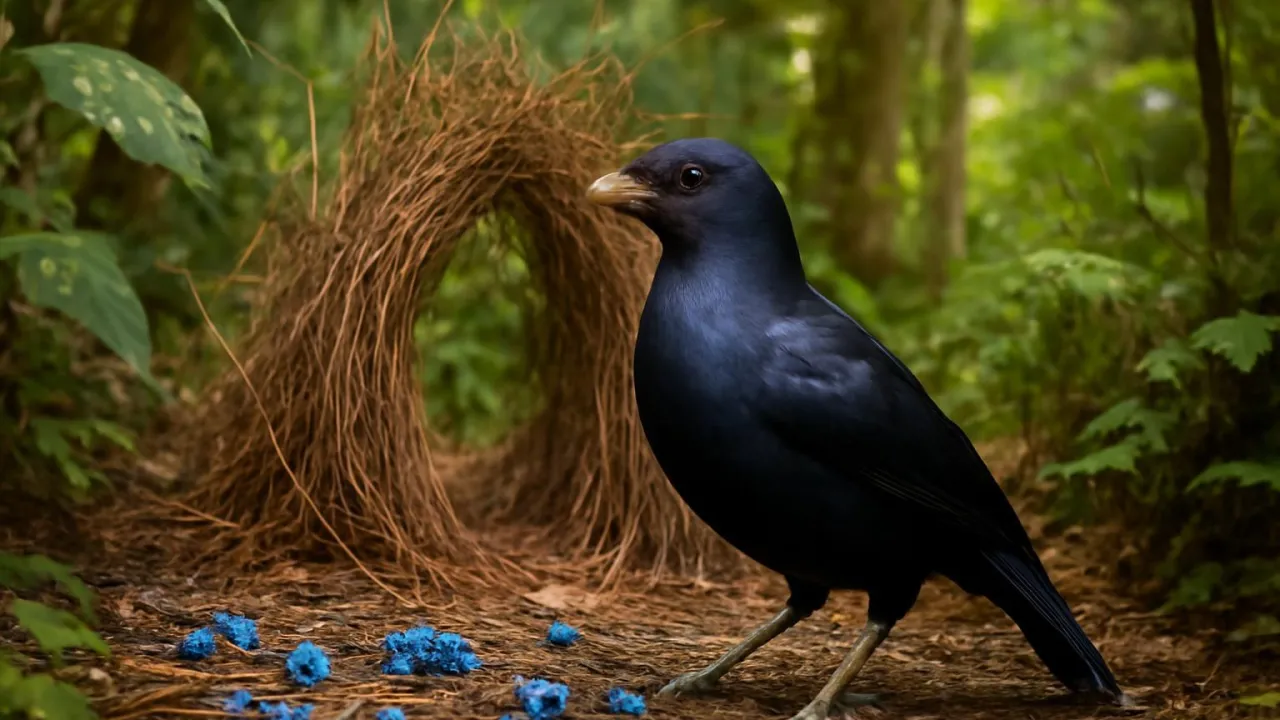
Male bowerbirds collect shiny blue objects like berries and bottle caps to decorate their homes!
✨ Word Sparks (Grade 2 Glossary)
Tap 🔊 to hear
mate
A bird’s special friend for having babies
nectar
Sweet juice inside flowers that birds drink
decorate
To add pretty things to make something nice
🪝
Have you ever seen a bird build a colorful house to attract a friend?
1
Amazing Builders
Bowerbirds build special homes called bowers to attract . They gather colorful objects like berries and flowers. These birds work hard every day to their bowers. The males are the ones who build and decorate.
2
Where They Live
Bowerbirds live in forests in Australia and New Guinea. They like warm, leafy places with lots of trees. They eat fruits, insects, and from flowers. Their homes are hidden on the forest floor among plants.
3
Bright Colors
Bowerbirds use bright blue and red objects to their bowers. These colors help attract female birds. The males arrange the objects very carefully. Their colorful homes look like art galleries.
Some bowerbird species can mimic sounds from their environment, including other animals and machines!
✨ Word Sparks (Grade 3 Glossary)
Tap 🔊 to hear
adaptation
A change that helps animals survive better
pollination
Moving pollen to help flowers make seeds
camouflage
Colors or patterns that help hide animals
🪝
Did you know bowerbirds use art and building skills to survive and find mates?
1
Master Builders
Bowerbirds build intricate structures called bowers to attract female mates. These bowers are decorated with colorful objects like berries, flowers, and shiny stones. The males carefully arrange these items to create an impressive display. This behavior is a unique to help them find partners.
2
Habitat and Diet
Bowerbirds live in the forests of Australia and New Guinea, where dense trees provide shelter. They eat a diet of fruits, insects, and nectar, gaining nutrients needed for survival. Their habitat offers many colorful items used for decoration. These birds play a role in by visiting flowers.
3
Camouflage and Protection
While males build bright bowers, their feathers often blend with forest colors for . This helps protect them from predators while they gather materials. The bowers also serve as a safe meeting place for courtship. Their clever use of colors and structures is a key survival strategy.
4
Pollination Partners
Bowerbirds help pollinate flowers as they feed on nectar, transferring pollen between plants. This symbiotic relationship benefits both the birds and plants in the ecosystem. Their role in food webs supports forest health and biodiversity. Understanding these connections shows how animals and plants depend on each other.
2. How do bowerbirds help plants in their habitat?
🤯 Mind-Blowing Fact • Grade 4
Some bowerbirds can imitate human sounds and other animals, adding to their courtship performances!
✨ Word Sparks (Grade 4 Glossary)
Tap 🔊 to hear
ecosystem
A community of living things and their environment
symbiosis
A helpful relationship between different living things
pollination
When pollen moves to help plants make seeds
🪝
How do bowerbirds use art and nature to survive and shape their ecosystems?
1
Complex Courtship Builders
Male bowerbirds construct elaborate bowers decorated with brightly colored objects to attract females, demonstrating a fascinating cause-and-effect relationship between art and mating success. These structures vary by species and location, showing adaptation to different environments. The bowers not only attract mates but also serve as a display of the male’s fitness and creativity.
2
Ecosystem Roles and Impact
Bowerbirds contribute to their by aiding in as they feed on nectar, which helps plants reproduce and maintain biodiversity. Their fruit-eating habits also assist seed dispersal, supporting forest regeneration. Human activities like deforestation threaten their habitats, impacting both the birds and the forest ecosystems they help sustain.
3
Geographic Distribution
Bowerbirds are native to Australia and New Guinea, inhabiting tropical and subtropical forests with dense vegetation. Different species occupy varied niches within these forests, from lowland rainforests to mountainous areas. Their distribution reflects their adaptability to diverse forest environments and climate conditions.
4
Symbiotic Relationships
Through their feeding and nesting behaviors, bowerbirds engage in symbiotic relationships with plants by pollinating flowers and dispersing seeds, which benefits both parties. These interactions highlight the interconnectedness of species within forest food webs. Protecting bowerbirds also helps preserve the health and balance of their .
1. What role do bowerbirds play in their ecosystems?
2. Why are bowerbirds’ colorful bowers important?
🤯 Mind-Blowing Fact • Grade 5
Bowerbirds can mimic up to 20 different sounds, including other birds and human noises, to impress mates!
✨ Word Sparks (Grade 5 Glossary)
Tap 🔊 to hear
sexual dimorphism
Males and females look different in appearance
cognitive
Related to thinking and problem-solving skills
deforestation
Cutting down trees that hurts animal homes
🪝
How do bowerbirds’ unique behaviors influence their survival, reproduction, and ecosystems?
1
Taxonomy and Scientific Context
Bowerbirds belong to the family Ptilonorhynchidae, consisting of around 20 species native to Australia and New Guinea. Their classification highlights their evolutionary adaptations for specialized courtship behaviors. These birds exhibit , with males often more colorful and skilled in bower construction. Understanding their taxonomy helps scientists study evolutionary biology and animal behavior.
2
Physiological Mechanics of Bower Building
Male bowerbirds use precise motor skills and spatial awareness to build and decorate bowers with colorful objects, demonstrating advanced abilities. Their ability to select and arrange items shows problem-solving and aesthetic sense uncommon in birds. The bowers’ structure varies by species but generally includes a cleared area surrounded by walls made from twigs. This behavior increases mating success through visual and auditory displays.
3
Conservation and Botanical History
Habitat loss due to threatens many bowerbird species, impacting their ability to find suitable building materials and mates. Conservation efforts focus on protecting forest habitats and educating the public about their ecological roles. Historically, indigenous cultures have recognized bowerbirds’ unique behaviors, integrating them into local folklore and natural history knowledge.
4
Quantitative Comparisons
Bowerbirds range from 18 to 30 centimeters in length and weigh between 40 to 150 grams depending on species. They can gather dozens of objects, sometimes traveling hundreds of meters to collect colorful items. Some species mimic sounds at frequencies between 1,000 and 8,000 hertz, aiding in complex courtship rituals. Their bowers can take several weeks to complete, illustrating significant time investment.
5
Ecological Influence and Behavioral Complexity
Bowerbirds’ behaviors influence forest ecology by promoting seed dispersal and pollination, enhancing plant diversity. Their mimicry and elaborate displays demonstrate advanced communication and social interaction skills. These birds’ survival depends on intact habitats, making them indicators of ecosystem health. Studying bowerbirds provides insights into the evolution of animal art, intelligence, and ecological interdependence.