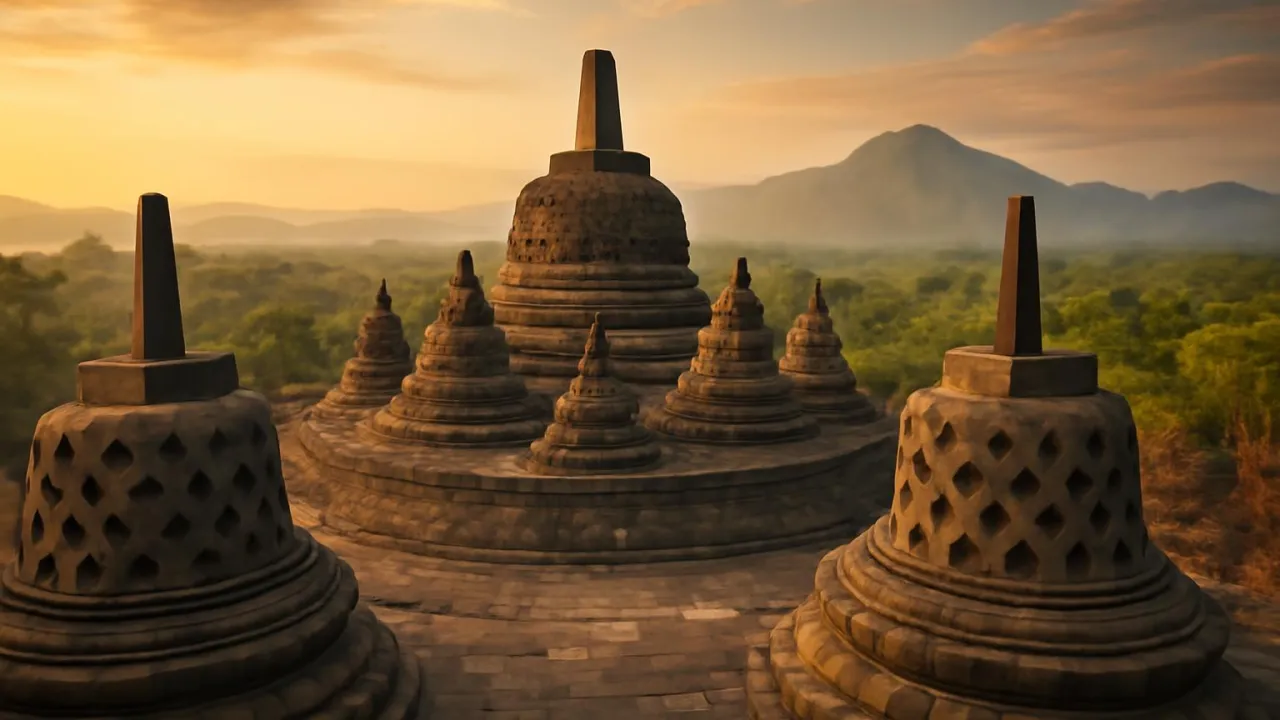
Borobudur was built with over two million stone blocks stacked without glue!
✨ Word Sparks (Grade 2 Glossary)
Tap 🔊 to hear
carving
A picture cut into stone.
spiral
A path that goes around and up.
jungle
A thick, green forest.
🪝
Can you imagine walking up a giant stone puzzle?
1
Walking the Spiral Path
Borobudur is shaped like a huge stone mountain. People walk up its path, passing many . Each step takes you higher and higher.
2
Stories in Stone
The walls are covered with carved pictures. These show stories about the Buddha’s life. Visitors love to look at the details.
3
A Temple Above the Jungle
Borobudur sits above green trees and rice fields. Birds and monkeys live nearby, and mist covers the land in the morning. People visit to see the sunrise from the top.
Borobudur’s design forms a giant 3D mandala you can walk through!
✨ Word Sparks (Grade 3 Glossary)
Tap 🔊 to hear
mandala
A special circle that means the universe.
stupa
A bell-shaped Buddhist monument.
volcanic stone
Rock formed from cooled lava.
🪝
What secrets might you find in a temple built like a giant stone mandala?
1
A Mountain of Meaning
Borobudur rises above Java like a giant stone mountain. Its shape is a , a symbol for the universe in Buddhism. Pilgrims walk in circles, climbing higher as they follow the path. Each level brings them closer to the top and to enlightenment.
2
Stone Stories and Statues
Over 2,600 carved panels cover Borobudur’s walls. These carvings tell stories about Buddha’s life and teachings. There are also 504 Buddha statues and 72 bell-shaped on the upper terraces. The stone carvings show scenes of daily life, animals, and ancient legends.
3
Building Without Cement
Borobudur was built in the 800s using blocks. The builders used interlocking stones, not cement, to hold everything together. This clever technique helps the temple survive earthquakes and heavy rain. The temple’s design shows advanced engineering and artistic skill.
4
A Place for Pilgrims
People from all over the world visit Borobudur. Many come to walk the spiral path during sunrise and feel peaceful. The temple is an important place for Buddhists and a symbol of Indonesian heritage. Its beauty and mystery attract visitors year after year.
1. Why did builders use interlocking stones at Borobudur?
2. What shape is Borobudur’s overall design?
🤯 Mind-Blowing Fact • Grade 4
Borobudur’s drainage system uses over 100 carved stone spouts shaped like mythical animals!
✨ Word Sparks (Grade 4 Glossary)
Tap 🔊 to hear
relief panel
A carved picture that stands out from stone.
erosion
Wearing away by wind or water.
pilgrimage
A special journey to a holy place.
🪝
Can you picture a temple so grand it looks like a stone mountain rising from the misty jungle?
1
A Monument of Stone and Spirit
Borobudur Temple stands as the largest Buddhist monument on Earth, built around 800 CE by the Sailendra Dynasty. Its nine stacked platforms form a massive mandala, symbolizing the Buddhist path from the earthly world to enlightenment. Each platform is covered with intricate carvings showing scenes from Buddha’s life, as well as lessons and legends. The temple’s unique design invites pilgrims to walk its spiraling path, reflecting on each story as they climb.
2
Ingenious Engineering in Volcanic Stone
Constructed from over two million volcanic stone blocks, Borobudur’s builders used no cement or glue. Instead, they relied on a system of interlocking stones and precise placement, allowing the temple to withstand earthquakes and heavy tropical rains. The structure’s base is square, but it rises to circular terraces crowned with 72 bell-shaped stupas. The temple’s drainage system, with 100 spouts shaped like mythical creatures, helps protect it from .
3
A Living Storybook
The walls of Borobudur are decorated with more than 2,600 —stone carvings that tell stories from Buddhist teachings and daily life in ancient Java. These panels include images of ships, animals, and people, offering a window into the past. The temple also features 504 Buddha statues, each seated serenely in meditation. As visitors walk the spiraling path, they follow a journey from the earthly world to spiritual awakening.
4
Legacy and Wonder
For centuries, Borobudur was hidden under layers of volcanic ash and jungle before being rediscovered in the 1800s. Today, it is a UNESCO World Heritage Site, attracting people from around the world for both and tourism. The temple’s design, artistry, and engineering continue to inspire architects and historians. Borobudur stands as a symbol of Indonesia’s rich cultural heritage and the enduring power of human creativity.
1. How does Borobudur’s drainage system protect the temple?
2. Why do pilgrims walk the spiral path at Borobudur?
🤯 Mind-Blowing Fact • Grade 5
Borobudur’s 2,672 story panels make it the largest ancient stone storybook in the world!
✨ Word Sparks (Grade 5 Glossary)
Tap 🔊 to hear
bas-relief
A raised picture carved into stone.
mandala
A detailed design showing the universe.
makara
A mythical animal in Hindu and Buddhist art.
🪝
What if you could walk through a massive stone mandala that tells stories with every step you take?
1
A Masterpiece of Buddhist Architecture
Borobudur Temple, constructed during the Sailendra Dynasty around 800 CE, is the world’s largest Buddhist monument and a marvel of ancient engineering. Rising 118 feet (36 meters) above the Kedu Plain, its design forms a three-dimensional symbolizing the Buddhist universe. The temple consists of nine stacked platforms—six square and three circular—culminating in a grand central stupa. Each level represents a stage in the journey toward enlightenment, guiding pilgrims from the base’s earthly realm to the spiritual heights above.
2
Engineering Genius: Stones That Endure
Borobudur was built using over two million andesite volcanic stone blocks, all precisely cut and laid without mortar. The builders employed a sophisticated interlocking technique, fitting stones together like a giant puzzle, which allows the structure to withstand earthquakes and the region’s heavy monsoon rains. An advanced drainage system, featuring more than 100 carved spouts shaped like mythical creatures, channels water away to prevent erosion. This ingenious design has helped Borobudur survive for over a thousand years.
3
Carved Stories and Sacred Statues
The temple’s walls are covered with 2,672 panels, making Borobudur the world’s largest and most detailed ancient storybook. These panels illustrate scenes from Buddhist scriptures, daily life in 9th-century Java, and ancient maritime adventures. There are 504 Buddha statues throughout the monument, and the upper terraces are crowned with 72 perforated stupas, each containing a meditating Buddha. The layout and iconography guide visitors on a symbolic pilgrimage from the world of desire to enlightenment.
4
Rediscovery and Global Significance
For centuries, Borobudur lay hidden beneath volcanic ash and jungle growth until its rediscovery by Sir Thomas Stamford Raffles in 1814. Restoration efforts in the 20th century, led by UNESCO and Indonesia, stabilized the structure and preserved its intricate carvings. Today, Borobudur is a UNESCO World Heritage Site and a major pilgrimage destination, especially during Vesak, the most important Buddhist festival. The temple’s influence can be seen in Buddhist architecture across Southeast Asia and beyond.
5
Borobudur’s Enduring Legacy
Borobudur stands not only as a religious monument but also as an enduring symbol of Indonesia’s artistic, spiritual, and engineering achievements. Its layout, advanced stonework, and narrative reliefs continue to inspire historians, architects, and visitors from around the globe. The temple’s survival through earthquakes, volcanic eruptions, and centuries of neglect demonstrates the resilience of both its builders and its cultural meaning. Borobudur remains a testament to the creativity and devotion of the people who built it, inviting all who visit to reflect on the journey toward enlightenment.