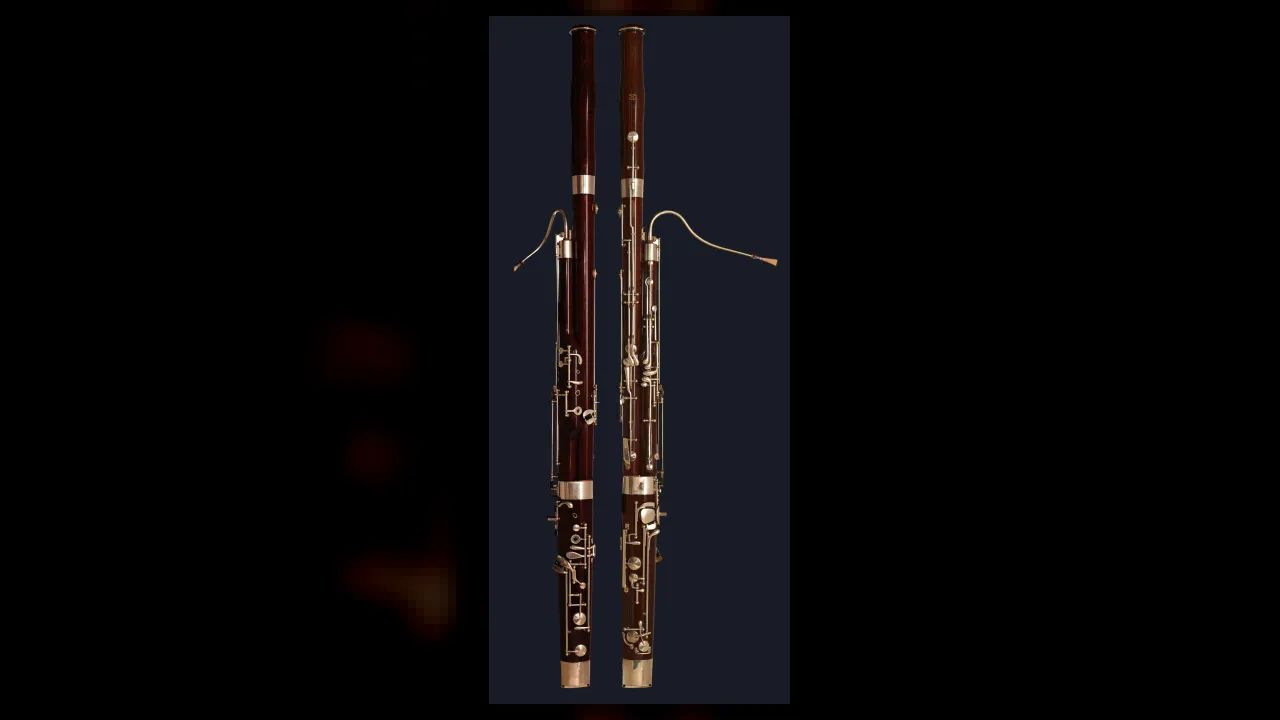
1. Why did instrument makers fold the air tube inside a bassoon?
2. What kind of wood gives most bassoons their warm reddish-brown glow?
🤯 Mind-Blowing Fact • Grade 2
In Italian and German, the bassoon is called fagotto or Fagott—meaning a bundle of sticks—because its dismantled wooden joints look like firewood tied together!
✨ Word Sparks (Grade 2 Glossary)
Tap 🔊 to hear
boot joint
Bottom wooden piece hiding the U-turn tube
seat strap
Leather strap under chair supporting bassoon's weight
fagotto
Italian name meaning bundle of wooden sticks
🪝
Why does one musician's left thumb have to dance across nine different keys on a bassoon?
1
Marching Brooms and Grumpy Grandpas
Have you ever heard enchanted brooms hopping through The Sorcerer's Apprentice or grumpy Grandfather scolding in Peter and the Wolf? Both unforgettable characters spring to life through the bouncy, expressive voice of the bassoon!
2
A U-Turn at the Bottom
To sing deep bass notes, a woodwind needs more than eight feet of air tunnel. Inside the bottom , a hidden metal U-tube turns the air around so it travels down one maple pipe and straight back up its neighbor!
3
Super-Busy Thumbs
A curved metal bocal brings the wide double reed to the player's lips while a holds the weight. Meanwhile, the player's left thumb alone operates at least nine shiny silver keys!
1. What happens to the air column inside the bottom boot joint of a bassoon?
2. Which character does the bassoon portray in Prokofiev's Peter and the Wolf?
🤯 Mind-Blowing Fact • Grade 3
Tone holes in a bassoon's wing joint are drilled at steep slanting angles through thick maple walls so human fingers can reach notes spaced far apart inside the bore!
✨ Word Sparks (Grade 3 Glossary)
Tap 🔊 to hear
dulcian
One-piece Renaissance ancestor of the jointed bassoon
wing joint
Upper wooden section with slanted finger holes
tenor
Expressive high-male vocal range above deep bass
🪝
How can the deep bass of the woodwind family also sing hauntingly high solos above the whole orchestra?
1
More Than a Musical Comedian
People used to nickname the bassoon the clown of the orchestra because its crisp, dry staccato hops sound irresistibly witty. Yet in the very next measure, that same maple tower can soar into an eerie, breathtaking high melody that hushes every listener!
2
Five Joints and an Eight-Foot Cone
When a bassoonist unpacks the case, five pieces assemble like a puzzle: the S-curved metal bocal, , boot joint, long bass joint, and white-rimmed bell. Inside, the conical bore widens steadily from just four millimeters inside the bocal across 2.54 meters of folded maple.
3
Thumb Gymnastics
Because bassoonists cover several angled tone holes directly while controlling long bass pipes, both thumbs work overtime. Thirteen or more keys cluster under the two thumbs alone—nine under the left thumb and four under the right!
4
From Renaissance Dulcian to Rite of Spring
Evolving from the one-piece sixteenth-century and modernized in 1830s Germany by Johann Adam Heckel, the bassoon shocked Paris in 1913 by opening Stravinsky's The Rite of Spring at the top of its range.
1. Why are several finger holes on a bassoon drilled at steep diagonal angles through thick wood?
2. Which famous 1913 ballet opens with an unforgettable solo in the bassoon's extreme highest register?
🤯 Mind-Blowing Fact • Grade 4
Unlike black grenadilla clarinets and oboes, bassoons are crafted from pale mountain maple aged for over a decade before being stained their classic glowing mahogany red!
✨ Word Sparks (Grade 4 Glossary)
Tap 🔊 to hear
chimney hole
Long narrow tunnel drilled through thick wood
pizzicato
Plucking strings with fingers instead of bowing
Heckel system
Dominant German key design for modern bassoons
🪝
Why do thick maple walls, angled chimney holes, and thirteen thumb keys give the bassoon one of the richest palettes in music?
1
Chameleon of the Woodwind Section
Ask a bassoon to chuckle alongside cellos, blend seamlessly into French horns, or float an aching tenor aria above quiet strings, and it shifts character in a single breath. Spanning more than three and a half octaves from rumbling B-flat1 to singing E5, the bassoon serves as cello, comedian, and lyric poet of the wind choir.
2
Folded Conical Bore and Chimney Acoustics
Standing 1.34 meters tall, a bassoon conceals 2.54 meters of gently expanding conical air column carved from seasoned sycamore maple—lighter and warmer-toned than dense tropical grenadilla. Breath enters a wide double reed slipped onto a slender S-curved metal bocal, descends the thick-walled wing joint, loops 180 degrees through a metal U-tube inside the boot joint, and climbs the long joint to the white-ringed bell. Long, narrow tone-hole chimneys drilled obliquely through the wing wall act as acoustic low-pass filters, rounding off harsh upper partials into a nutty, vocal resonance.
3
Carl Almenräder and the Heckel Revolution
Seventeenth-century French builders split the one-piece Renaissance dulcian into four jointed sections so bores could be reamed accurately. In 1831, German virtuoso Carl Almenräder partnered with instrument maker Johann Adam Heckel in Biebrich to overhaul intonation and projection—establishing the German Heckel key system played by nearly every orchestra worldwide today, alongside a distinct French Buffet tradition.
4
Virtuoso Thumbs and Iconic Scores
With nine to eleven keys clustered beneath the left thumb and four more under the right, bassoonists execute dazzling finger choreography across Mozart's joyous Bassoon Concerto, Paul Dukas's mischievous The Sorcerer's Apprentice, and Stravinsky's stratospheric Rite of Spring.
1. How do the long, narrow angled tone-hole chimneys in the wing joint shape the bassoon's tone?
2. Which pair teamed up in 1830s Germany to create the dominant modern bassoon system?
🤯 Mind-Blowing Fact • Grade 5
Baroque composer Antonio Vivaldi loved the bassoon's agile expressiveness so deeply that he wrote thirty-nine solo concertos for it—more than for any instrument except the violin!
✨ Word Sparks (Grade 5 Glossary)
Tap 🔊 to hear
whisper key
Left-thumb key closing tiny bocal pinhole vent
cantilena
Smooth, flowing vocal-style instrumental melody line
condensation
Warm breath turning into liquid droplets inside
🪝
How does a 2.54-meter folded maple cone produce speech-like vowel formants that blend invisibly with horns, strings, and voices alike?
1
Master of Disguise and Soloist of Depth
Play a sustained middle-register chord with two bassoons and two French horns, and even seasoned concertgoers struggle to tell where brass ends and woodwind begins. Capable of razor-crisp staccato articulation, subterranean bass pedals, and plaintive tenor , the non-transposing concert bassoon spans over three and a half octaves from B-flat1 (58.27 Hz) to E5 (659.3 Hz) and beyond.
2
Folded Conical Physics and the Meyer Formant
Organologically a double-reed folded conical aerophone, the bassoon compresses a 2.54-meter expanding air column into a 1.34-meter frame of seasoned European sycamore maple (Acer pseudoplatanus), sealed inside the descending bore with waterproof rubber or epoxy lining to prevent breath rot. Two broad Arundo donax blades (~15 mm wide at the tip) vibrate atop a slender S-curved metal bocal whose 4-millimeter entrance widens steadily at roughly a 1:70 taper all the way through the wing, U-bent boot, bass joint, and bell (~40 mm bore). Acoustician Jürgen Meyer demonstrated that the bassoon's long, obliquely drilled tone-hole chimneys and conical flare generate a strong fixed acoustic formant around 440–500 Hz—closely mirroring the human sung vowel 'oh' and explaining its uncanny vocal warmth and horn-like blend.
3
Thumb Ergonomics and Whisper-Key Voicing
Because bassoon acoustics rely heavily on cross-fingerings and venting across three overblown harmonic registers, keywork evolved extraordinary density. A standard Heckel-system bassoon places nine to eleven keys under the player's left thumb—including a delicate pinhole '' on the bocal nub that stabilizes low-register fundamentals—while the right thumb commands four additional levers alongside a seat strap or harness.
4
Heckel Versus French Buffet Lineages
Descending from the sixteenth-century one-piece dulcian (curtal) and late-seventeenth-century French jointed bassoons, nineteenth-century design diverged into two distinct schools: the narrower-bored, intensely vocal French Buffet crampon system (favored by Ravel and Saint-Saëns) and the broader-bored, resonant German system perfected from 1831 onward by Carl Almenräder and the Heckel dynasty in Biebrich.
5
Four Centuries of Indispensable Repertoire
From Antonio Vivaldi's astonishing thirty-nine bassoon concertos and Mozart's effervescent K. 191 Concerto to Tchaikovsky's shadowy Symphony No. 6 abyss, Dukas's dancing brooms, and the ethereal high C4–D5 incantation opening Stravinsky's The Rite of Spring, the bassoon remains irreplaceable.