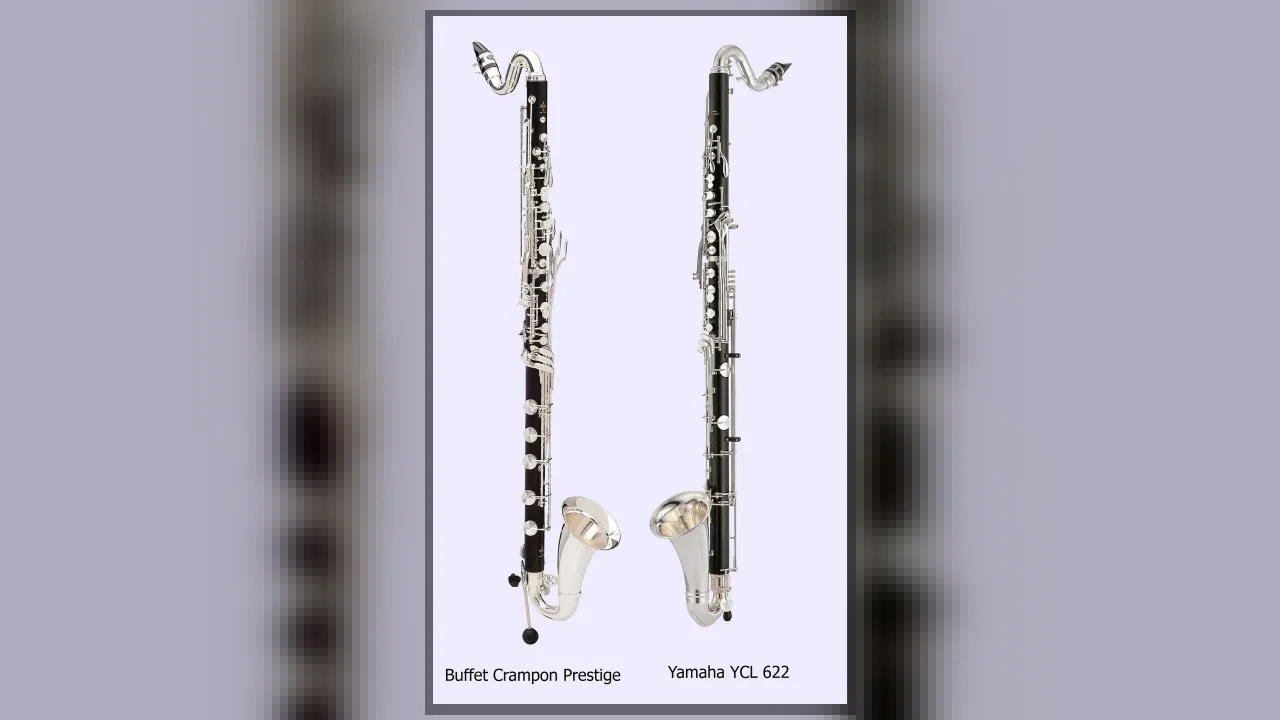
1. Which way does the shiny metal bell at the bottom of a bass clarinet point?
2. What helps support a heavy bass clarinet while a musician sits and plays?
🤯 Mind-Blowing Fact • Grade 2
Before Adolphe Sax invented the saxophone, his first big hit at age twenty-three was redesigning the modern bass clarinet!
✨ Word Sparks (Grade 2 Glossary)
Tap 🔊 to hear
celesta
Keyboard instrument ringing with twinkling bell bars
tone hole
Opening uncovered or sealed to change pitch
mellow
Smooth, rich, gentle sound without harshness
🪝
What happens when you stretch a clarinet's tube twice as long and curve its bell upward?
1
Spooky Whispers and Fairy Tales
Hush—did a friendly dragon just sigh in the shadows behind the curtain? Whenever movie or ballet music needs magical mystery, composers call on the rich, velvety purr of the bass clarinet.
2
Twice the Length, Octave Lower
Stretch a regular clarinet's air tube to twice its length and every note drops one full octave deeper! Because no musician has arms four feet long, a curved silver neck brings the mouthpiece close while metal rods reach distant .
3
Dancing With Sparkling Bells
In Tchaikovsky's Nutcracker ballet, the dark bass clarinet answers the twinkling during the Dance of the Sugar Plum Fairy, proving giants can tiptoe with feather-light grace.
1. How much lower does a bass clarinet sound compared to a standard soprano clarinet?
2. Which famous holiday ballet pairs the bass clarinet with the sparkling celesta?
🤯 Mind-Blowing Fact • Grade 3
Orchestral low-C bass clarinets feature extra thumb paddles that extend their deepest rumble all the way down to concert B-flat1—matching a bassoon!
✨ Word Sparks (Grade 3 Glossary)
Tap 🔊 to hear
register vent
Small pinhole key helping high notes speak
stopped pipe
Tube acting acoustically closed at one end
projection
Ability of sound to carry across halls
🪝
Why did early bass clarinets look like bent bassoons until a young Belgian inventor stepped in?
1
Velvet Thunder in the Woodwinds
Imagine a sound as dark as midnight espresso yet nimble enough to skip through rapid scales without losing its breath. When the bass clarinet enters an orchestra or wind band, the entire woodwind floor suddenly gains cinema-sized depth.
2
Adolphe Sax's 1838 Breakthrough
Early eighteenth-century makers folded bass clarinets into awkward serpent or bassoon shapes with muffled holes. In 1838, twenty-three-year-old Belgian craftsman Adolphe Sax straightened the hardwood body, aligned every tone hole acoustically, and added a curved brass neck plus a gleaming upturned bell that projected clearly.
3
Closed-Pipe Power
Like its smaller cousin, the bass clarinet pairs a wide single cane reed with a cylindrical bore. Acting as a , its four-foot air column vibrates at slow frequencies and overblows a musical twelfth using two coordinated .
4
From Fairylands to Jazz
Orchestral masters like Tchaikovsky, Mahler, and Wagner prized its solemn warmth, while fearless jazz innovator Eric Dolphy showed it could leap across three-and-a-half octaves with astonishing vocal fire.
1. How did Adolphe Sax transform the bass clarinet in 1838?
2. Why does a bass clarinet need two separate register vents instead of just one?
🤯 Mind-Blowing Fact • Grade 4
On a bass clarinet, every single finger hole must be covered by padded metal keys rather than bare fingertips because the holes are too wide and far apart!
✨ Word Sparks (Grade 4 Glossary)
Tap 🔊 to hear
wavelength
Physical distance of one complete sound wave
axle rod
Long metal bar linking keys to pads
timbre
Unique tone color distinguishing one instrument's voice
🪝
How can a straight cylindrical tube barely over a meter tall rumble as deeply as an eight-foot open pipe?
1
A Voice From Shadowed Caverns
Drop a single sustained low note from a bass clarinet beneath quiet strings, and the concert hall instantly feels twice as cavernous. Unlike the reedy snarl of a bassoon or the brassy punch of a tuba, this towering woodwind wraps its lowest pitches in dark, woody velvet that can whisper without quivering.
2
Quarter-Wavelength Acoustic Magic
Why doesn't the bass clarinet need an eight-foot tube to play bass notes? Because its wide cane reed vibrating against the mouthpiece behaves acoustically as a closed end, while its cylindrical grenadilla bore stays uniform in width until the upturned silver-plated brass bell. A closed-open cylinder fits just one-quarter of a sound wave inside its length, allowing an unfolded air column of roughly 1.35 meters to produce over five meters long!
3
Adolphe Sax and Dual-Vent Mechanics
Before inventing the saxophone in Paris, Adolphe Sax patented a revolutionary bass clarinet in Brussels in 1838. Abandoning clumsy folded tubes, he mounted large leather-padded cups on long so human hands could cover widely spaced holes. He also solved a tricky acoustic puzzle: on a long cylinder that overblows at the twelfth, one small vent cannot cleanly serve as a pinhole for B-flat4 and an overblow vent for higher notes, so modern bass clarinets employ an automatic dual-register mechanism.
4
Orchestral Drama and Modern Range
Extended professional models add thumb keys down to written low C, sounding concert B-flat1 at 58.3 Hz. Wagner wove its noble melancholy into Tristan und Isolde, Ferde Grofé painted desert mule trails with it in the Grand Canyon Suite, and jazz trailblazer Eric Dolphy unlocked soaring three-octave improvisations.
1. What acoustic principle lets a ~1.35-meter bass clarinet produce sound waves more than five meters long?
2. Why are bass clarinet tone holes covered by padded metal cups instead of bare fingers?
🤯 Mind-Blowing Fact • Grade 5
At concert B-flat1 (58.27 Hz), the sound wave emerging from a low-C bass clarinet stretches nearly 5.9 meters—more than four times longer than the instrument itself!
✨ Word Sparks (Grade 5 Glossary)
Tap 🔊 to hear
nodal point
Still spot along a standing sound wave
plateau pad
Closed metal key cup sealing wide holes
multiphonics
Technique sounding two or more pitches together
🪝
How did twenty-three-year-old Adolphe Sax turn an unruly eighteenth-century curiosity into the orchestra's stealthiest bass powerhouse?
1
Subterranean Warmth and Agile Flight
Listen to the opening hush of a Mahler symphony or a suspenseful film score when a solitary dark reed voice emerges from near-inaudibility, vibrating the floorboards without the buzzing edge of double reeds. Capable of pianissimo whispers that defy its bulk and three-octave leaps that rival a cello, the B-flat bass clarinet anchors the modern woodwind section with brooding elegance.
2
Stopped-Cylinder Physics at Scale
Pitched one octave below the B-flat soprano clarinet, the bass clarinet is a single-reed aerophone with a cylindrical bore approximately 24 millimeters in diameter machined from seasoned African blackwood (Dalbergia melanoxylon). Coupling a broad Arundo donax reed to a uniform cylinder establishes a quarter-wave resonator that strongly favors odd harmonics (1f, 3f, 5f) while suppressing even partials in the lowest register. Consequently, an orchestral low-C model with an acoustic path around 1.45 meters generates a fundamental of concert B-flat1 (58.27 Hz)—whose physical wavelength in room-temperature air approaches 5.9 meters!
3
Adolphe Sax's 1838 Engineering Triumph
Eighteenth-century prototypes like Gilles Lot's 1772 basse-tube folded the bore into unwieldy bassoon-like shapes with obliquely drilled chimneys that choked resonance. In 1838, working in Brussels eight years before patenting the saxophone, Adolphe Sax revolutionized the instrument: he straightened the wooden body, enlarged and acoustically repositioned every tone hole, covered them with on long keywork axles, curved a brass neck toward the player's embouchure, and redirected the lowest pitches upward through a flared metal bell.
4
Dual Register Vents and Voicing
Because overblowing jumps a twelfth (3f) rather than an octave, a single register pinhole cannot sit at the ideal for every upper note along such a long tube. Modern bass clarinets therefore incorporate an automatic or articulated double-register linkage that switches seamlessly between a lower vent for clarion notes (written B4–D#5) and an upper neck vent from E5 upward, extending upward into a vocal altissimo above concert G5 (~784 Hz).
5
Symphonic Color and Avant-Garde Voice
After Giacomo Meyerbeer showcased Sax's creation in his 1836–1838 Parisian grand operas, Wagner, Tchaikovsky, Stravinsky, and Shostakovich embraced its tragic, nocturnal, and whimsical colors. In the 1960s, multi-instrumentalist Eric Dolphy liberated the bass clarinet as a solo jazz powerhouse, unleashing , speech-like inflections, and blinding four-octave agility.